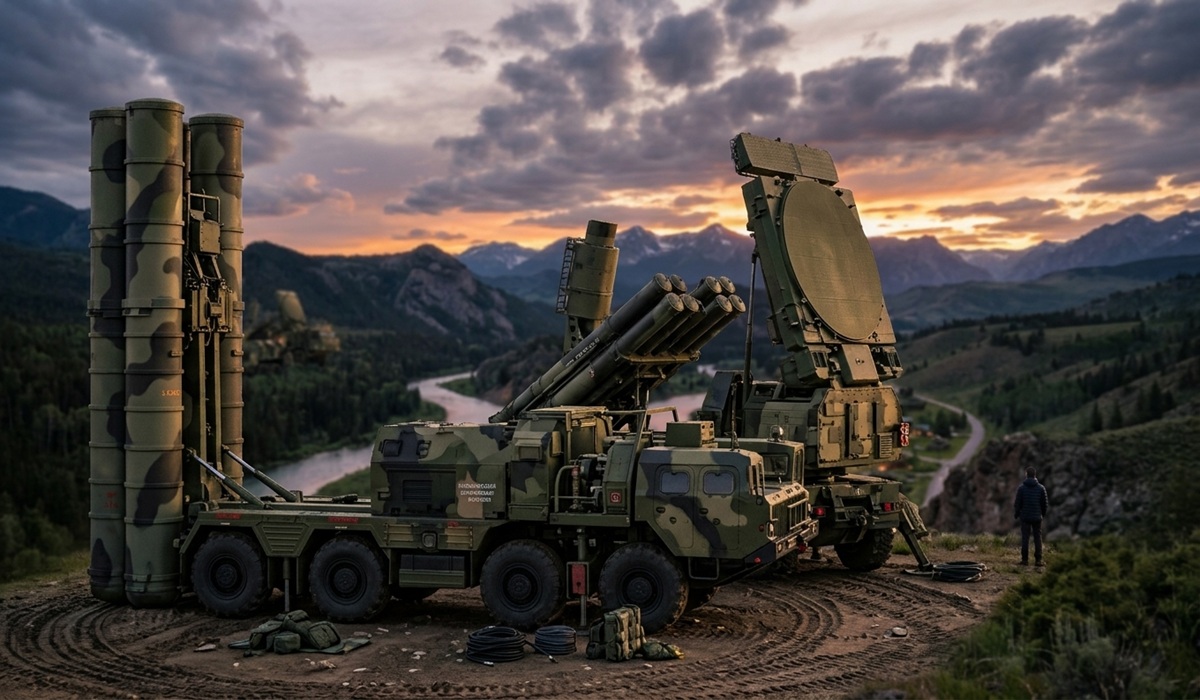
High-level diplomatic communications between Moscow and Tehran confirm that Russian President Vladimir Putin has signed off on supplying advanced defense hardware, including S-400 long-range air defense missile systems, to the Islamic Republic. For months, American and Israeli airstrikes targeted older Iranian radar installations and air defenses with near-total air supremacy. The deployment of these S-400 batteries fundamentally alters the calculus of regional air power, raising profound questions about the mechanics of military deterrence, stealth vulnerability, and the fluid definitions of diplomatic red lines in modern warfare.
The operational impact of these surface-to-air platforms centers on their multi-band radar network and long-range engagement envelope. Older defense networks relied heavily on narrower radar frequencies that fifth-generation stealth platforms, including the F-35 Lightning II, F-22 Raptor, and B-2 Spirit, were designed to delay or evade. The S-400 integrates early-warning acquisition radar arrays operating across VHF, L-band, and X-band frequencies. While low-observable aircraft hide effectively from higher-frequency target-tracking radars, lower-frequency search radars can detect stealth airframes at significantly greater distances.
Equipped with 40N6E long-range interceptors capable of engaging targets at distances up to 400 kilometers, the S-400 forces coalition strike packages to launch standoff munitions from much further out. American and Israeli air operations can no longer assume unimpeded transit through contested airspace. Instead, every strike mission over fortified territory will require extensive electronic warfare support, suppression of enemy air defenses operations, and dedicated decoy flights, sharply increasing the complexity and operational cost of maintaining aerial dominance.
The delivery of the S-400 to Iran is frequently labeled by analysts as a crossed red line, a threshold long maintained to avoid direct confrontation with Western powers or destabilizing regional security balances. However, viewing this transfer through a historical lens reveals a pragmatic reciprocity that defines modern conflict. When Western nations transferred long-range precision strike assets to Ukraine to strike deep targets, it established a clear precedent: sovereign nations in active conflicts will leverage external arms transfers to impose asymmetric costs on opposing forces.
In modern warfare, designated red lines often yield to the logic of attrition and geopolitical leverage. Just as Ukraine sought advanced Western systems to defend its infrastructure, Iran views Russian defense technology as essential to rebuilding its air defense network following widespread bomb damage. From the perspective of non-aligned state actors, providing advanced defensive capabilities to an ally facing sustained air bombardment is logically equivalent to supplying strike weaponry to counter an advancing force. War operates on necessity rather than strict moral symmetry, and expecting one side of a global fault line to observe informal restrictions while the opposing side escalates logistical support ignores the realities of international conflict.
The presence of Russian S-400s on Iranian soil signals a broader institutional transition in global warfare. Western air dominance, which remained largely unchallenged across the Middle East for over three decades, now faces persistent, high-tier technological denial. The transaction underscores a transactional, bi-directional strategic alliance between Moscow and Tehran. Having integrated Iranian technology into its own war effort, Russia’s reciprocal transfer of tier-one air defenses cements a durable military-industrial linkage.
Future air operations will no longer resemble routine interdiction. Striking protected installations will require sustained campaigns aimed at dismantling integrated radar grids, expanding the timeline of military engagements and accelerating the consumption of expensive standoff munitions. Ultimately, the deployment of the S-400 demonstrates that strategic red lines are continuously redrawn by necessity. As global powers supply increasingly sophisticated hardware to regional conflicts, the division between local engagements and global strategic competition becomes increasingly difficult to define.
About The Author