Mackenzie Valley Highway Named a Project of National Interest in the Northwest Territories
- TDS News
- Northern Canada
- November 29, 2026
By Editorial Board
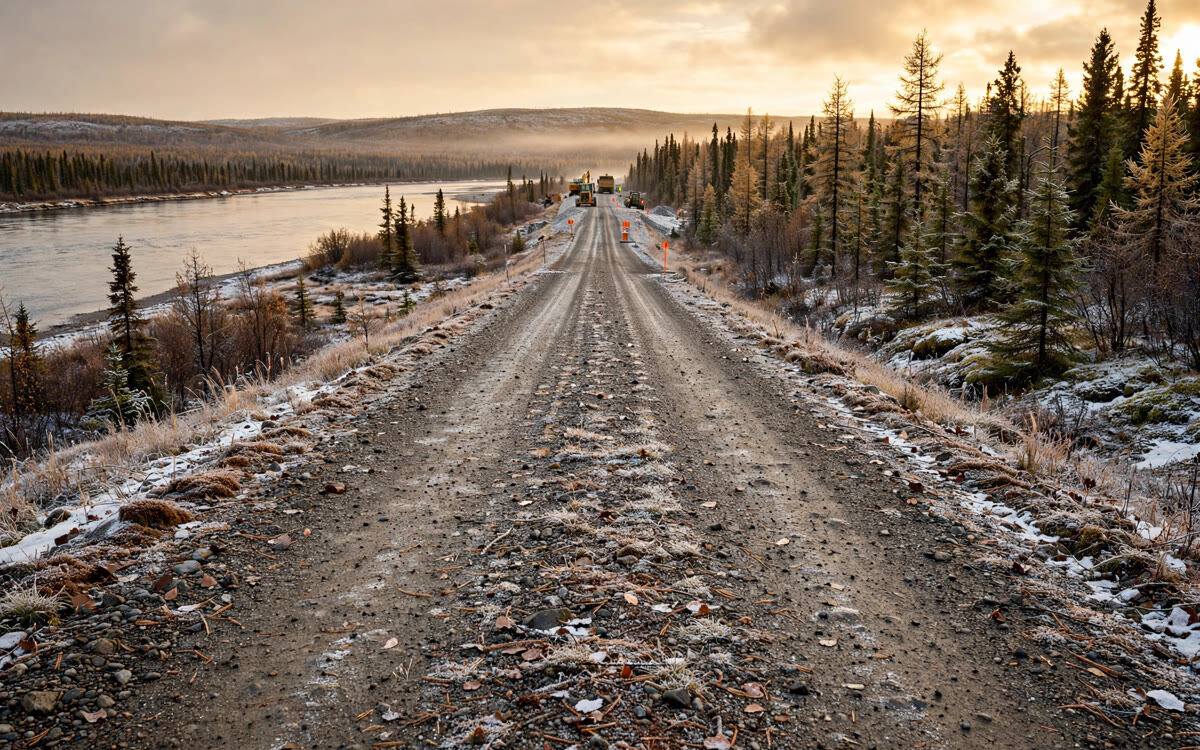
The Mackenzie Valley Highway has been listed as a project of national interest under the Building Canada Act, becoming the first project in the North of Canada to receive the designation. Prime Minister Mark Carney announced the listing in Yellowknife on Friday, November 27, 2026, appearing alongside territorial leaders and Indigenous leaders from across the region.
The proposed highway would run about 800 kilometres through the Mackenzie Valley, linking Highway 1 at Wrigley with the Dempster Highway south of Inuvik. The route would pass the communities of Tulita, Norman Wells and Fort Good Hope. Those communities are reached today by aircraft, by river barge during the summer months and by winter roads built across ice and snow, and the new road would give them a surface connection that stays open in every season.
The Government of Canada says the highway would improve transportation access for more than 10,000 people, including about 1,900 residents of the Sahtu region who would gain a road connection open through the whole year for the first time. Deliveries of food, fuel, medicine and construction materials would become more reliable, and the drive between Yellowknife and Inuvik would fall from about 38 hours to about 23 hours as the route becomes shorter by roughly 1,300 kilometres.
The project is expected to create about 3,000 jobs at the peak of construction. The government says the highway would also open new opportunities for local businesses, trade and tourism, and would support exploration and development of natural resources in the valley. The estimated cost of construction stands at 4.2 billion dollars, and the federal government has committed to fully fund construction along with certain maintenance costs. The 2026 federal budget set aside 3.1 billion dollars for the project over the coming five years.
The work will be carried out in partnership with Indigenous governments and the Government of the Northwest Territories. On November 25, 2026, Sahtu Secretariat Incorporated, the Gwich’in Tribal Council, the Pehdzéh Kí First Nation, the Government of the Northwest Territories and the Government of Canada signed a Leadership Governance Understanding that sets out how the highway will be governed and planned. Northwest Territories Premier R.J. Simpson said generations of Northerners have worked to make the highway a reality, and he told CBC that everyday life is going to be transformed for people in the region.
The listing means the Major Projects Office will coordinate federal regulatory requirements as the project moves through its environmental assessment with the Mackenzie Valley Environmental Impact Review Board. The highway was referred to the Major Projects Office in March 2026, and officials say construction could begin in late 2027 if the project receives its approvals. A new Crown corporation is also being created to manage the project.
The Prime Minister also announced more than 120 million dollars from the Arctic Infrastructure Fund to advance the Arctic Economic and Security Corridor. The corridor, led by the Tłįchǫ Government and the Yellowknives Dene First Nation in partnership with the Government of the Northwest Territories, would establish a road open in every season from Yellowknife to the Nunavut border. The funding will pay for route selection, environmental studies, engineering and regulatory work, with the goal of having the project ready for construction by 2029. Once complete and connected with the Grays Bay Road and Port project in Nunavut, the corridor would give the Northwest Territories a surface link to a deep water port on the Arctic Ocean.
About The Author