Silent Disenfranchisement: How Felony Voting Bans Maintain Minority Rule in the American
- TDS News
- Trending News
- November 10, 2026
Editorial Board
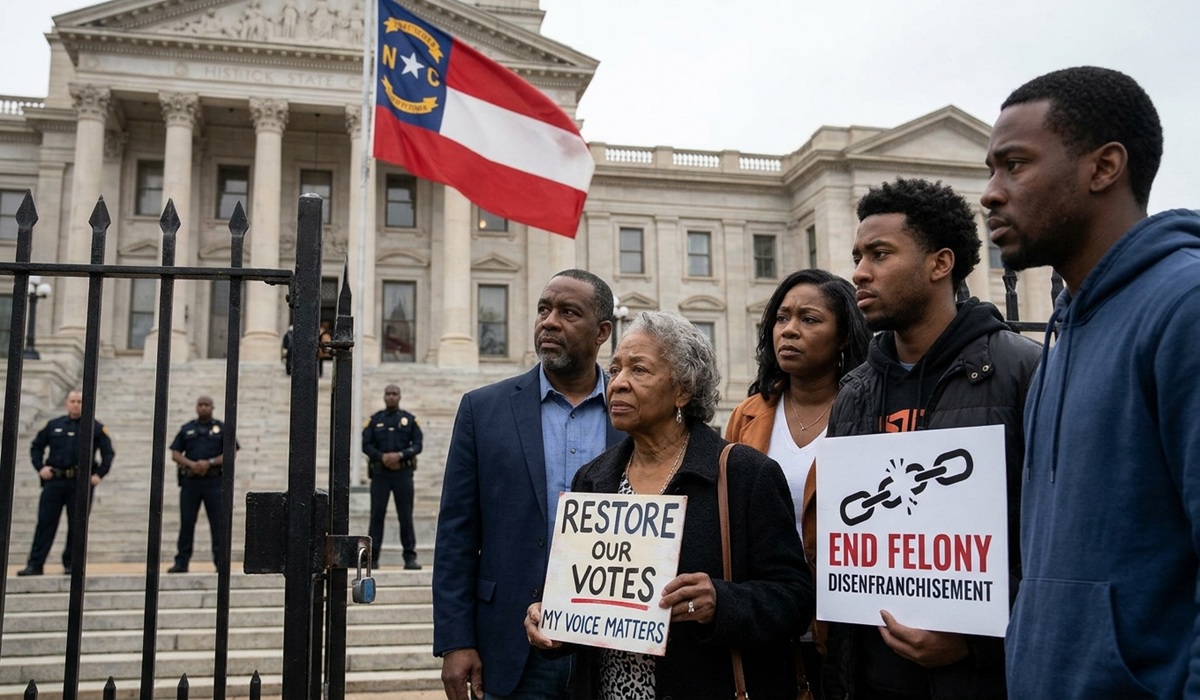
Across large swaths of the American South, a paradoxical demographic landscape defines state politics. Counties and cities with vast majority-Black populations, embedded in states with substantial African American communities, remain almost exclusively governed by white conservative majorities. While commentators often attribute this political divergence strictly to partisan polarization or judicial redistricting, the underlying structural engine driving this power imbalance is a legacy mechanism built directly into the criminal justice system: felony disenfranchisement laws. By stripping millions of justice-involved citizens of their voting rights, these statutes act as a quiet filter on the electorate, carving out large segments of minority communities and sustaining a status quo where white minority governance holds sway over majority-Black populations.
To understand why felony disenfranchisement wields such profound geographic and racial influence today, one must trace its origins back to the immediate aftermath of the Civil War. Following the ratification of the Fifteenth Amendment, which explicitly barred states from denying the right to vote based on race, Southern lawmakers sought legislative loopholes to preserve white political dominance. During the post-Reconstruction constitutional conventions of the late nineteenth century, states altered their criminal codes to mandate disenfranchisement for specific offenses. Rather than barring all criminals equally, lawmakers tailored the list of disenfranchising crimes to target offenses they believed were more frequently committed by newly freed Black citizens, such as petty theft, burglary, and bigamy, while excluding offenses typically committed by white citizens, such as bribery or assault. Combined with poll taxes and literacy tests, these laws laid the groundwork for Jim Crow voting restrictions, embedding systemic disenfranchisement into the statutory bedrock of the region.
In the modern era of mass incarceration, the compounding effect of these post-Reconstruction laws remains staggering. Because Black Americans are statistically stopped, arrested, convicted, and sentenced to longer prison terms at disproportionate rates compared to their white counterparts for identical offenses, felony disenfranchisement disproportionately removes African Americans from the voter rolls. In states like Mississippi, Alabama, and Florida, these laws have historically disenfranchised significant percentages of the adult Black population.
Concrete examples illustrate how this dynamic manifests on the electoral map. In Mississippi, a state constitution crafted in 1890 explicitly listed disenfranchising crimes designed to target Black citizens, a legal framework that persisted for well over a century. As a consequence, even though Mississippi boasts the highest percentage of Black residents of any state in the nation at roughly forty percent, it has not elected a Black candidate to statewide office since the Reconstruction era. Whole legislative districts in the Mississippi Delta and suburban corridors contain majorities of Black residents on paper, yet the active voting population is sharply curtailed because thousands of community members carry lifetime voting bans due to prior felony convictions.
Similarly, in Florida, before voters passed a landmark constitutional amendment intended to restore voting rights to former felons, over ten percent of the state’s adult voting population, and more than one in five adult Black Floridians, was legally barred from casting a ballot. Even after popular referendums pass, subsequent legislative hurdles, such as requiring full payment of all court fines and legal fees before voting rights are restored, often act as a modern wealth test, keeping hundreds of thousands of disenfranchised citizens off the voter rolls and preserving conservative majorities in highly contested districts.
If felony disenfranchisement were completely abolished across the United States, giving every citizen back their right to vote upon release, or even during incarceration, the symbolic and electoral consequences would re-shape American democracy. Symbolically, it would mark a formal break from the last structural remnants of Jim Crow electoral engineering, affirming that voting is an inherent constitutional right tied to citizenship rather than a privilege conferred by state legislatures.
Electorally, fully restoring voting rights to the millions of currently and formerly incarcerated individuals would inject hundreds of thousands of new voters into competitive Southern battlegrounds. In states like Georgia, North Carolina, and Florida, where statewide elections are frequently decided by thin margins, the full re-enfranchisement of justice-involved citizens, who lean heavily toward progressive or Democratic candidates when mobilized, would alter the political landscape. The concept of a “solid red state” across the Deep South would effectively dissolve, as newly empowered majorities in rural and urban counties alike could consistently elect representation that reflects their actual community demographics.
Reform efforts across the country highlight a patchwork of starkly different legal approaches. States like Maine and Vermont, along with Washington, D.C., represent one end of the spectrum: they never strip incarcerated citizens of their voting rights, allowing individuals to vote by mail directly from prison cells. A growing number of states, such as Minnesota and New Mexico, have recently passed laws that automatically restore voting rights the moment an individual steps out of prison, eliminating the requirement to complete probation or parole. On the opposite end of the spectrum, states like Kentucky, Mississippi, and Tennessee still require individual gubernatorial pardons, legislative action, or complex court petitions for rights restoration, creating formidable bureaucratic barriers.
The practice of restricting voting rights in the United States stands out globally. In many democratic nations, voting is viewed as an essential component of rehabilitation rather than a privilege to be stripped away as punishment. In countries like Germany, Norway, Finland, and Canada, incarcerated individuals retain their full voting rights. In places like Germany and Norway, election officials and political parties actively enter correction facilities during campaign seasons, setting up polling stations inside prison walls, hosting candidate debates, and distributing campaign literature to ensure detained citizens remain engaged in civil society. The philosophy in these nations dictates that maintaining a prisoner’s connection to democratic processes reduces recidivism and reinforces their duty to society upon release.
Despite the persistence of these restrictive voting laws in the United States, recent national electoral cycles revealed the limits of structural disenfranchisement when voter discontent peaks. In recent elections, political behavior shattered conventional demographic assumptions. Facing broader economic headwinds, physical infrastructure challenges, rising cost-of-living pressures, and frustration over healthcare access, voters across diverse demographics turned out in historic numbers. Even within heavily gerrymandered and disenfranchised districts, voters mobilized along ideological and practical lines rather than strictly racial ones. Citizens who were eligible to vote recognized that the prevailing economic and social conditions were directly impacting their daily lives, driving them to reject incumbent leadership and flip key seats blue.
Ultimately, felony disenfranchisement remains one of the most powerful structural levers shaping American political power. While engineered legal barriers continue to suppress turnout and preserve minority rule in key regions, the evolving national debate over voter restoration—coupled with an electorate increasingly focused on tangible economic and societal outcomes—underscores a growing push to redefine the boundaries of American democracy.
About The Author