The Death of a Warmonger: Stripping Away The Santimony of Lindsey Graham’s Legacy
- TDS News
- Breaking News
- July 12, 2026
By: Donovan Martin Sr, Editor in Chief
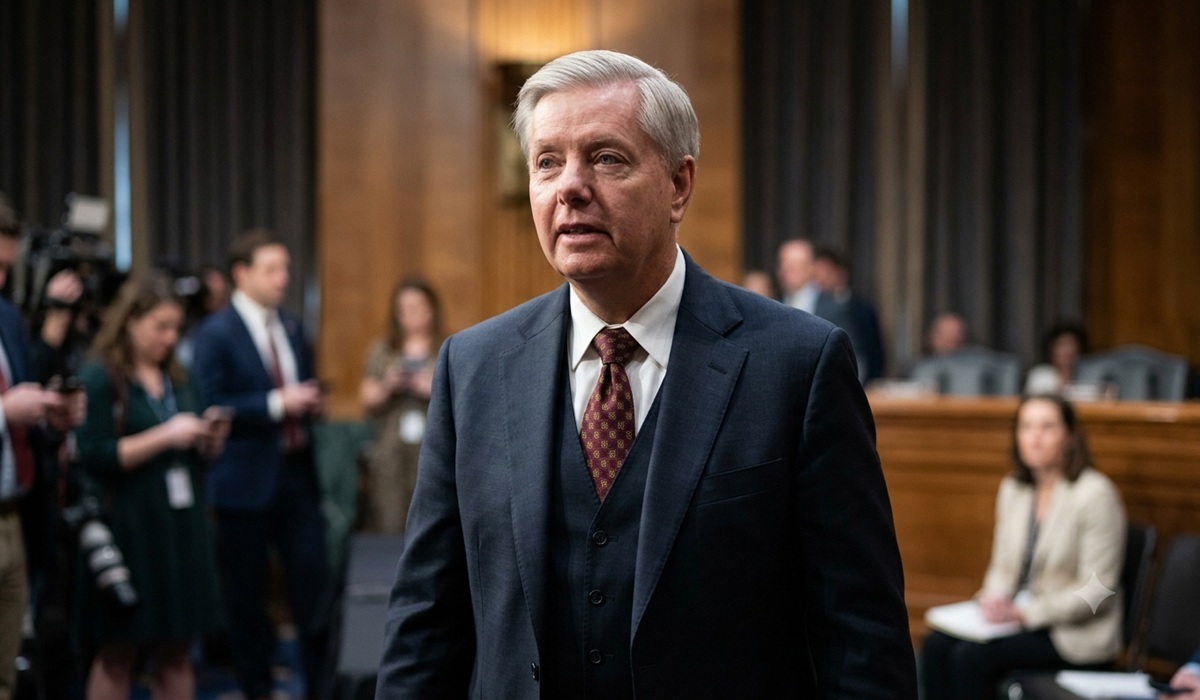
The passing of a long-serving politician usually triggers a rehearsed choreography of grief in Washington. The press releases roll out, flags drop to half-staff, and the airwaves fill with sanitized retrospectives about a life spent in public service. But as the tributes pour in for Senator Lindsey Graham, who died just hours after returning from his latest trip to Ukraine, a massive gulf opens up between the official eulogies and the reality of the legacy he leaves behind. To look honestly at his decades in power is to see a career that became a textbook definition of how the capital changes a person, transforming what began as a promise to represent the people into a lifelong pursuit of global conflict and personal preservation.
Every career in politics starts somewhere, and usually, it begins with the right reasons. When Graham first entered the political arena in South Carolina in the nineties, he positioned himself as a creature of his home state, a small-town lawyer who understood the struggles of everyday people. But stay in Washington long enough, and the air changes you. Over time, the passion for the voters gets replaced by the comfort of the routine, the status of the committee assignments, and the steady accumulation of influence. The job stops being about public service and turns into an exercise in maintaining a grip on power, collecting a paycheck, and watching your net worth rise while the people who put you there continue to struggle.
The defining characteristic of Graham’s public life, especially in his later years, was an insatiable appetite for war. He was an unyielding hawk, a man who seemed to view the entire globe through the crosshairs of American military intervention. Where others saw opportunities for diplomacy or cautioned against the devastating human cost of conflict, he saw a chance to send troops, deploy missiles, and escalate tensions. He earned a reputation as a warmonger not because he defended the nation, but because he actively sought out new theaters of war, consistently pushing hardline stances against Iran, Russia, and China.
His rhetoric regarding other nations and cultures frequently crossed the line from aggressive statecraft into something far more troubling. The way he spoke about foreign adversaries often carried a distinct undercurrent of cultural condescension, a dismissive attitude that reduced complex societies and human beings to mere obstacles in the way of Western dominance. It was a horrific way to communicate on the global stage, showcasing a profound lack of empathy and a willingness to dehumanize entire populations if it served a specific geopolitical narrative. To hear a sitting United States Senator speak so casually about destruction and conflict was a terrible representation of what this country is supposed to stand for.
This relentless drive for military engagement was not just ideological; it was highly profitable for the networks that sustain Washington. The military-industrial complex thrives on perpetual anxiety, and politicians who beat the drums of war loudest are often the ones who find their campaign coffers the most full. The sheer volume of money required to keep someone like Graham in office during modern elections is staggering, running into hundreds of millions of dollars to protect a single Senate seat. When an election becomes a battleground that commands that kind of financial capital, you have to ask a fundamental question: how does a public servant secure that level of funding, and who is writing those checks?
The answers are always found by following the money. The regular citizens of South Carolina, dealing with inflation, healthcare costs, and failing infrastructure, are not the ones pooling together hundreds of millions of dollars to buy airtime. The money comes from outside interests, from defense contractors, corporate PACs, and wealthy donors who benefit directly from a foreign policy that prioritizes defense spending over domestic well-being. When a senator becomes entirely reliant on this financial machine to survive a contentious reelection campaign, their allegiance inevitably shifts. They are no longer working for the factory worker or the teacher in their home state; they are answering to the financial benefactors who keep them in the game. The people who ultimately benefit are the ones manufacturing the weapons, while the public is left holding the bill.
There is a golden rule in civilized society that you do not celebrate a person’s death, and this perspective is not about breaking that rule. Death is a tragedy for those close to a person, and human empathy dictates a level of respect for the grief of a family. But a public legacy belongs to the public. When the media attempts to paint a flawless portrait of a statesman, it does a disservice to history and to the people who suffered under the policies he championed. It is entirely justifiable to look at his career and say that his representation of the people was deeply flawed, and that his rhetoric was often unacceptable. Pointing out the damage done by a career defined by hawkish aggression is not about malice; it is about historical accuracy.
Even within his home state, the ground was already shifting beneath him. South Carolina has long been viewed as a reliable stronghold for his party, but recent election cycles have proven that the political landscape is far more volatile than the establishment likes to admit. The opposition had already made significant inroads, turning what used to be guaranteed victories into highly competitive, expensive, and stressful battles. The state was in play during his last run, forcing an unprecedented influx of national cash just to keep his seat secure. The vulnerability was real, driven by a growing exhaustion among voters who felt their senator cared more about the borders of foreign nations than the conditions of his own communities.
Now, with his sudden passing, that political vulnerability becomes a wide-open question. The calculations change instantly. The temporary appointment by the governor will fill the seat for a moment, but the underlying tension in South Carolina politics is about to explode into the open. The state is no longer a guaranteed lock for the status quo. The upcoming electoral battle will not just be a fight between two parties; it will be a referendum on whether the voters want to continue electing beltway insiders who prioritize global chess games, or if they are ready for a leadership that actually looks inward.
Looking forward requires a deep level of introspection about how we evaluate our leaders. A career spent entirely within the halls of Congress should be judged by how much better off the people are, not by how many times a politician appeared on a Sunday morning talk show or how many war zones they visited. Lindsey Graham’s final chapter ended right after a journey to a war zone, a fitting but somber encapsulation of a life that became entirely detached from the quiet, everyday needs of the state he was elected to serve. He leaves behind a fractured political landscape, a legacy marred by the defense of endless conflict, and a stark reminder of what happens when the allure of Washington completely replaces the duty to the people.
About The Author