While the World Watches Oil Tankers, the Real Pressure Point May Be Running Beneath the Sea
- TDS News
- U.S.A
- May 22, 2026
By: Donovan Martin Sr, Editor In Chief
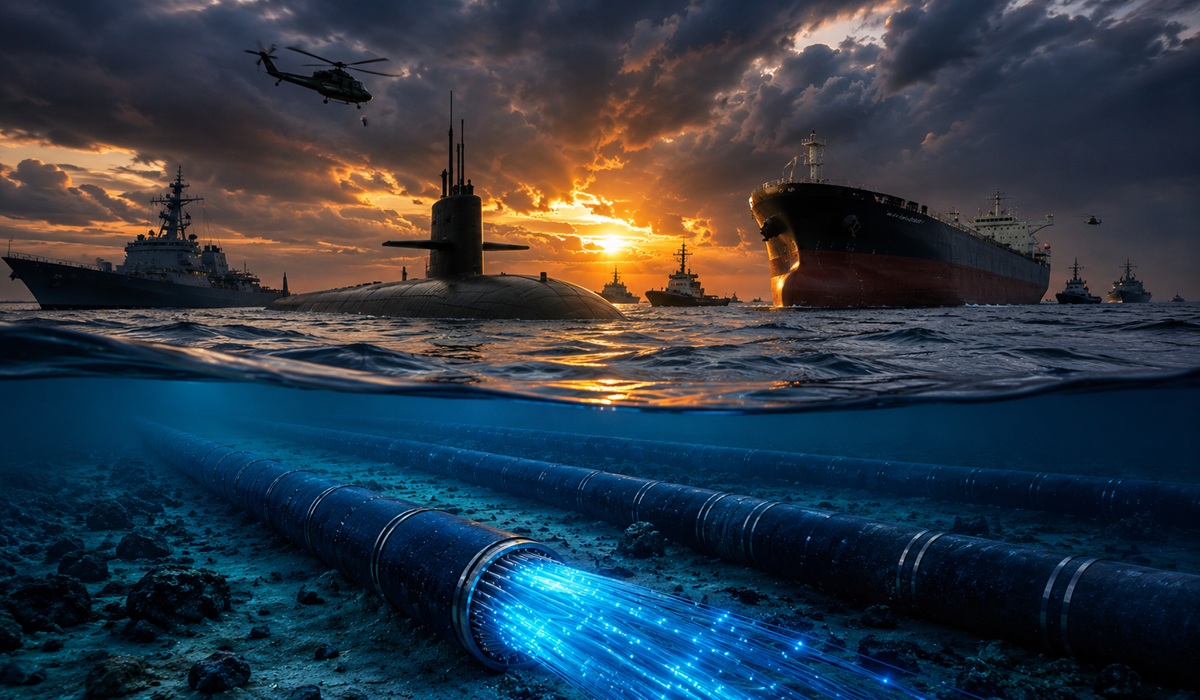
For weeks, much of the global conversation surrounding rising tensions involving Iran and the Strait of Hormuz has focused almost entirely on oil. Television graphics continue showing tanker routes. Analysts debate crude prices. Governments warn about shipping disruptions. Markets react to every military movement near one of the most strategically important waterways on Earth. Yet beneath the surface of those same waters lies another system that receives far less public attention, despite being just as critical to the modern global economy. Running along the seabed are vast networks of fiber-optic cables carrying enormous volumes of the world’s internet traffic, financial transactions, cloud communications, government data, military coordination systems, and corporate infrastructure connecting Europe, the Middle East, Asia, and parts of Africa.
Security analysts have quietly warned for years that undersea cables represent one of the modern world’s most vulnerable strategic targets. Unlike oil tankers, they are largely invisible to the public. There are no dramatic satellite images of them moving across oceans. Most people never think about them at all. Yet these cables form the nervous system of the global economy. Every second, banks, governments, stock markets, hospitals, military systems, logistics companies, airlines, and technology giants depend on those connections functioning without interruption. A serious disruption to key routes near the Gulf region would not simply slow internet speeds. It could create cascading disruptions affecting communication systems, financial markets, international commerce, cloud infrastructure, and data traffic flowing between entire continents.
That is why growing discussion surrounding potential threats to undersea infrastructure has generated enormous concern within intelligence circles and global telecommunications industries. Reports and speculation surrounding the possibility of cable disruptions have intensified alongside broader geopolitical tensions, although public evidence of any finalized operational plan remains limited. Still, the conversation itself reflects a deeper reality that many governments already understand. Modern conflicts are no longer defined purely by missiles, tanks, aircraft, or naval blockades. Increasingly, control over information systems, communications networks, satellite infrastructure, cloud computing, and digital chokepoints may hold equal strategic importance to control over oil or territory.
The Strait of Hormuz itself occupies a uniquely sensitive position within that equation. It remains one of the world’s most important energy corridors, but geographically it also sits near major digital transit pathways connecting East and West. Any instability involving shipping lanes naturally creates anxiety about broader infrastructure vulnerabilities nearby. The modern global economy does not separate physical trade from digital systems anymore. Oil shipments, financial settlements, cargo logistics, energy trading platforms, banking transfers, cloud servers, and communications infrastructure are all deeply interconnected. Disruptions in one area can rapidly trigger consequences across entirely different sectors.
What makes the current conversation particularly unsettling is the growing recognition that economic warfare no longer requires direct military confrontation. Governments, intelligence agencies, cyber actors, and private corporations now operate within an environment where leverage often comes from infrastructure dependence itself. A country does not necessarily need to win a traditional war to create global instability. The mere threat of disrupting supply chains, communications systems, or digital infrastructure can influence markets, diplomacy, insurance rates, shipping behavior, and political decision-making across multiple continents simultaneously.
Technology companies have become central players in that geopolitical landscape whether they want to be or not. Firms such as Google, Meta, Microsoft, Amazon, Apple, and satellite communications providers increasingly sit at the intersection of global politics, national security, and digital infrastructure. Governments around the world have become more suspicious of foreign technology platforms over concerns involving surveillance, influence operations, intelligence gathering, data sovereignty, and military cooperation. In recent years, multiple countries have accused major technology firms or communications applications of indirectly assisting foreign intelligence operations, although many of those claims remain disputed or politically charged. The result is an atmosphere where trust between governments and multinational technology corporations has become increasingly fragile.
Speculation surrounding satellite internet systems has added another layer to the discussion. Companies connected to space-based communications networks, particularly those capable of bypassing terrestrial cable infrastructure, are now viewed by some analysts as potentially critical players during future geopolitical crises. If undersea cables were disrupted on a large scale, satellite systems could theoretically help stabilize portions of global communications traffic, though experts caution they currently lack the total capacity required to replace the enormous volume carried by fiber-optic networks. Satellite internet remains powerful, but the global digital economy still overwhelmingly depends on physical cables running beneath oceans.
That reality places companies involved in satellite communications into an unusually sensitive geopolitical position. On one hand, they represent resilience and redundancy during infrastructure crises. On the other hand, some governments may view foreign-controlled satellite systems with suspicion, particularly during periods of conflict or heightened regional tension. Questions surrounding access, licensing, surveillance concerns, military cooperation, and information control quickly become politically explosive. In several conflict zones over recent years, satellite communication technologies have already demonstrated how private companies can suddenly find themselves operating within spaces traditionally dominated by governments and militaries.
At the same time, experts caution against overstating any single country’s ability to completely sever global digital communications through one regional disruption alone. The internet was designed with redundancy in mind, and global networks contain multiple pathways capable of rerouting portions of traffic during outages. However, redundancy does not mean immunity. Major disruptions to critical cable corridors could still create severe slowdowns, increased latency, financial instability, regional outages, and substantial economic losses depending on the scale and duration of any incident. Even temporary disruptions affecting key financial data routes could trigger enormous market anxiety given how dependent modern banking systems are on real-time connectivity.
The broader issue may ultimately be psychological as much as operational. For years, public understanding of geopolitical vulnerability centered primarily around oil pipelines, military bases, naval fleets, and airspace. Increasingly, however, the world’s greatest vulnerabilities may be digital, invisible, and deeply integrated into ordinary life in ways most people barely notice. Financial markets, emergency services, hospitals, aviation systems, supply chains, telecommunications networks, cloud storage, and even basic consumer applications all rely on infrastructure that remains surprisingly exposed beneath oceans, across satellites, and inside data centers spread around the world.
That is why some analysts argue the real story unfolding beneath current tensions is not simply about energy markets or military escalation. It is about the growing realization that data itself has become one of the most valuable strategic assets on Earth. Oil still powers economies, but information now powers nearly everything else. Governments understand that. Corporations understand that. Intelligence agencies certainly understand that. The public is only beginning to realize it.
And while much of the world continues watching the tankers moving across the Strait of Hormuz, many security experts are quietly watching the seabed beneath them.
About The Author