By: Donovan Martin, Editor in Chief
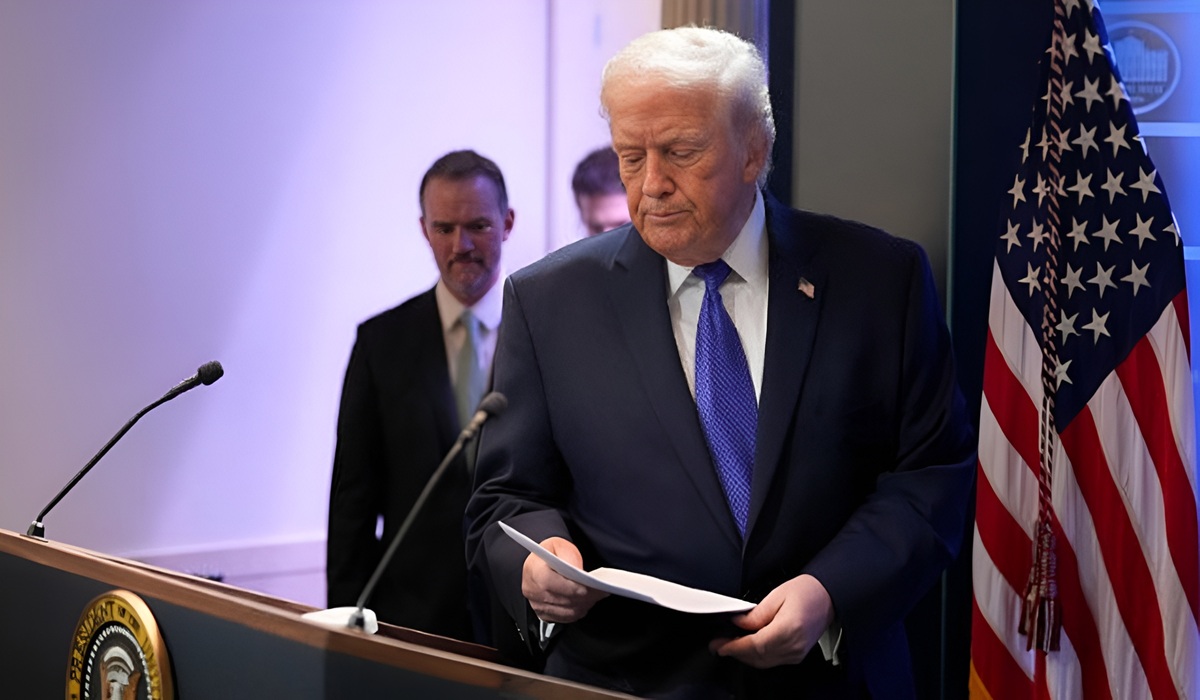
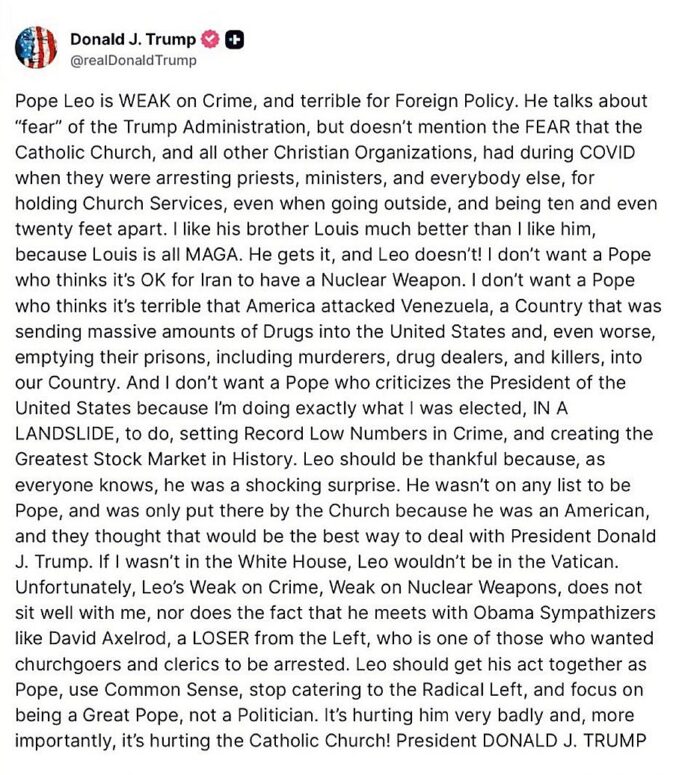
The political world has seen its share of confrontations, but what unfolded in recent days has crossed into territory that many are struggling to fully comprehend. Donald Trump took to his Truth Social platform and launched a direct, deeply personal attack on Pope Leo XIV, igniting a global reaction that is reverberating far beyond politics and into the very core of religious life.
Trump’s remarks were not veiled in diplomacy or softened by restraint. He described the Pope as “weak on war” and went further, stating that he did not want “a Pope who thinks weakness is strength,” framing the pontiff not as a spiritual authority but as a flawed and dangerous voice on the world stage. In another pointed remark, he suggested the Pope was “terrible for global leadership” and implied that his influence could embolden adversaries. These are not casual criticisms. They represent a direct challenge to the authority and purpose of the papacy itself.
What makes this moment so significant is not just the language used, but who it is directed at. The Pope is not a political rival in the conventional sense. He is the spiritual leader of more than a billion Catholics worldwide and a symbolic moral voice that transcends borders, governments, and ideologies. Historically, world leaders, regardless of their disagreements with Vatican positions, have exercised extreme caution when addressing the Pope publicly. Even during times of war, tension, and ideological conflict, criticism of the papacy has been measured, indirect, and respectful of its unique role.
This is why Trump’s comments are being described by many observers as unprecedented. He did not simply disagree with the Pope’s stance on conflict or diplomacy. He dismissed his role entirely, reframing the Pope’s calls for peace as weakness and positioning himself in direct opposition to the Church’s moral authority. In doing so, he has effectively drawn a line between political power and spiritual leadership, not as separate forces, but as competing ones.
The context surrounding the Pope’s statements makes the attack even more striking. Pope Leo XIV has consistently called for restraint, dialogue, and peace in the face of escalating global tensions. His messaging reflects long standing Catholic doctrine, which emphasizes the sanctity of life, the moral limits of warfare, and the responsibility of leaders to seek peaceful solutions wherever possible. In that light, his position is not radical or controversial within the Church. It is foundational.
Trump’s response, however, reframes that foundation as a liability. By portraying calls for peace as weakness, he is not just criticizing a policy stance. He is challenging the philosophical underpinnings of one of the oldest institutions in the world. That is where the deeper tension lies. This is not simply about geopolitics. It is about competing visions of leadership, morality, and strength.
Religious leaders across denominations are now grappling with the implications. Within the Catholic world, there is a growing sense that this moment represents more than a disagreement. It feels like a rupture. Bishops and theologians have begun to emphasize that the Pope’s role is not to act as a geopolitical strategist, but as a moral guide. His duty is to speak on behalf of peace, justice, and human dignity, even when those messages are inconvenient or unpopular with powerful nations.
Beyond the Church, the broader concern is the precedent this sets. If a sitting U.S. president openly attacks the Pope in such direct and personal terms, it raises questions about what boundaries remain. Does this signal a shift where religious institutions are treated as just another political target. Does it erode the long standing, if informal, understanding that spiritual leadership occupies a different space, one that is not subject to the same kind of public dismantling.
There is also an unmistakable pattern emerging in how Trump communicates. His use of Truth Social has become increasingly central to his leadership style, often featuring rapid, emotionally charged posts that blur the line between policy, personal grievance, and symbolic messaging. Critics argue that this approach introduces a level of unpredictability that complicates both domestic governance and international relations. Supporters, on the other hand, see it as a form of direct communication that bypasses traditional media filters. Regardless of interpretation, the impact is undeniable.
In this case, that impact has reached into the heart of the religious world. The reaction has not been limited to political commentators or diplomatic analysts. Faith communities themselves are responding, trying to understand what it means when the most powerful political office in the world openly challenges the moral authority of the papacy.
For many, the concern is not just about the words that were said, but about what they represent. A shift in tone. A shift in boundaries. A shift in how power is exercised and against whom it is directed. Moments like this do not occur in isolation. They shape expectations, influence behavior, and redefine what is considered acceptable in public discourse.
This is why the significance of Trump’s attack cannot be understated. It is rare. It is profound. It cuts across politics, religion, and global leadership in a way that few events ever do. Whether it is remembered as an isolated outburst or the beginning of a broader transformation remains to be seen. What is certain is that it has already changed the conversation, and the effects of that change are only just beginning to unfold.
About The Author