Xi Jinping – Cheng Li Wun Handshake Ripples United States
- Naveed Aman Khan
- Pinpoint
- China
- East Asia
- Tiger's Eye Advisory Group - Trending News
- April 16, 2026
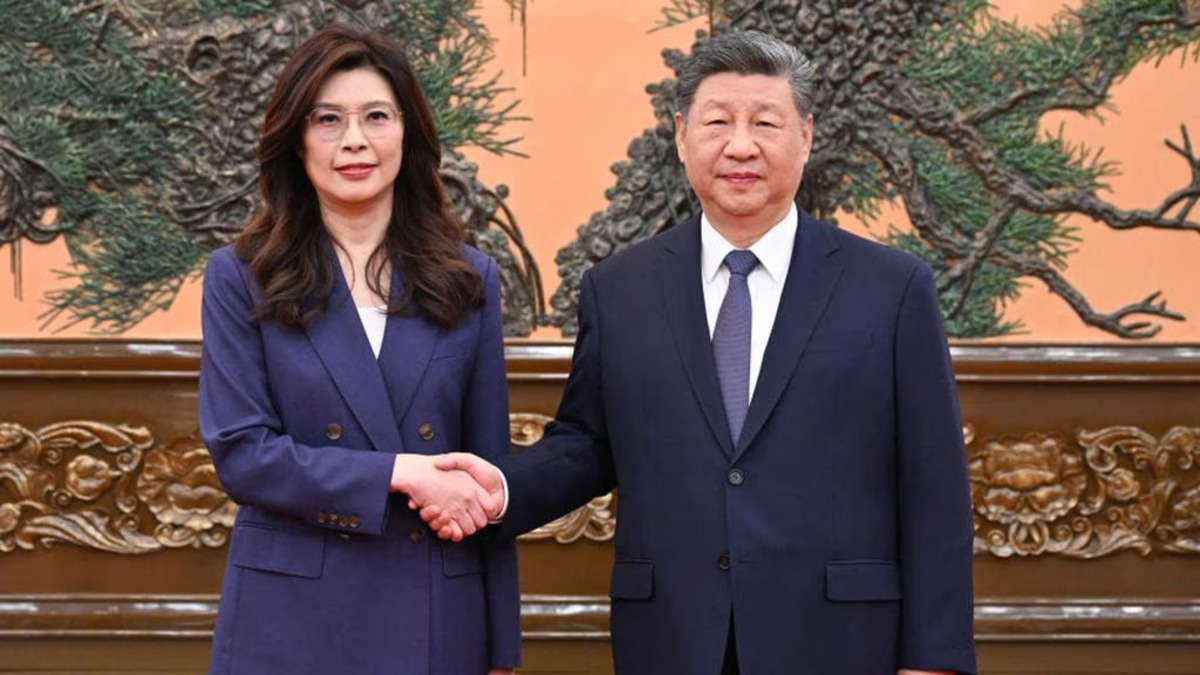
The recent visit of Taiwan’s opposition leader Cheng Li-wun to China marks a pivotal moment in cross-strait relations, carrying implications far beyond symbolic diplomacy. Coming at a time of heightened geopolitical tension, the visit reflects a recalibration of political strategies not only in Taipei and Beijing but also in Washington. It underscores the complex interplay of diplomacy, domestic politics, and great power rivalry shaping the future of Taiwan.
Cheng Li-wun, chairperson of the Kuomintang (KMT), undertook this visit at the formal invitation of Chinese President Xi Jinping, signaling a deliberate and strategic initiative from Beijing. The trip—the first by a KMT leader in nearly a decade—was framed as a “peace mission,” emphasizing dialogue and reconciliation over confrontation. The objectives were clear: revive communication channels, reduce tensions, and promote the so-called “1992 Consensus,” which recognizes the idea of “one China” while allowing differing interpretations.
From Beijing’s perspective, the visit was an opportunity to bypass Taiwan’s ruling Democratic Progressive Party (DPP) government, which it views as pro-independence, and instead engage directly with a more receptive political force. Xi Jinping’s messaging during the meeting—emphasizing shared heritage and inevitable reunification—was consistent with China’s long-term strategy of peaceful integration, albeit backed by the implicit threat of force.
For Cheng and the KMT, the visit served both ideological and political purposes. Ideologically, it aligned with the party’s traditional stance favoring engagement with China. Politically, it positioned the KMT as a viable alternative to the DPP by advocating peace and economic cooperation over military confrontation. However, this approach has triggered significant domestic controversy in Taiwan, where critics argue that such engagement risks undermining sovereignty and democratic autonomy.
The immediate impact of the visit is already visible. China has announced a series of incentives, including easing trade restrictions, expanding tourism, and restoring flights, aimed at building goodwill among the Taiwanese population. These measures reflect a classic “carrot-and-stick” strategy—offering economic benefits while maintaining military pressure. The dual approach seeks to influence public opinion within Taiwan and deepen internal divisions between political factions.
The visit also places pressure on Taiwan’s current administration. While it does not directly alter government policy, it creates a competing narrative: one that suggests peace and prosperity can be achieved through accommodation with Beijing. This could resonate with segments of Taiwanese society concerned about the risks of conflict, particularly if economic incentives begin to yield tangible benefits. However, it is equally likely to provoke backlash among those who prioritize national identity and political autonomy.
The broader geopolitical context further amplifies the significance of this development. The anticipated visit of U.S. President Donald Trump to China next month introduces another layer of complexity. With Washington traditionally acting as Taiwan’s primary security guarantor, any shift in U.S.-China relations could have profound implications for Taipei. Beijing may use the KMT engagement as leverage to demonstrate that peaceful unification is achievable without external interference, thereby influencing U.S. policy calculations.
At the same time, the recent U.S. confrontation with Iran has indirectly strengthened China’s strategic position. As Washington’s attention and resources are stretched across multiple theaters, Beijing gains greater latitude to assert its influence in East Asia. While this does not immediately translate into a military advantage over Taiwan, it enhances China’s diplomatic leverage and reduces the likelihood of decisive U.S. intervention in a crisis scenario.
Nevertheless, the question of whether China can gain control over Taiwan without resorting to force remains highly contested. Beijing continues to emphasize “peaceful reunification,” but it has not renounced the use of military options. The ongoing military exercises and pressure tactics around Taiwan indicate that coercion remains an integral part of China’s strategy. At the same time, diplomatic and political efforts—such as engaging opposition parties and offering economic incentives—suggest a preference for gradual integration rather than abrupt confrontation.
Taiwan’s future, therefore, lies at the intersection of these competing strategies. Public opinion on the island remains a judging factor. Surveys consistently show that most Taiwanese prefer maintaining the status quo rather than pursuing immediate unification or independence. This creates a delicate balance that both Beijing and Taipei must navigate.
The opposition leader’s visit is unlikely to fundamentally alter this equilibrium in the short term. However, it could have long-term implications by normalizing high-level engagement and creating alternative channels of influence. If the KMT gains political ground domestically, such interactions could become more frequent, gradually shifting the dynamics of cross-strait relations.
In assessing whether China will achieve control over Taiwan sooner, it is important to recognize that reunification is not merely a question of capability but also of cost and legitimacy. A military invasion would carry enormous risks, including international sanctions, economic disruption, and potential conflict with the United States. Conversely, a diplomatic approach, while slower, offers the possibility of achieving the same objective with fewer risks.
The visit of Taiwan’s opposition leader to Beijing represents a significant, though not decisive , development in the evolving cross-strait equation. It highlights Beijing’s multifaceted strategy, combining diplomacy, economic incentives, and military pressure. It also exposes the internal divisions within Taiwan and the broader uncertainties in U.S.-China relations.
The future of Taiwan will likely be shaped not by a single decisive event but by a gradual accumulation of political, economic, and strategic shifts. Whether China ultimately achieves reunification through persuasion or coercion will depend on the interplay of these forces—and on the choices made by the Taiwanese people themselves. Hence, Chinese President Xi Jinping and Taiwanese Opposition leader Cheng Li wun handshake has rippled United States amid global power shifts.
About The Author