Colombia: Ten Years After Historic Peace Deal, Civilians Face Escalating Violence and Surging Humanitarian Crisis
- Kingston Bailey
- Trending News
- Latin
- November 23, 2026
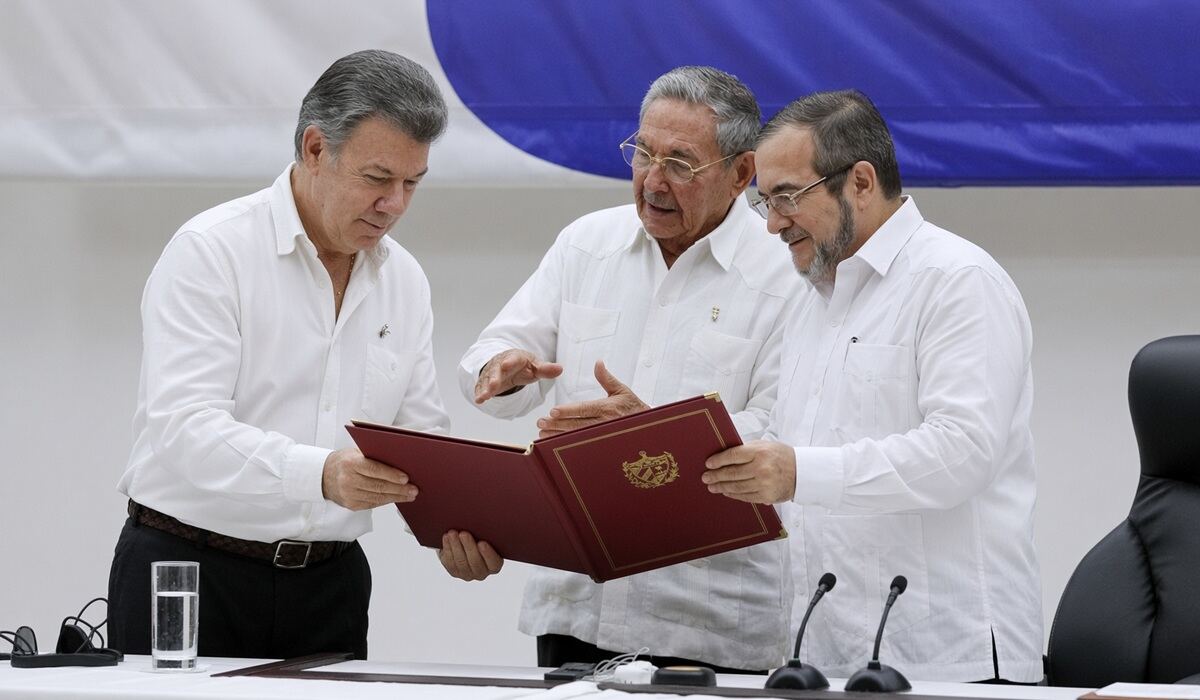
Ten years ago tomorrow, on November 24, 2016, Colombia stood before the world and signed a historic peace agreement with the Revolutionary Armed Forces of Colombia (FARC), bringing a formal end to fifty years of brutal armed confrontation. It was a moment of immense promise, a blueprint designed to heal a fractured nation over a 15-year horizon. Yet a decade later, the reality on the ground tells a starkly different story. Peace was signed on paper, not secured in the countryside.
According to stark new findings released by the Norwegian Refugee Council (NRC) ahead of Tuesday’s anniversary, conflict across Colombia has not only reignited, it has fractured into a more complex, relentless crisis that continues to tear civilian lives apart. When the accord was signed in 2016, 5.8 million people required humanitarian assistance. Today, that number has surged by nearly 40 per cent to more than 8.1 million.
“A decade after the signing of the peace agreement, conflict in Colombia has again intensified and continues to tear lives apart – and for millions of Colombians the violence never stopped,” said Jan Egeland, Secretary General of the Norwegian Refugee Council.
The 2016 accord was built around six ambitious pillars: comprehensive rural reform, political participation, disarmament and reincorporation of combatants, a solution to illicit drugs, a transitional justice system for victims, and strict verification mechanisms. However, where the state failed to establish a lasting institutional presence in remote territories, armed groups rushed in to fill the vacuum.
Following the 2016 deal, the International Committee of the Red Cross (ICRC) identified five active armed conflicts in Colombia by 2018. By 2025, that figure had climbed to eight, with local NGOs reporting a more than 20 per cent expansion in the ranks of organised armed groups. The impact in 2026 remains relentless. Data from the UN Office for the Coordination of Humanitarian Affairs (OCHA) shows that between January and April 2026 alone, over 630,000 people were directly affected by armed conflict.
Colombia also remains one of the world’s most neglected displacement crises. While hosting one of the largest populations of refugees and migrants globally, predominantly from Venezuela, it ranks among the top three countries worldwide for Internally Displaced Persons (IDPs), surpassed only by Sudan. For rural communities, Indigenous peoples, and Afro-Colombians living in isolated regions, the absence of state protection means living under the suffocating micro-management of armed factions.
“Almost half of the people we have recently assisted report living with constant anxiety, as the rules imposed by organised armed groups dictate the specific hours when they can enter and leave their homes, what they must plant in their fields, and the colour of the clothes they wear,” Egeland explained.
Between September and November 2026, the NRC surveyed 150 humanitarian aid recipients across five heavily impacted departments: Arauca, Cauca, Chocó, Nariño, and Norte de Santander. The results are sobering: 75 per cent of respondents stated they experience the same level of violence, or worse, than when the peace agreement was signed ten years ago. Specifically, 46 per cent reported that conditions are harder today, while 29 per cent said they remain just as difficult.
Behind those statistics are harrowing human realities. One father forced to abandon his home recounted to the NRC how armed groups held his community hostage: “We could not leave our territory without permission from the armed group controlling the area. There was no food; we only had water when it rained, and those who fell ill had to endure the pain in silence.” Ultimately, his family escaped under the cover of darkness, trekking across treacherous mountains to survive.
With personal and community security cited as the top concern by nearly 52 per cent of surveyed residents, communities are calling urgently for direct international field presence (54.2 per cent) and rapid emergency response (42.7 per cent). Over 93 per cent confirmed that humanitarian operations directly stabilize their communities.
“Decades of visiting Colombia’s remote regions have shown me the resilience of its people, but also the heavy price the rural populations pay when promises are broken,” Egeland said, urging both the Colombian government and international donors to step up immediately.
“Real peace is not only measured by the number of pledges signed on paper,” he added. “It is measured on the ground, by whether a mother can send her children to school without fear of forced recruitment, and whether displaced families can return home with dignity and safety.”
The peace agreement’s 15-year implementation window closes in 2031. With only five years remaining on that schedule, time is rapidly running out to prove that Colombia’s landmark accord was more than ink on a page—and to ensure that innocent civilians caught in the crossfire are not abandoned to another decade of war.
About The Author