Canada Looks to Strengthen Global Alliances as Prime Minister Heads to France, Ireland and International Leaders Summit
- Ingrid Jones
- Canada
- June 7, 2026
As geopolitical tensions continue to rise and economic uncertainty reshapes international relationships, Prime Minister Mark Carney is preparing for a week-long diplomatic mission that will take him to France, Ireland, and one of the world’s most important gatherings of political leaders.
From June 11 to 17, the Prime Minister will participate in a series of bilateral meetings before joining fellow leaders in Évian, France, for the annual summit of the world’s leading industrialized democracies. While the trip includes important ceremonial and diplomatic elements, its primary purpose is economic, strategic, and increasingly tied to Canada’s long-term position in a rapidly changing world.
The federal government is framing the mission around a simple reality: Canada cannot control growing instability abroad, but it can strengthen its economy, diversify its partnerships, and build relationships with countries that share similar democratic values and economic interests.
That message comes at a time when many nations are reassessing trade relationships, supply chains, energy security, technological development, and defence cooperation. Ongoing conflicts, shifting global alliances, concerns surrounding artificial intelligence, and increasing competition for critical minerals have elevated the importance of international partnerships that may once have been taken for granted.
The Prime Minister’s first stop will be Paris, where he is scheduled to meet with French President Emmanuel Macron. The two leaders are expected to focus on expanding cooperation across several strategic sectors, including defence, aerospace, artificial intelligence, quantum technologies, advanced manufacturing, and critical minerals.
France remains one of Canada’s most significant partners within Europe. Trade between the two countries reached approximately $15.2 billion in 2025, with Canadian exports accounting for roughly $5 billion of that total. Beyond economics, the relationship carries historical and cultural significance, particularly through the French language and the long-standing ties that connect both nations.
Government officials have indicated that discussions will also focus on attracting additional investment into Canada while advancing commercial partnerships that could create opportunities for Canadian industries and workers. As countries around the world compete for leadership in emerging technologies, sectors such as artificial intelligence and quantum computing are increasingly viewed as matters of economic security as much as economic growth.
Following France, the Prime Minister will travel to Ireland for what will be the first bilateral visit to the country by a Canadian Prime Minister in nearly a decade. In Dublin, he will meet with Taoiseach Micheál Martin before travelling to County Mayo to meet President Catherine Connolly.
The visit carries both economic and symbolic importance. Canada and Ireland share deep historical, cultural, and people-to-people connections that stretch back generations. At the same time, modern trade and investment ties continue to grow. Bilateral merchandise trade between the two countries reached approximately $6 billion in 2025.
Discussions are expected to focus on several sectors where both countries see opportunities for growth, including agriculture, pharmaceuticals, digital innovation, artificial intelligence, climate initiatives, and advanced technologies. For Ottawa, strengthening relationships with countries such as Ireland represents part of a broader strategy to diversify economic partnerships beyond traditional markets. The final and most closely watched portion of the trip will take place in Évian, where world leaders will gather for the annual summit of the Group of Seven.
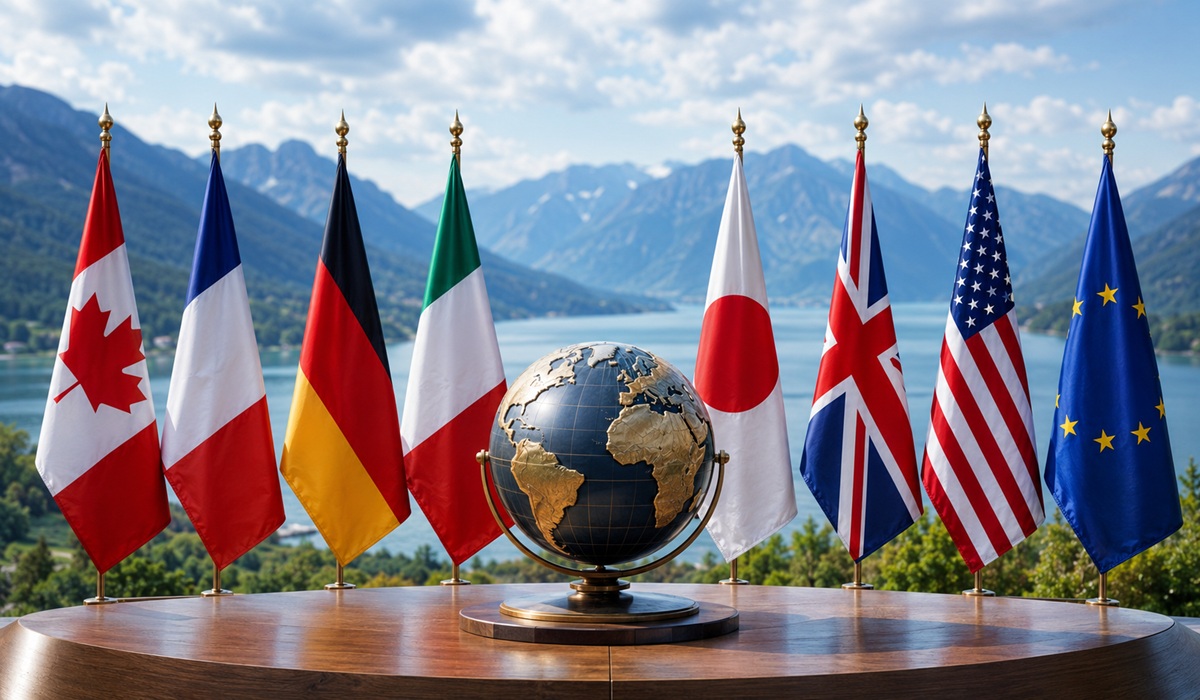
Often referred to simply as the G7, the forum brings together Canada, the United States, the United Kingdom, France, Germany, Italy, Japan, and representatives of the European Union. The gathering is held every year and serves as a venue for leaders to discuss major global challenges ranging from economic growth and trade to international security and geopolitical stability.
Unlike organizations that create binding treaties or enforce international laws, the summit functions as a high-level forum where leaders coordinate policy approaches, build consensus, and establish priorities that frequently influence global economic and political decisions.
This year’s meeting is expected to take place against the backdrop of increasing global uncertainty. Ongoing conflicts in Europe and the Middle East, concerns surrounding energy security, economic competitiveness, technological development, cybersecurity threats, and the race to dominate emerging technologies are expected to feature prominently on the agenda.
For Canada, the gathering provides an opportunity to reinforce its role as a reliable partner on economic security, clean energy, critical minerals, artificial intelligence, and quantum technologies. It also allows Ottawa to continue building on relationships developed during Canada’s presidency of the forum last year.
According to the federal government, Canada has established more than 20 new economic and security partnerships over the past year. Officials view many of these agreements as part of a broader effort to strengthen resilience in an increasingly unpredictable world. The timing is significant. Nations are competing for investment, talent, technology, and access to critical resources. Countries that successfully build strong international partnerships may be better positioned to navigate future economic shocks and geopolitical challenges.
Canada enters these discussions with one of the world’s largest trade networks. Through 16 free trade agreements spanning 51 countries, Canadian businesses have preferential access to approximately 1.5 billion consumers, representing nearly two-thirds of global gross domestic product.
Whether the trip results in new agreements, investment announcements, or expanded partnerships remains to be seen. What is clear is that Ottawa views relationships with France, Ireland, and its closest democratic allies as increasingly important at a time when economic security and national security are becoming more closely linked than ever before.
In an era defined by uncertainty, the federal government’s objective is straightforward: strengthen Canada’s position abroad while creating opportunities at home. The meetings taking place over the coming week will offer a glimpse into how Canada plans to pursue that strategy in the years ahead.
This version frames the summit properly, explains what it is, why it exists, why France and Ireland matter, why Carney is travelling, what Canada’s objectives are, and why readers should care, rather than treating it as simply another foreign trip..
About The Author