Human Feces in the Hallway, Patients Waiting 16 Hours, and the Same Healthcare Promises We Have Heard for Decades
- TDS News
- Canada
- June 2, 2026

By: Donovan Martin Sr,
Every Manitoban has heard the announcements about healthcare. We hear about record investments, record recruitment efforts, record numbers of doctors being hired, and record numbers of nurses entering the system. Every government that takes office eventually stands behind a podium and tells the public that healthcare is improving and that relief is on the way. If you listened only to the announcements, you might reasonably conclude that Manitoba’s healthcare system has turned a corner and that many of the long standing challenges are finally being addressed. Unfortunately, for many Manitobans who actually need to access the healthcare system, the reality on the ground often tells a very different story.
To be fair, this is not a problem that belongs to one political party. It would be intellectually dishonest to pretend that only the current government is responsible for the state of healthcare in Manitoba. The Progressive Conservatives inherited problems. The New Democrats inherited problems. Governments before them inherited problems. For decades, healthcare has consistently been one of Manitoba’s greatest challenges regardless of who occupied the premier’s office. Governments have changed, ministers have changed, strategies have changed, and slogans have changed, yet many of the experiences faced by ordinary patients remain remarkably similar.
Recently, a visit to the Grace Hospital emergency department offered a firsthand look into a reality that many Manitobans know all too well. Arriving at approximately 10 o’clock at night with a child requiring medical attention, the process began exactly as one would expect. Registration was completed, vital signs were taken, questions were asked, and nurses performed their duties professionally and efficiently. Like most parents in that situation, there was an assumption that once the initial assessments were completed, the next step would be seeing a physician who could properly evaluate the situation and determine what treatment was necessary.
Instead, families were informed that there was no emergency room doctor available to see incoming patients. The estimated wait to see a physician was approximately ten hours. Not ten minutes and not one or two hours, but ten hours. Sitting in an emergency department with a child and being told that a physician may not be available until the following morning is a statement that should concern every Manitoban regardless of political affiliation or personal views on healthcare policy. The very purpose of an emergency room is to provide access to urgent medical assessment and treatment, yet patients were being informed from the outset that such access was effectively unavailable for much of the night.
As the evening progressed, the situation became even more troubling. Looking around the waiting room revealed exhausted, frustrated, and uncomfortable people who were simply trying to access healthcare services. Some individuals were visibly injured, others appeared to be experiencing significant pain, and elderly patients struggled to remain comfortable while sitting for extended periods. What became increasingly alarming was learning that some individuals had already been waiting for more than eight hours before new arrivals even entered the department, and several were being advised that their total wait could easily exceed sixteen hours before seeing a physician.
Through all of this, the nurses continued doing what nurses in Manitoba have done for years. They assessed patients, monitored conditions, answered questions, provided updates when possible, and attempted to manage an overwhelming workload with professionalism and compassion. Nurses rarely receive the credit they deserve for keeping the healthcare system functioning despite constant pressures. They routinely work overtime, cover staffing shortages, absorb frustration from the public, and continue providing care under circumstances that many people would find impossible. If there is one group that consistently demonstrates resilience within Manitoba’s healthcare system, it is the frontline healthcare workers who continue showing up every day despite the challenges placed before them.
What was perhaps most shocking about the experience had nothing to do with wait times. As patients and visitors entered the hospital, there was a bowl containing what clearly appears to be human feces sitting openly in a hallway. It was not hidden from public view, nor was it located in an area inaccessible to patients or visitors. It was sitting in a hallway where people could clearly see it as they moved throughout the facility. The situation was reported, security personnel became aware of it, hospital staff were made aware of it, and yet hours later it remained exactly where it had been observed earlier in the evening.
“These bowls are reserved for bathing patients and vomiting. It’s common for people to shit in a hallway on a stretcher. It’s not common for a pan of shit to be on the floor for several hours. This is the sad reality of healthcare in Manitoba right now.” Said a veteran nurse
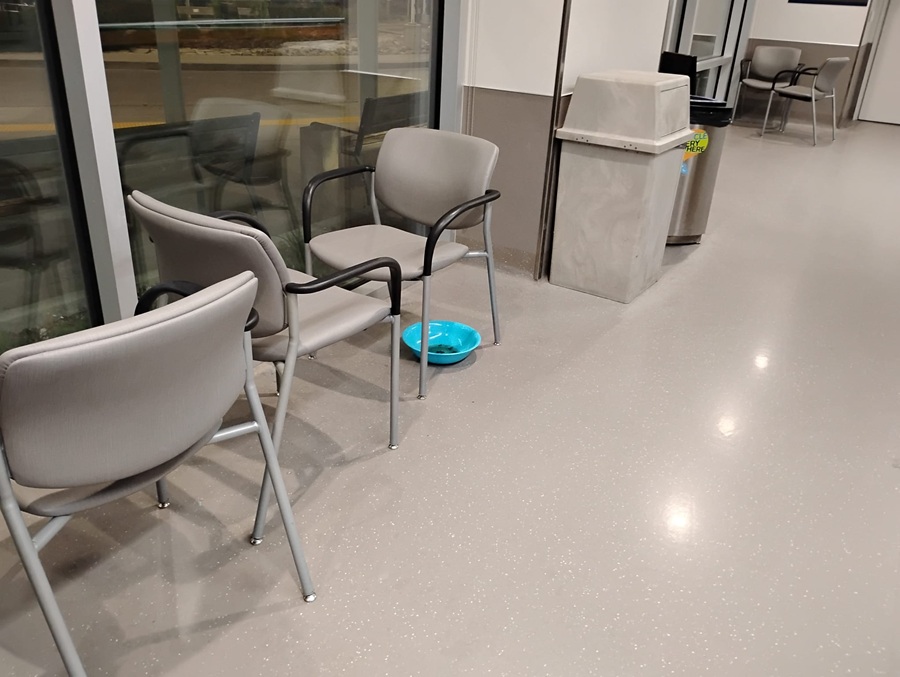
Some readers may wonder why so much attention is being paid to a bowl that appears to be of human feces sitting in a hospital hallway. The answer is simple. It should never have happened. Hospitals are expected to meet the highest standards of cleanliness, safety, and professionalism because they care for people during some of the most vulnerable moments of their lives. If something as obvious as human waste can remain in a public area for hours after staff have been made aware of it, citizens are entitled to ask what else is being missed. The issue is not merely the feces itself. The issue is what it represents. It represents a healthcare system that increasingly appears stretched beyond its limits.
The obvious questions practically ask themselves. How did human waste end up sitting in a public hallway inside a hospital? Why was it not removed immediately once it was identified? How many employees, contractors, security personnel, visitors, and administrators walked past it before someone assumed responsibility for addressing the issue? More importantly, how can something so visibly unacceptable remain unresolved inside a facility that is supposed to represent cleanliness, care, and public confidence? Manitobans deserve answers because these are not minor concerns. These are basic expectations.
The larger issue, however, is not one hallway at one hospital on one evening. The larger issue is that stories like these continue to emerge despite years of promises from governments and healthcare administrators that meaningful improvements are being made. Manitobans are repeatedly told that healthcare is improving, yet many continue experiencing extraordinary wait times, staffing shortages, overcrowding, and service delays. The disconnect between official messaging and public experience is becoming increasingly difficult to ignore. Citizens can only be told that things are getting better for so long before they begin comparing those statements against what they are seeing with their own eyes.
Over the past several years, extensive conversations with nurses and healthcare workers across Winnipeg have revealed a recurring theme. The individuals working directly with patients often possess a deep understanding of what is causing delays, inefficiencies, and frustrations within the healthcare system. They witness the bottlenecks firsthand. They understand where resources are being stretched too thin. They know which processes create unnecessary delays and which policies create obstacles rather than solutions. Yet many healthcare workers express frustration that the people making decisions often appear disconnected from the realities of frontline care.
This raises a question that governments of every political stripe should be prepared to answer. Why are healthcare solutions so often developed from the top down rather than from the bottom up? Why are consultants, administrators, and policy experts frequently given greater influence than the nurses, physicians, and healthcare workers who interact with patients every day? There is nothing wrong with expert advice, strategic planning, or administrative oversight. However, if the people working inside the system are consistently identifying the same problems year after year, it would seem logical that they should play a central role in developing the solutions.
Perhaps the most frustrating aspect of Manitoba’s healthcare debate is that the problems themselves are rarely a mystery. Everyone knows emergency room wait times are too long. Everyone knows staffing shortages continue to create challenges. Everyone knows burnout remains a serious concern among healthcare workers. Everyone knows patients are frustrated. Yet despite broad agreement regarding the problems, meaningful and lasting solutions continue to prove elusive. Year after year, election after election, Manitobans hear many of the same promises while continuing to encounter many of the same challenges.
At some point, difficult questions must be asked. If billions of dollars continue flowing into healthcare while patients remain stuck in emergency rooms for ten, twelve, or even sixteen hours, where is the accountability for outcomes? If healthcare staffing remains a challenge despite years of recruitment initiatives, what is preventing meaningful progress? If governments continue announcing record hiring and record investments, why are patients still walking into emergency departments and being told there is no physician available to see them for much of the night? Who made the decision that an emergency room could continue accepting patients despite there being no physician available to assess them for approximately ten hours? These are not partisan questions. They are questions that ordinary Manitobans are asking because they deserve answers.
The greatest tragedy in all of this is that frontline healthcare workers often bear the public’s frustration despite having the least control over the problems being discussed. Nurses did not create the staffing shortages. Frontline workers did not create the policy failures. Healthcare aides did not create the bureaucratic structures that govern decision making. Yet they are often the people forced to explain delays, absorb criticism, and manage impossible situations while attempting to care for patients. The people working on the front lines deserve support, resources, and respect rather than being left to carry the burden of systemic failures they did not create.
Perhaps the most concerning development is that many Manitobans have become conditioned to accept situations that should provoke outrage. Imagine human feces sitting in a public hallway at a bank for hours after staff were informed. Imagine human feces sitting in a public hallway at City Hall for hours after staff were informed. Imagine human feces sitting in a public hallway at an airport for hours after staff were informed. There would be immediate action, immediate accountability, and immediate answers. Yet when similar stories emerge from healthcare facilities, the public response is increasingly one of resignation. That should concern every Manitoban because normalization is often the first sign that people have stopped believing meaningful change is possible.
Manitobans deserve an honest conversation about healthcare. Not another announcement. Not another slogan. Not another promise that relief is just around the corner. They deserve a serious discussion about what is working, what is not working, and why many of the same challenges continue appearing decade after decade. Most importantly, they deserve leaders who are willing to listen to the people providing care every day rather than assuming solutions can be imposed from boardrooms, consultant reports, and briefing notes.
Because for the parent sitting in an emergency room in the middle of the night with a sick child, none of the political talking points matter. What matters is whether there is a doctor available to provide care when that child needs help. What matters is whether the healthcare system is functioning when citizens need it most. What matters is whether the promises being made by those in positions of authority are actually reflected in the experiences of the people they were elected and appointed to serve. Until that gap is closed, Manitobans will continue asking the same question they have been asking for decades. How many more governments are going to promise to fix healthcare before Manitobans finally begin seeing the results they have been promised for so long?
About The Author