The Prestige of Canadian Mastery: Noémie L. Côté’s Espresso Impressionism in Living Colour
- TDS News
- Tiger's Eye Advisory Group - Trending News
- January 29, 2026
By: Donovan Martin Sr, Editor in Chief
Canada has always had a quiet habit of producing artists who don’t merely paint what they see, but translate what it means to be alive inside a place. That is the real tradition here. It is not simply landscape. It is temperament. It is weather in the bones. It is distance, memory, and endurance, carried forward in colour and form.
From Emily Carr’s unshakable devotion to the coastal spirit of the West, to Kenojuak Ashevak’s luminous power of line and imagination, Canadian art has never been only about beauty. It has always been about identity. It has been about survival. It has been about tenderness held in the same hands as strength. It has been about the ability to look at a place and tell the truth of how it feels, not just how it photographs.
Noémie L. Côté belongs in that lineage because her work earns it. She has earned the conversation. She has earned the attention. She has built a body of work that carries the kind of technical confidence and emotional clarity that only comes from devotion, repetition, and an almost stubborn refusal to settle for “good enough.” The result is art that feels immediate and lasting at the same time, like something you recognize before you can explain why.
What makes her rise so remarkable is that it has not arrived with noise. It has arrived with focus. Her paintings are being collected across North America by people who understand that the right piece does more than fill a wall. It changes a room. It shifts a mood. It becomes a living presence in someone’s everyday life. That is not a small thing, and it is not accidental. It takes a rare artist to create work that holds its power quietly, without demanding attention, yet somehow never fades into the background.
She describes her purpose with a clarity that feels more like a philosophy than a marketing line. She paints to capture how a place feels rather than how it looks. That single idea explains why her landscapes land the way they do. They are not trying to prove anything. They are trying to give something back. They function like sanctuaries. They feel like quiet companions in a space, meant to bring warmth, presence, and balance. They do not perform for the viewer. They replenish the viewer, and in today’s world, that is a form of brilliance.
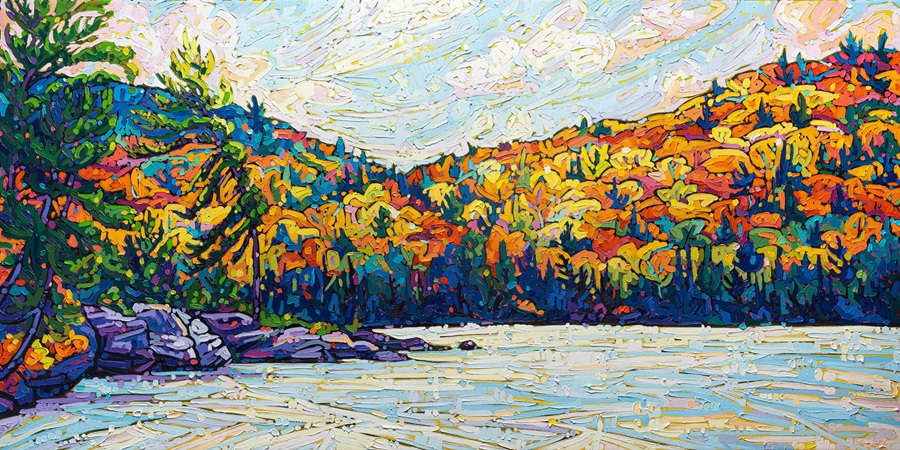
Her signature style, often described as Espresso Impressionism, carries the lift and movement of impressionist tradition but with a modern edge that feels bolder, more decisive, and more intimate at the same time. There is nothing timid in her colour. There is nothing tentative in her choices. Yet the final effect is never chaos. It is controlled vitality. It is energy held in a steady hand. It is the kind of work that looks alive from across a room, then becomes even more impressive when you step closer and realize how intentional every choice was.
Part of what gives her work this uncommon sensitivity is her life experience. Raised in international environments as a diplomat’s child, she developed an early sensitivity to place, atmosphere, and cultural nuance long before most artists even realize that “place” has a personality. Those years created a kind of awareness that doesn’t fade. They gave her a way of seeing beyond one horizon. Her artistic roots were also shaped through years spent in Africa, where close observation of light and colour became second nature. Later, returning to Canada as a teenager, she formed a deep connection to the changing seasons and diverse terrains of North America. Those influences continue to guide her work today, giving it the rare combination of global sensitivity and unmistakable Canadian spirit.
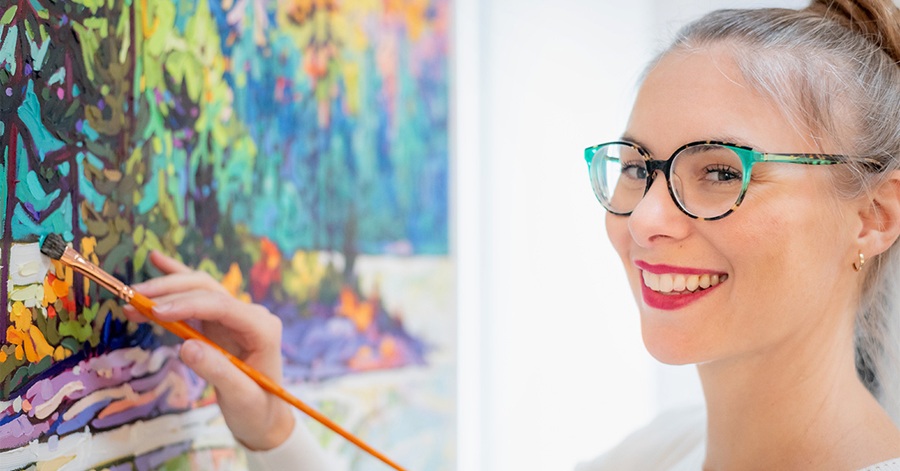
Working with thick, textured oils and bold pre-mixed colours, she captures not just what a landscape looks like, but how it feels in the moment. The pre-mixing alone signals patience and intent, because the painting begins long before the brush touches canvas. Her texture is not a gimmick. It becomes atmosphere. It becomes weather. It becomes the mood of the place itself. Her skies are not “background.” They behave like living systems. The clouds are built like moving air, swirling with softness yet holding structure, like wind you can sense before it touches you. That is craft. That is control. That is an artist who knows exactly what she is doing.
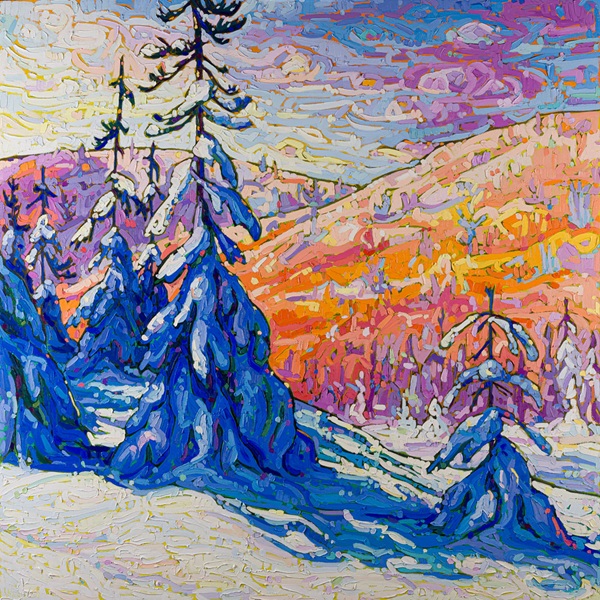
Her colour choices are fearless, yet never reckless. Her blues carry calm, distance, clarity, and the hush that Canada knows so well. Her golds and oranges don’t simply signal autumn, they carry memory and warmth, and that uniquely Canadian ache of knowing beauty can be brief, which is exactly why it becomes sacred. Even her accents of violet, magenta, and ember-red feel purposeful, like sparks placed where the eye needs to wake up. This is colour used as emotion, not decoration. It is a painter’s understanding of psychology as much as it is a painter’s understanding of pigment.
This is why collectors respond to her work the way they do. A painting is not simply “nice.” It is useful in the deepest sense of the word. It has the ability to change how a person feels in a room. That is why people describe these paintings as making a space feel complete and deeply personal. That is why the work doesn’t disappear into the background of a home. It lives there. It steadies the atmosphere. It holds presence. It becomes part of daily life in a way that feels intimate and quietly powerful.
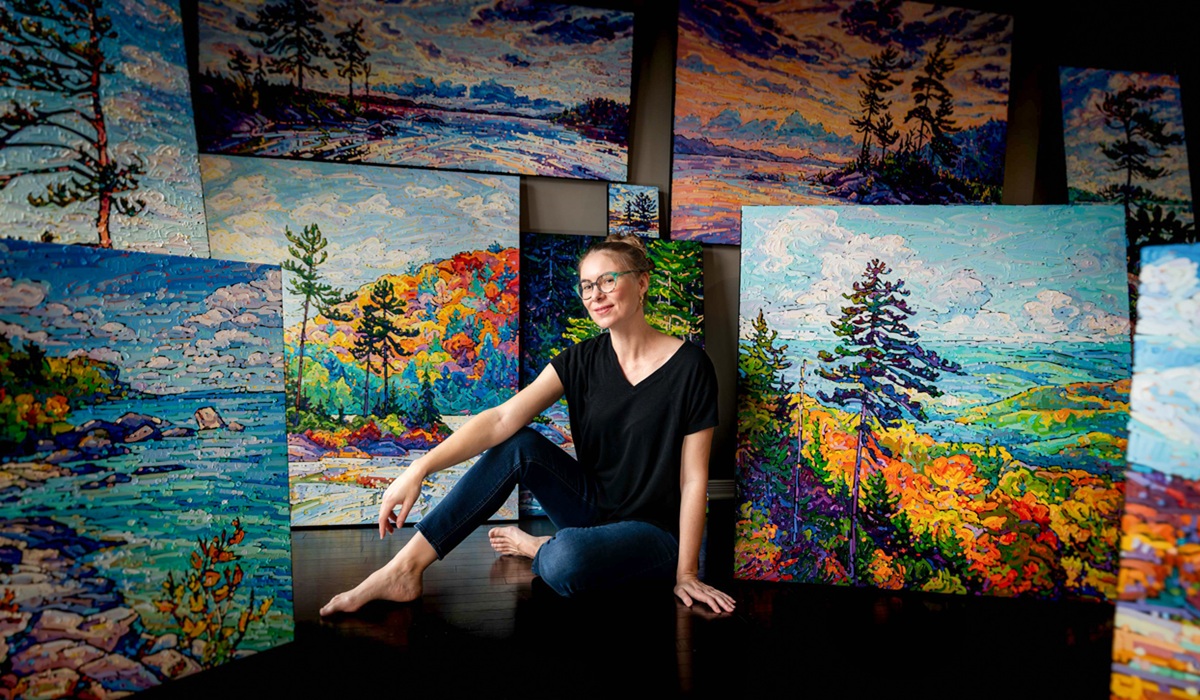
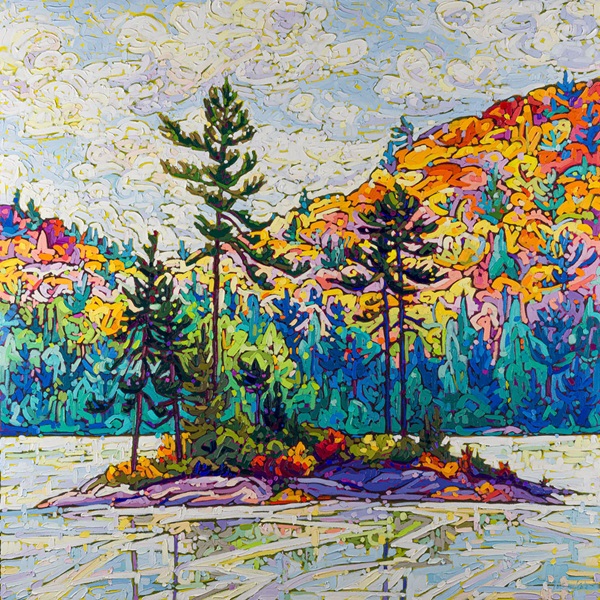
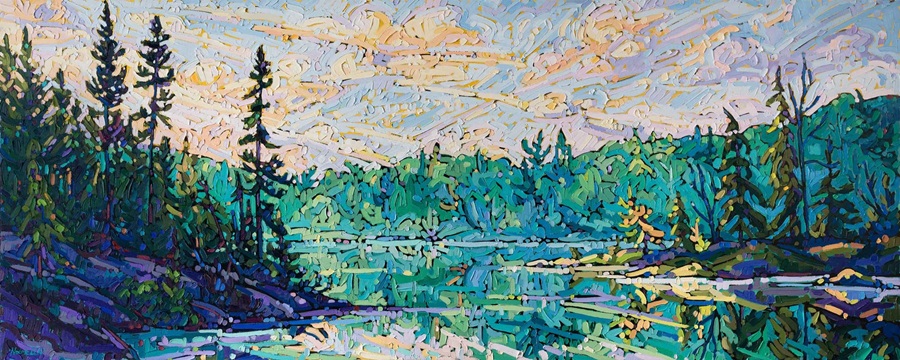
Looking at the paintings in the photo, what stands out immediately is how movement is controlled without losing serenity. The brushwork has momentum, but it never collapses into mess or noise. The surface is sculpted, textured, alive, catching light differently depending on where you stand, making the painting shift subtly with the room’s natural illumination. Step back and you feel the sweep and emotional tone of the scene. Step closer and the craftsmanship takes over, revealing the deliberate placement, the layers of intention, and the confident refusal to overwork what is already speaking.
In one piece, the shoreline acts as an anchor, holding the whole scene steady while everything above it moves. The trees rise like slender sentinels, not dominating the land, but coexisting with it, standing as witnesses to time rather than owners of space. In another, winter is not portrayed as punishment, loneliness, or emptiness. It is luminous stillness, sculpted in deep blues that make the cold feel almost holy. The warmth behind it does not soften the scene, it strengthens it, reminding the viewer that light can exist inside harshness, and calm can be a form of power. In an autumn landscape, the terrain becomes orchestral, layered golds and fire tones rolling across the canvas with such depth and rhythm that it feels like the land is breathing rather than posing.
The accolades attached to her name are not cosmetic. They are evidence that the art world is seeing the same mastery collectors are seeing. Her Maple Leaf Award recognition in 2025 for Western Style Art, her First Place win for CFA Artist of the Year in 2024, the Collectors Art Prize distinction honoring her in 2025, and the Artistic Expression Award from the Society of Canadian Artists in 2024 collectively tell one story. This is not a fleeting moment. This is an artist building something substantial, validated across different juries and institutions, without losing the integrity of her voice.
But perhaps the most telling detail in all of it is her humility. It would be easy for an artist in this position to turn success into distance, to become unreachable, to replace sincerity with image. Her approach feels grounded, almost grateful, as though she understands that art is not merely a product. It is a relationship. Her work is high demand, yet her words remain human, and that is part of why people trust her. She is not chasing attention. She is chasing truth, and the attention follows because the truth is visible on the canvas.
This moment matters, and it feels worth saying out loud in a country that sometimes forgets to celebrate its own greatness until the rest of the world has already done it. Canada does not lack excellence. It has always had it. What we sometimes lack is the instinct to recognize excellence while it is still rising, while the story is still being written in real time.
Noémie L. Côté is one of those artists you do not have to wait on. Her work is already here. It is already collecting people. It is already changing rooms, changing moods, and changing how people carry their days. It is already proving itself across juried exhibitions and private collections. It is already delivering what great art has always promised, which is not escape, but renewal.
And there is something deeply Canadian in the kind of renewal she offers. It is not loud. It is not performative. It is resilient. It is tender. It is the steady beauty of a place that keeps going through winter, keeps making room for spring, and keeps insisting on colour even when the sky tries to take it away.
We are grateful for her time in this interview, because time is a currency that becomes more valuable the more the world asks for it. When an artist is in demand, minutes are not casual anymore. They are precious. So we say thank you, not as flattery, but as acknowledgment of what it takes to keep showing up, to keep producing at a world-class level, and to still speak like a person whose first loyalty is to the work itself.
If you want to understand why collectors choose Noémie, don’t start by asking what her paintings cost. Start by asking what they give. They give a room a heartbeat. They give the ordinary day a moment of elevation. They give people a private refuge that does not require leaving home. They are landscapes, yes, but they are also emotional architecture, built to restore the spirit.
Her work does not just hang on a wall. It holds a standard. It proves that Canadian excellence is not a historical footnote. It is alive right now, painted in colour, built in texture, and offered with the kind of quiet confidence that belongs among the best on any stage in the world.
About The Author