The False Taiwan Invasion Narrative: The US War Economy at Work
- TDS News
- Tiger's Eye Advisory Group - Trending News
- December 28, 2025
By: Donovan Martin Sr, Editor In Chief
The claim that China is on the verge of invading Taiwan has become a permanent fixture of American political and media life. It is framed as urgent, inevitable, and accelerating. Timelines are floated with confidence, language hardens, and speculation is treated as foresight. Yet this intensity remains remarkably localized. Outside the United States and a narrow circle of closely aligned partners, the same sense of immediacy is largely absent. Across much of Asia, the Middle East, Africa, and the Global South, governments continue to speak in measured tones, markets operate on assumptions of continuity, and public rhetoric emphasizes stability rather than countdowns.
That disconnect is not accidental. It is the starting point for understanding why this narrative persists.
One basic historical fact is almost always missing from the discussion. The last time China fought a major war was in 1979, during a brief and limited conflict with Vietnam. For more than four decades, China has not engaged in sustained, large-scale warfare. That does not make China passive or harmless, but it does matter when assessing claims that it is perpetually on the brink of launching one of the most complex amphibious invasions in modern history. Such an operation would target a densely populated, highly developed territory whose destruction would directly undermine China’s own economic and strategic interests.
At the same time, the United States officially maintains a One China policy. This is not ambiguous in name, even if it is ambiguous in practice. Washington does not recognize Taiwan as an independent country. It acknowledges Beijing’s position that there is one China, while maintaining unofficial relations with Taiwan. This framework was deliberately designed to reduce the risk of war by preserving strategic ambiguity.
Yet layered on top of this policy is a separate set of commitments obligating the United States to assist Taiwan in maintaining its self-defense. The contradiction is rarely interrogated. Why does a country that formally acknowledges a One China framework also position itself as Taiwan’s primary external security backer? The answer is not legal coherence; it is leverage. Taiwan has long functioned as a strategic pressure point in U.S.–China relations, a place where ambiguity can be weaponized politically without requiring formal recognition or outright conflict.
For decades, this balancing act held. What has changed is not China’s war record or Taiwan’s political status, but the scale of U.S. global military engagement and the economic structure that sustains it.
Over the past decade, the United States has approved and delivered many billions of dollars in arms to Taiwan. These sales have steadily increased in both size and frequency. Recently, a new arms package valued at roughly eleven billion dollars is set to be presented to Congress. This proposed sale does not replace previous ones; it sits on top of an already substantial pipeline of weapons transfers, support systems, and long-term servicing contracts.
The justification is always framed as defensive deterrence. But the strategic reality is unavoidable. No amount of U.S. weapons supplied to Taiwan could enable it to defeat China in a full-scale war. This is not a controversial claim inside serious military planning circles; it is an accepted assumption. Geography alone makes the idea implausible. China’s proximity, industrial capacity, and missile forces would overwhelm Taiwan in any direct confrontation, regardless of how advanced the supplied systems might be.
U.S. policymakers understand this. Taiwan’s leadership understands this. China understands this. The arms are not intended to secure victory. They serve political, economic, and symbolic purposes.
To understand why, Taiwan cannot be viewed in isolation. It must be placed within the broader reality of U.S. military posture.
The United States is currently involved, directly or indirectly, in an extraordinary number of conflicts and military operations. It plays a central role in the war in Ukraine, supplying weapons, intelligence, logistics, and training while privately acknowledging that Ukraine is unlikely to achieve a decisive military victory over Russia. It continues to supply arms, logistics, and military support to Israel amid ongoing regional conflicts. It conducts counterterrorism operations and air campaigns across parts of the Middle East and Africa, including ongoing operations in countries such as Somalia. It has expanded military pressure and signaling in the Indo-Pacific, deepening defense coordination with Japan and the Philippines while intensifying freedom-of-navigation operations. It has maintained aggressive posturing toward Venezuela. All of this sits atop a global network of more than 800 military bases and installations, unmatched by any other country.
This is not a posture of restraint. It is a posture of constant engagement.
The U.S. military is vast, but it is also stretched thin. Managing overlapping commitments across Europe, the Middle East, Africa, and the Pacific places sustained strain on personnel, equipment, and political bandwidth. In such an environment, the emergence of a new “imminent” threat is not just a security concern; it is a financial and institutional opportunity.
This is where money becomes the connective tissue that explains the persistence of the Taiwan invasion narrative.
Defense contractors benefit directly from heightened threat perceptions. Large arms packages generate immediate revenue and decades of follow-on contracts for maintenance, upgrades, and replenishment. These companies lobby aggressively for expanded sales, presenting them as essential to deterrence. In return, they fund political campaigns, support policy research, and maintain close relationships with lawmakers and officials.
Think tanks translate these interests into authoritative language. Their reports warn of narrowing windows, eroding deterrence, and urgent timelines. These messages are then amplified by media outlets that benefit from fear-driven engagement and continued access to power. The narrative spreads across both right-leaning and left-leaning media, tailored to different audiences but pointing toward the same conclusion: more arms, more urgency, more spending.
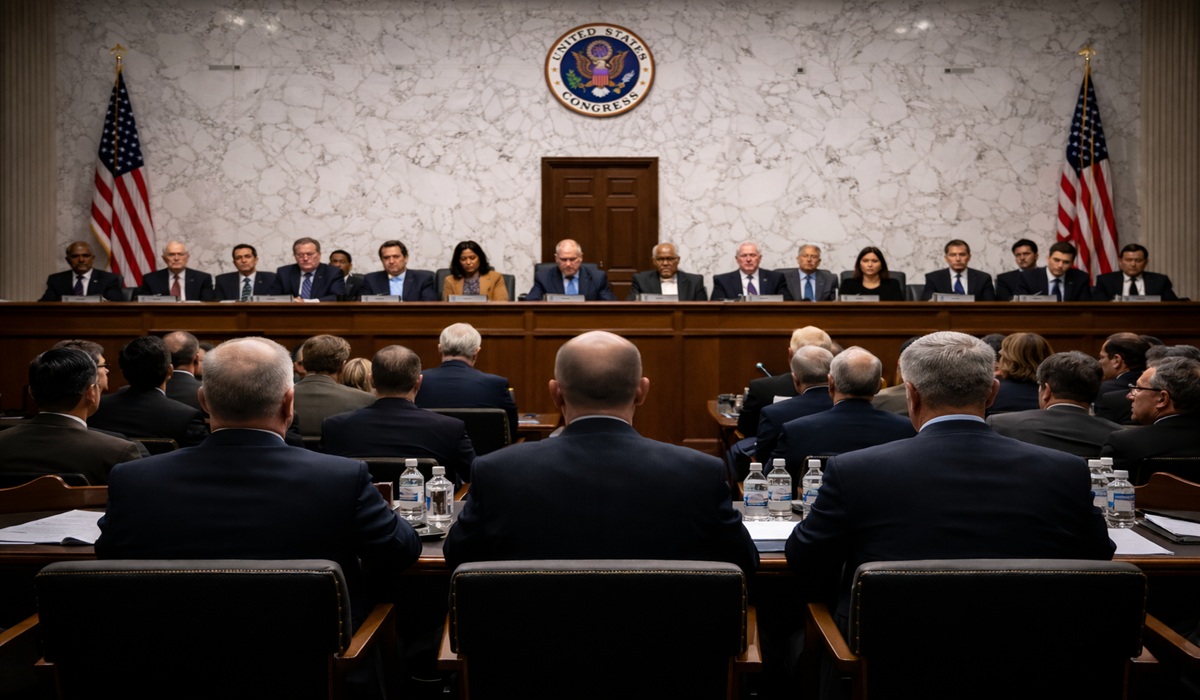
Congress enters the process late. By the time a major arms sale reaches the floor, opposition has already been framed as irresponsible or dangerous. Yet Congress itself has been steadily sidelined as a meaningful check on executive power. Under the current Trump administration, executive authority has routinely bypassed legislative oversight. In this context, congressional approval functions less as deliberation and more as procedural validation.
Once the deal moves forward, the cycle completes itself. Contractors profit. Politicians receive campaign support. Experts gain visibility. Media outlets sustain engagement. The system rewards escalation even when escalation increases risk.
This is where the contradiction becomes unavoidable.
Donald Trump has repeatedly presented himself as a president of peace, a leader opposed to endless wars. Yet under his administration, the United States has expanded bombing campaigns, loosened rules of engagement, escalated proxy conflicts, accelerated arms sales to historic levels, deepened military involvement in Ukraine, sustained large-scale military support for Israel, intensified pressure campaigns in Latin America, and heightened military signaling across the Indo-Pacific.
This is not the dismantling of the war machine. It is its rebranding.
The modern system no longer requires formal declarations of war. Conflict is fragmented, outsourced, and financially abstracted. Bombing becomes counterterrorism. Arms sales become deterrence. Proxy wars become support for sovereignty. Each action is rhetorically isolated, even as together they form a near-constant state of global military engagement.
Taiwan fits cleanly into this model. It allows the United States to posture as defensive while accelerating weapons sales, to claim stability while manufacturing urgency, and to invoke peace while preparing for a conflict it openly acknowledges cannot be won outright. The invasion narrative is not about readiness; it is about justification.
The deeper danger is not that analysts discuss risk. It is that a system built on money, messaging, and political survival steadily narrows the space for restraint. When fear becomes profitable, restraint becomes invisible. When presidents can claim peace while enabling conflict, accountability dissolves.
Nobody truly wants a war over Taiwan. Not China. Not Taiwan’s population. Not the global economy. And despite the rhetoric, not the United States. But history shows that wars do not begin only because they are desired. They begin when narratives harden, incentives align, and political systems lose the ability to step back.
The most dangerous moment is not when a country prepares for war. It is when it convinces itself that war is inevitable, manageable, or economically necessary.
That is the real alarm.
Not that China will invade Taiwan tomorrow—but that a global system driven by money and momentum is conditioning the world to accept conflict as normal, even as it tells itself it is acting in the name of peace.
What gets lost in all of this is the quiet reality that peace is not passive. Peace requires discipline, patience, and a willingness to accept uncertainty rather than monetize it. Strategic ambiguity was never meant to be a weakness; it was meant to be a buffer against miscalculation. When ambiguity is replaced with constant escalation rhetoric, the buffer erodes. Red lines blur. Signals get misread. History shows that wars between major powers rarely begin with clear decisions—they begin with accumulated pressure, hardened assumptions, and leaders boxed in by narratives they no longer control.
The people who pay the price are never the ones who profit from the rhetoric. It is not defense executives, politicians, or media personalities who absorb the consequences of escalation. It is civilians, workers, families, and entire regions whose futures are disrupted by conflicts they neither voted for nor benefit from. Taiwan’s population does not want to become a battlefield. The Chinese public does not want a war that collapses economic stability. The global economy, already strained, cannot absorb another manufactured crisis without lasting damage. Peace, in this context, is not idealism—it is the only rational outcome.
The final danger is normalization. When conflict is framed as constant, manageable, and inevitable, societies stop resisting it. War becomes background noise. Arms sales become routine. Escalation becomes policy instead of failure. That is the moment when systems built on money and momentum override human judgment. The real task now is not predicting invasion dates or approving larger weapons packages, but restoring the political courage to de-escalate, to question incentives, and to remember that peace is not achieved by preparing endlessly for war—but by refusing to let profit-driven fear decide humanity’s future.
About The Author