“President of Peace” Trump Bombs Nigeria, Testing His Own Promise
- TDS News
- Tiger's Eye Advisory Group - Trending News
- December 27, 2025
By: Donovan Martin Sr, Editor in Chief
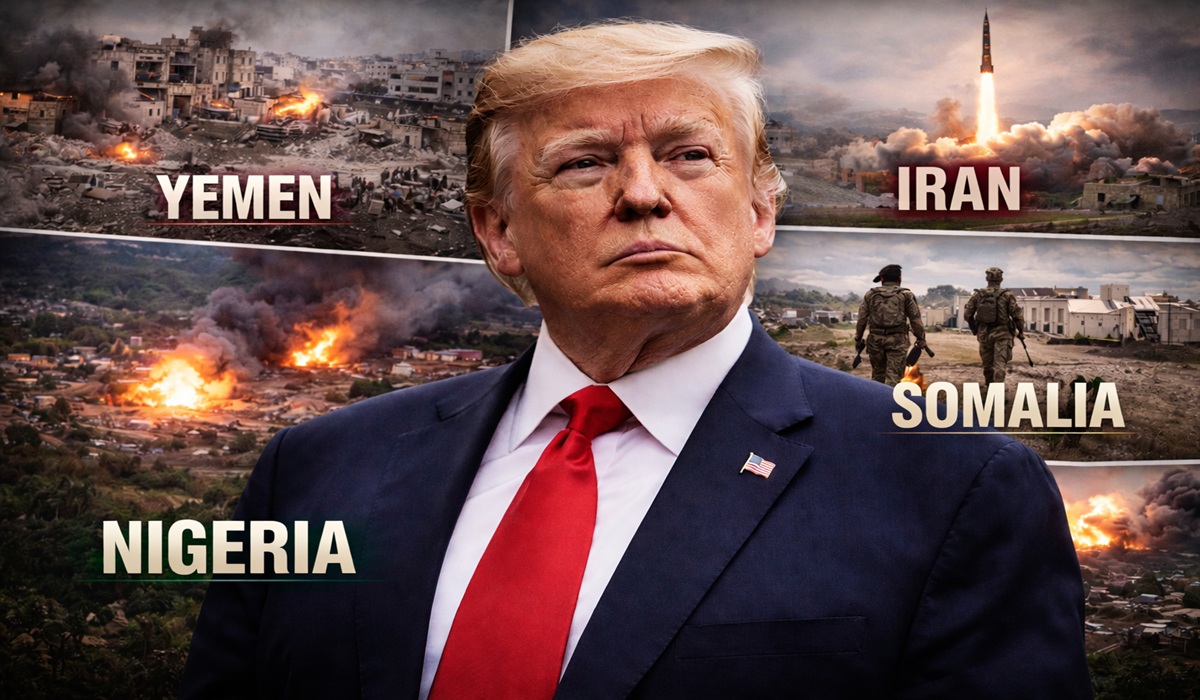
For much of the past half-century, United States foreign policy has followed a recurring pattern: moral justification paired with strategic consequence. Each intervention is framed as necessary, urgent, and exceptional. Each is presented as a break from past failures. Donald Trump entered office explicitly rejecting that tradition. He repeatedly described himself as a president of peace, criticized previous administrations for endless wars, and promised to keep the United States out of foreign conflicts that did not directly threaten American security.
That framing matters, because it establishes the standard by which his administration’s authorization of military action in Nigeria must be judged.
The stated justification rests on two claims: the persecution of Christians and the need to eliminate ISIS-linked extremist groups. Both concerns are real. Religious violence exists in Nigeria. Extremist groups exploit instability. Civilians are killed. None of this is disputed. What is disputed is whether Nigeria represents a unique case warranting U.S. military intervention, and whether the public rationale aligns with the facts on the ground.
Nigeria’s violence is not a simple Christian-versus-Muslim conflict. It is driven by insurgency, criminal banditry, land disputes, governance failure, and corruption. While Christians have been targeted in specific attacks, particularly in central regions, overall casualty data complicates the persecution narrative. More Muslims have died in Nigeria’s conflicts than Christians. This is a demographic reality, not an ideological claim. The violence is regional and political before it is religious.
When viewed globally, the selectivity becomes difficult to ignore. Christians are persecuted in numerous countries. In Syria, Christian communities have suffered devastating losses during the civil war, proportionally greater than those seen in Nigeria. Yet the Trump administration hosted Syria’s president at the White House despite his role in mass civilian casualties. When Israeli airstrikes damaged a Christian church, there was no U.S. threat of intervention. In Pakistan, Egypt, Iraq, and parts of Central Asia, Christian persecution continues with limited diplomatic response and no military action.
This inconsistency does not negate the suffering of Nigerian Christians. It raises a more fundamental question: why Nigeria, and why now?
The counterterrorism justification also demands historical clarity. ISIS did not emerge in isolation. Its origins trace directly to the destabilization of Iraq following the 2003 U.S.-led invasion. The dismantling of Iraqi state institutions, particularly the army, created a pool of trained, alienated men who later formed the backbone of insurgent movements. Al-Qaeda in Iraq, from which ISIS evolved, thrived because the state collapsed.
The United States did not single-handedly create ISIS, but it played a decisive role in creating the conditions that allowed it to grow. Regime change, proxy warfare, arms proliferation, and intelligence failures all contributed. That history matters when counterterrorism is again used to justify military action.
Nigeria is not militarily incapable. It has one of the largest armed forces in Africa and decades of experience fighting insurgent groups. If the objective were narrowly defined as eliminating militants, Nigeria could act independently. U.S. involvement points to broader strategic considerations.
Geography is central to understanding those considerations. Nigeria sits at a critical crossroads. To its north lies Niger, rich in uranium and other strategic minerals essential for modern energy systems and defense technologies. Beyond Niger lie Mali and Burkina Faso, now part of the Alliance of Sahel States formed after the removal of French-backed governments. Under Burkina Faso’s Captain Ibrahim Traoré, these states expelled French forces, rejected Western military oversight, and withdrew from ECOWAS.
ECOWAS was originally established as an economic bloc to promote regional integration. Over time, it evolved into a political enforcement mechanism aligned closely with Western interests. Nigeria, as its dominant power, was prepared to intervene militarily against the Sahel states following their coups. That plan collapsed under practical realities. Such a war would have endangered Nigeria’s oil pipelines, shipping routes, and internal stability.
Recent events underscore the shift. Nigerian forces entered Burkina Faso’s airspace under the pretext of stopping a coup and were forced to land, exposing Nigeria’s diminished regional leverage. The Sahel states are no longer passive. They are armed, politically unified, and openly resistant to Western influence.
A U.S. military presence in Nigeria, framed as assistance, places Washington closer to Niger’s mineral wealth and nearer to governments that have rejected Western security arrangements. Statements from AFRICOM leadership criticizing Captain Traoré echo rhetoric previously used against leaders in Libya and Iraq—language that historically preceded destabilization rather than stability.
The domestic narrative in the United States did not develop organically. Weeks before the operation, a Christian advocacy organization appeared on Fox News highlighting persecution in Nigeria. The issue circulated widely. Trump later tweeted that the United States “may have to go in” if Nigeria failed to protect Christians. The sequence matters. Moral justification was established before military action was authorized.
This approach follows a familiar pattern. Iraq was framed around weapons of mass destruction. Afghanistan around counterterrorism and nation-building. Libya around humanitarian protection. In each case, intervention produced prolonged instability and weakened state institutions. Iraq’s oil, Afghanistan’s mineral deposits, Libya’s energy infrastructure, and Syria’s oil fields all became strategic considerations after the fact. Ukraine’s agricultural land and energy assets are now part of similar geopolitical calculations. The pattern is consistent.
Nigeria fits into this history uncomfortably well.
The country’s corruption is longstanding and documented. Oil wealth has enriched elites while public services deteriorated. Allegations surrounding Nigeria’s current president—including claims related to financial misconduct and academic irregularities—have circulated internationally for years. Whether every allegation is provable is secondary to the political reality: Nigeria’s leadership depends heavily on Western legitimacy and security partnerships, making it a cooperative ally.
The broader geopolitical context reinforces the stakes. The expansion of BRICS, the erosion of dollar dominance, and the Sahel states’ rejection of Western military presence challenge existing power structures. Argentina’s abrupt retreat from BRICS alignment followed pressure amid concerns over control of lithium, agriculture, and energy resources. Venezuela’s oil has been extracted through sanctions and seizures. Syria’s oil continues to be produced under foreign military protection. These are not isolated cases.
None of this requires assuming uniquely malicious intent. States act in their perceived interests. Humanitarian concern and strategic calculation often coexist. The issue is not whether the United States should care about violence in Nigeria. It should. The issue is whether military intervention will reduce that violence or entrench another cycle of dependency, instability, and external leverage.
For Donald Trump, the contradiction is no longer theoretical. A president elected on the promise of ending wars has authorized force. A leader who condemned interventionism now relies on its language. That contradiction will not be resolved by speeches or tweets, but by outcomes on the ground.
If Nigeria stabilizes, protects civilians, and retains sovereignty over its political and economic future, the intervention will be defended as necessary. If it fractures further, becomes militarized beyond its control, or sees its resources leveraged by foreign interests while violence persists, the justification will collapse under the weight of precedent.
History is unforgiving. Iraq, Afghanistan, Libya, and Syria were all sold as limited, moral, and strategic. None remained so. Each left behind weakened institutions and long-term instability.
Nigeria is not Iraq. The Sahel is not the Middle East. But patterns do not require identical conditions to repeat themselves. They require only familiar incentives and unchallenged assumptions.
The question is no longer whether the United States can intervene in Nigeria. It already has. The question is whether this intervention marks a genuine departure from past failures—or whether it will be added to the record of conflicts explained in noble terms and remembered for their consequences.
Because once bombs fall, intentions stop mattering. Outcomes do.
And those outcomes will define not only Nigeria’s future, but the credibility of every claim made in the name of peace.
About The Author