Why the BNP Succeeded After the Revolution — and Why the Student Bloc Failed
- Naveed Aman Khan
- Trending News
- South Asia
- February 15, 2026
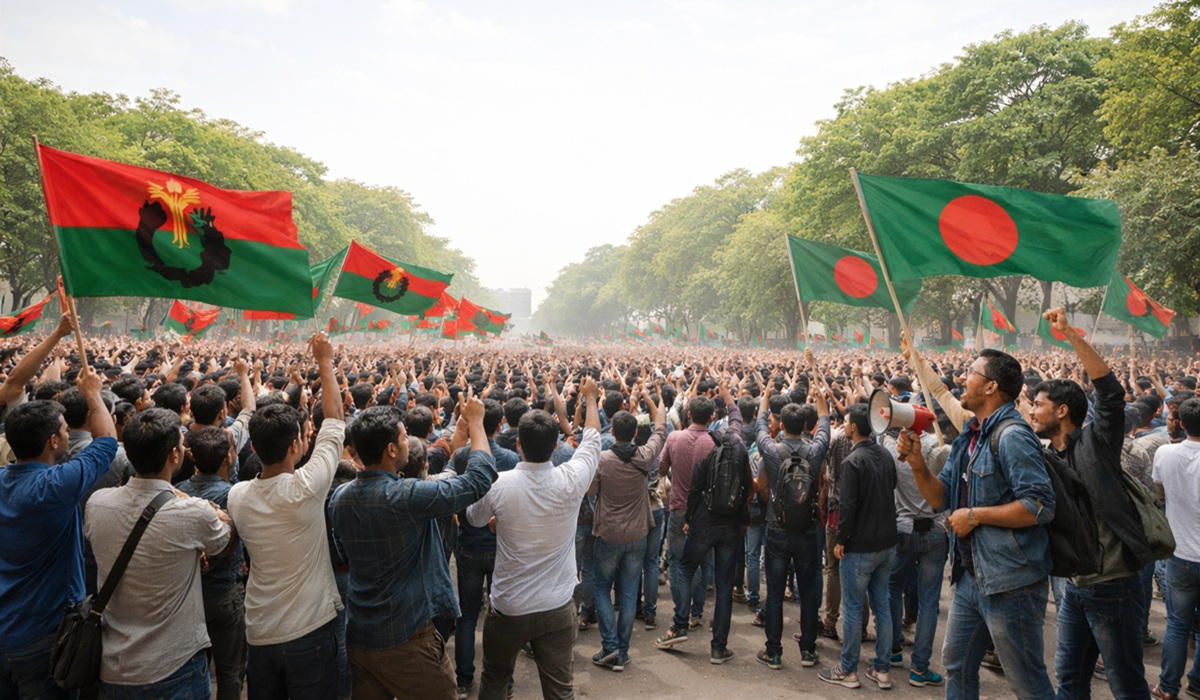
Bangladesh’s recent general elections have ushered in a new phase in South Asian politics. The results delivered a clear victory to the Bangladesh Nationalist Party (BNP), while the student movement that had mobilized vigorously against Sheikh Hasina failed to translate its street momentum into meaningful electoral gains. This contrast underscores a fundamental political reality: protest popularity and electoral success operate in different arenas. What resonates powerfully in public squares does not necessarily carry the same force inside the ballot box. Understanding this distinction is key to interpreting the outcome of this electoral contest.
It would be overly simplistic to attribute the BNP’s victory solely to anti-incumbent sentiment. The party has spent decades cultivating an extensive organizational network that stretches from rural union councils to urban wards. In a country where a majority of the population still resides in rural areas, local influence, community ties, and personal relationships play a decisive role in shaping voter behavior. The BNP effectively activated these networks. By centering its campaign on inflation, unemployment, and economic stagnation, it positioned itself as a stable and experienced alternative. This message resonated particularly with the middle class and small business owners seeking predictability after prolonged political turbulence.
By contrast, the student movement’s energy remained largely concentrated in urban centers and on social media platforms. Protest politics thrives on passion, symbolism, and moral clarity; electoral politics, however, depends on candidate selection, polling infrastructure, grassroots mobilization, and financial resources. The student bloc lacked a nationwide organizational structure and a comprehensive economic program capable of persuading rural voters. While it succeeded in establishing itself as a powerful voice for change, doubts persisted regarding its readiness to govern.
The role of the political and economic elite also shaped the outcome. Business leaders and segments of the bureaucracy tend to favor options that promise policy continuity and institutional stability. The BNP presented itself as a guarantor of such continuity. In contrast, the students’ platform of structural reform and accountability generated uncertainty among influential stakeholders. As a result, financial and media support tilted toward the BNP, creating a tangible advantage during the campaign.
The broader state environment cannot be ignored either. In Bangladesh, administrative and security institutions have historically influenced political atmospheres, even when remaining formally neutral. Stability and predictability often emerge as implicit priorities within centers of power. As an established and organized political force, the BNP appeared more aligned with these priorities, whereas the student bloc struggled to secure comparable institutional confidence.
This raises a critical question: What did the student movement ultimately achieve? It gained national recognition, reshaped public discourse, and brought youth politics into the mainstream. Yet converting political visibility into parliamentary seats requires two essential components: a clear policy blueprint—particularly on economic and foreign affairs—and a nationwide party structure. Both remained underdeveloped. In times of economic strain and regional uncertainty, voters often gravitate toward experienced leadership. Concerns about exports, foreign exchange reserves, and diplomatic balance made many citizens wary of entrusting governance to an untested force.
The BNP’s electoral strategy was also more methodical. It strategically nominated locally influential candidates and forged regional alliances to prevent vote fragmentation. Meanwhile, the student bloc faced internal disagreements and leadership challenges. Social media popularity proved insufficient to replace door-to-door outreach and election-day organization, which remain critical in South Asian political culture.
Ultimately, the success or failure of a revolution depends on its objectives. If the aim was merely to disrupt entrenched power structures, the movement achieved partial success. But if the goal was to construct an entirely new political culture and dismantle elite dominance, that process remains incomplete. History suggests that transforming a movement into a durable political force often requires years of institution-building, policy development, and cadre training.
This election reaffirms a fundamental lesson: political change may begin in the streets, but it is consolidated through institutions and ballots. The BNP’s victory reflects disciplined organization, a focused economic message, and alignment with institutional preferences. The student bloc’s defeat, meanwhile, highlights the difficulty of converting revolutionary fervor into sustainable political power. For now, Bangladesh’s political landscape has returned to established actors—but the aspirations that fueled the movement have not disappeared.
About The Author