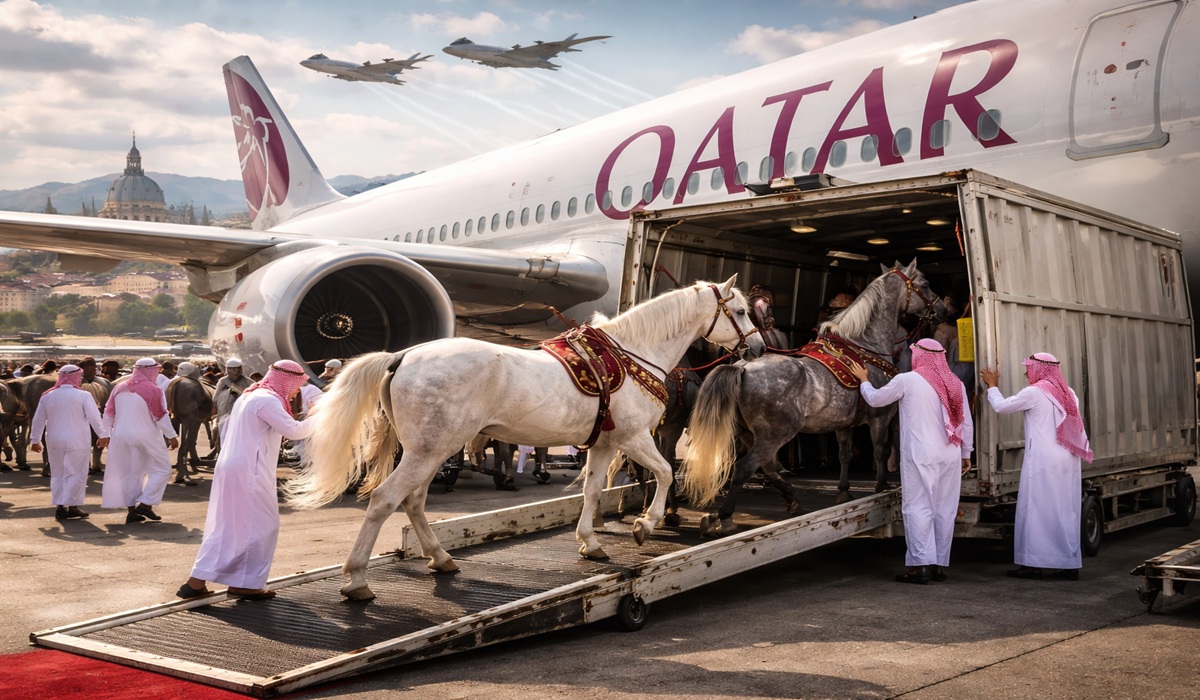
The Middle East once again finds itself at an historic crossroads, where war, fear, power, and survival intertwine in complex and often unpredictable ways. The recent emergency relocation of 147 high-value show jumping horses from Qatar to Belgium appear, at first glance, to be a logistical or sporting matter. However, beneath the surface, it reflects a deeper geopolitical anxiety that is gripping the Gulf region. Due to the ongoing war in the ME, Qatar Airways has moved 18 of its passenger aircrafts to Teruel Airport in Spain for safekeeping. The aircrafts being moved include A380, A330, A350, Boeing 747, 789. Teruel Airport, opened in 2013, is Europe’s largest industrial aerospace platform.
This unusual incident raises a critical question: does this move signal growing fear among the ruling elites of Gulf monarchies such as Qatar, Kuwait, Bahrain, and the United Arab Emirates? And more importantly, could it be an early indicator of a broader pattern of elite asset relocation—or even potential political instability?
The escalating tensions between Iran and the United States–Israel axis have placed the Gulf in a precarious position. Iran’s military doctrine has long been rooted in asymmetric warfare, relying on missiles, drones, and proxy networks rather than conventional large-scale engagements. In any prolonged conflict, Gulf states—due to their proximity and strategic alignment with the United States—are likely to become primary targets.
This vulnerability is not theoretical. Many Gulf countries host American military bases, making them integral components of Washington’s regional security architecture. From Tehran’s perspective, these installations are legitimate targets in the event of war. Thus, the Gulf is not merely a bystander but a potential battlefield.
In this context, the evacuation of elite horses begins to look less like a routine precaution and more like a symbol of elite anxiety. Historically, when ruling classes begin moving valuable assets abroad, it often precedes periods of instability. From Iraq to Libya, such patterns have served as early warning signs of deeper political change.
However, drawing a direct parallel between those cases and the Gulf monarchies would be analytically flawed. The political systems in Qatar, UAE, Bahrain, and Kuwait differ significantly from republics like Iraq or revolutionary states like Iran. Gulf monarchies are built on a combination of tribal legitimacy, economic prosperity, and strong security apparatuses. Their citizens generally benefit from high standards of living, which reduces the likelihood of internal uprisings.
Moreover, global powers have a vested interest in maintaining stability in the Gulf. The region is central to global energy markets, and any disruption would have far-reaching economic consequences. This external support acts as a buffer against regime collapse.
The comparison with Iran is also instructive. Despite decades of sanctions, military threats, and covert operations, the Iranian regime has proven remarkably resilient. Its ideological foundation and internal power structures have allowed it to withstand immense pressure. The failure of the United States and Israel to achieve regime change in Iran does not necessarily imply that Gulf regimes are more vulnerable—if anything, their alliance with Western powers may enhance their survival prospects.
So, is the relocation of these horses the beginning of a broader elite exodus? The evidence suggests otherwise. It is more plausibly an example of risk management rather than panic-driven flight. These horses are not just animals; they are multi-million-dollar investments and elite athletic assets. Ensuring their safety during a period of heightened uncertainty is a rational decision.
Symbolism matters in geopolitics. The movement of such high-value assets does send a psychological signal. It reflects an awareness among Gulf elites that the regional security environment is deteriorating. Fear—whether acknowledged or not—is becoming a factor in decision-making.
If the conflict between Iran and the US–Israel nexus escalates into a sustained war the consequences for the Gulf could be severe. Missile strikes, drone attacks, and disruptions to oil infrastructure could destabilize economies and undermine investor confidence. In such a scenario, elite asset relocation may intensify—not just of horses, but of capital and even families.
However, idea that Gulf rulers themselves might flee their countries remains highly speculative. These regimes are deeply entrenched, supported by powerful security institutions and international alliances. Unlike leaders in fall states, Gulf monarchs have both the resources and the support to maintain control.
A more nuanced possibility is the gradual externalization of wealth and risk. This would not constitute regime collapse but rather a hedging strategy against uncertainty. In other words, rulers may prepare for worst-case scenarios without abandoning their positions.
The transfer of Qatar’s elite horses should not be interpreted as the beginning of regime change in the Gulf. It is a signal—but not of imminent fall . It highlights the growing tension and the subtle ways in which geopolitical risk is shaping elite behavior. The real question is not whether horses are leaving, but whether stability itself is quietly being relocated. If diplomacy fails and conflict intensifies, the Middle East could witness shifts not just in military alignments, but in the very structure of power across the region. For now, the Gulf remains stable—but increasingly cautious. And in geopolitics, caution is often the first sign that something deeper is unfolding beneath the surface.
About The Author