By: Donovan Martin Sr, Editor in Chief
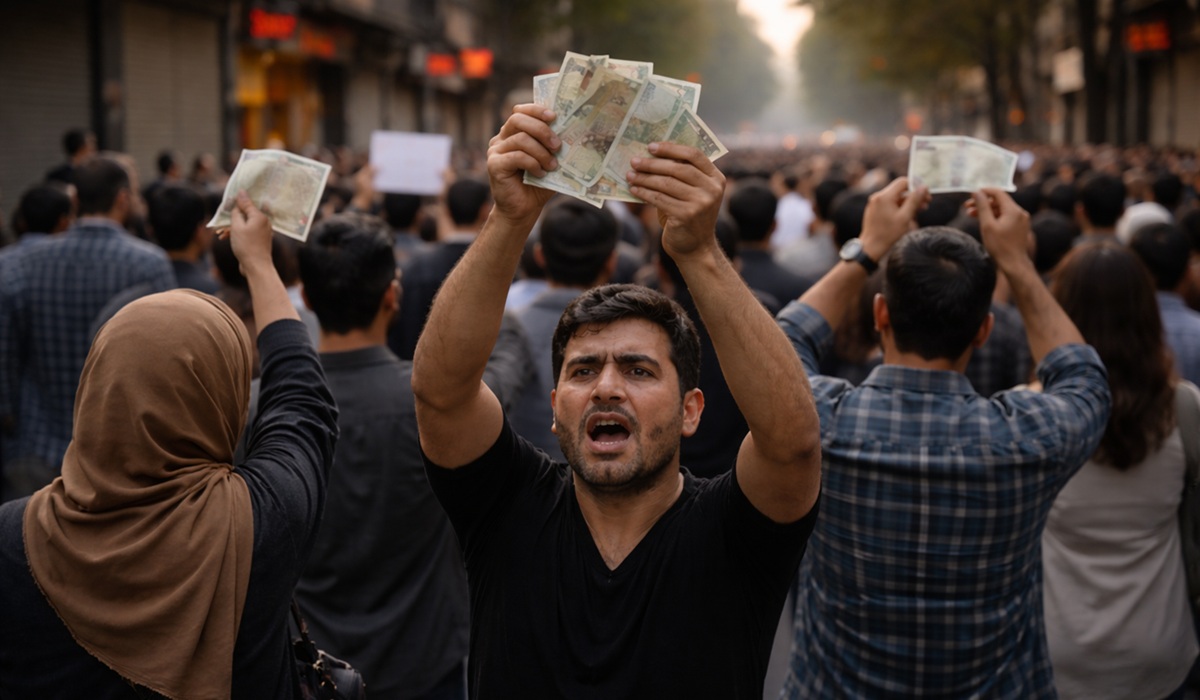
The current protests unfolding across Iran did not begin with ideology, factional politics, or sudden calls for revolution. They began with the currency. As the rial slid sharply in value, everyday life became immediately more expensive. Wages lagged behind prices, savings evaporated, imports became unaffordable, and confidence in the economy collapsed. Shopkeepers closed their doors, workers walked out, and families who had already endured years of pressure reached a breaking point. The crowds in the streets were responding first and foremost to a material reality: the money they earned no longer worked.
That currency collapse is the lead, not a footnote. It is also the most predictable outcome of a long-running strategy of economic pressure directed at Iran by America and its allies, layered over decades of historical intervention, isolation, and coercion. What is happening now is not spontaneous. It is the visible moment when economic warfare translated into social rupture.
Iran’s modern relationship with Western power has been shaped by intervention since the mid-20th century. The 1953 overthrow of Iran’s elected government established a precedent that economic independence and political autonomy would not be tolerated if they conflicted with external interests. That legacy never fully disappeared. It evolved. Overt coups gave way to sanctions, financial isolation, information warfare, and pressure through international systems controlled by Western powers.
Over the past two decades, this strategy has become increasingly explicit. Economic pressure was no longer framed as a side effect of diplomacy but as the primary mechanism for forcing change. Sanctions were designed to target the foundations of Iran’s economy: oil exports, banking access, shipping insurance, foreign reserves, and participation in global financial systems. Each layer reduced hard currency inflows. Each restriction made the rial more vulnerable. The goal was not ambiguity. Officials spoke openly of making normal economic life impossible.
The consequences were cumulative. Oil revenues declined sharply. Access to international banking narrowed. Importers struggled to secure dollars and euros. As foreign currency became scarce, the rial weakened. Inflation accelerated. Essential goods rose in price. Confidence drained from the market. Currency collapse is as much psychological as mathematical, and once trust erodes, devaluation feeds on itself. What Iran experienced was not mismanagement alone; it was pressure applied at structural choke points.
America and allied states understood this dynamic well. Economic documents, treasury briefings, and policy statements repeatedly emphasized that sustained pressure would strain governance and test social cohesion. The suffering of ordinary people was acknowledged, even anticipated, and framed as leverage. This is not a hidden record. It is stated plainly in official language.
The intelligence dimension of this pressure did not take the form of agents directing crowds or staging protests. Modern destabilization rarely works that way. Instead, it operates by shaping the environment in which unrest becomes likely and sustainable. Over years, Western governments funded Persian-language media, expanded external broadcasting, supported civil society networks abroad, and invested heavily in digital tools that allowed communication beyond state controls. These programs were openly budgeted and publicly defended as support for freedom of expression.
When the rial collapsed and protests erupted, this infrastructure mattered. Demonstrations spread quickly, images circulated widely, and coordination persisted despite restrictions. That does not mean protesters were acting on foreign instruction. Their anger was real and rooted in lived experience. But the channels that amplified that anger had been deliberately strengthened long before the first shop shuttered its doors.
The role of international agreements is central to understanding why the currency shock was so destabilizing. The nuclear deal temporarily reconnected Iran to the global economy. Trade resumed cautiously. Investment returned. The rial stabilized. Public expectations shifted. For many Iranians, it marked the first glimpse of economic normalcy in years. When America withdrew from that framework and encouraged allies to follow, it did so with full awareness of what would follow. Contracts collapsed. Capital fled. Expectations were violently reversed. The psychological shock was as damaging as the financial one.
Attempts by Iran to mitigate this reversal through memoranda of understanding and alternative partnerships with non-Western states faced a further obstacle: secondary sanctions. These measures were specifically designed to punish third parties for engaging economically with Iran. Even informal agreements became liabilities. As a result, Iran’s options narrowed further, reinforcing currency instability and accelerating devaluation.
The protests that followed were therefore not sudden awakenings. They were the point at which years of accumulated pressure became unbearable. Currency-driven unrest is historically among the most volatile forms of protest because it cuts across class, ideology, and region. Merchants, laborers, students, and pensioners are all affected simultaneously. In Iran, the falling rial turned economic anxiety into collective action.
It is important to be precise here. America and its allies did not invent Iran’s internal problems; political constraints existed independently. But external pressure magnified every weakness. It restricted the state’s ability to respond, limited policy flexibility, and ensured that economic shocks landed with maximum force. When people protested, they were reacting to immediate hardship, not abstract geopolitics. Yet the conditions that produced that hardship were shaped deliberately.
Historical continuity matters. Iran has experienced this cycle before: external pressure, internal strain, public unrest, and intensified confrontation. Each phase reinforces the next. What has changed is the sophistication of the tools. Financial systems now function as weapons. Currency markets become battlefields. Information flows shape perception in real time. Regime change no longer requires tanks or coups; it relies on making governance unsustainable.
None of this was concealed. Western policymakers repeatedly stated that sustained economic pain would increase internal pressure and force transformation. They described this as strategic necessity. Whether one views it as legitimate statecraft or collective punishment depends on perspective, but the intent was clear.
Reducing the protests to foreign orchestration alone would be inaccurate and dismissive of Iranian agency. The people in the streets are not actors in someone else’s script. They are responding to collapsing purchasing power, shrinking opportunity, and a future that feels increasingly constrained. At the same time, ignoring the role of external strategy would be equally misleading. The rial did not fall in a vacuum. It fell under sustained pressure designed to make that outcome likely.
What is unfolding now is the convergence of history, economics, and strategy. The collapse of the currency was the spark, but the fuel was decades in the making. Economic warfare weakened the foundations. Information infrastructure shaped how unrest spread. Diplomatic reversals shattered expectations. Secondary sanctions closed escape routes. When the rial fell, the streets filled not because of a sudden ideological shift, but because daily survival had become harder overnight.
Iran’s current unrest is therefore best understood not as an anomaly, but as the predictable outcome of a long-running confrontation conducted through markets, money, and pressure rather than open conflict. The consequences are visible in prices, protests, and public squares. Whether this strategy achieves its stated goals remains uncertain. What is clear is that the moment Iran is living through was neither accidental nor unforeseen. It is the result of deliberate choices, historical patterns, and an economic war whose front lines run through ordinary lives.
About The Author