For most of modern history, data has been something we stored close to where we lived. First in filing cabinets, then in server rooms, then in sprawling industrial-scale data centers scattered across deserts, cities, and remote cold regions. Artificial intelligence has changed the scale of that equation. AI does not merely store information; it consumes energy, generates heat, and demands constant, uninterrupted computation at a level humanity has never experienced before. As those demands accelerate, a once-theoretical idea is now being discussed seriously in engineering, defense, and scientific circles: placing AI data centers beyond Earth itself, in orbit, on the Moon, or eventually on Mars.
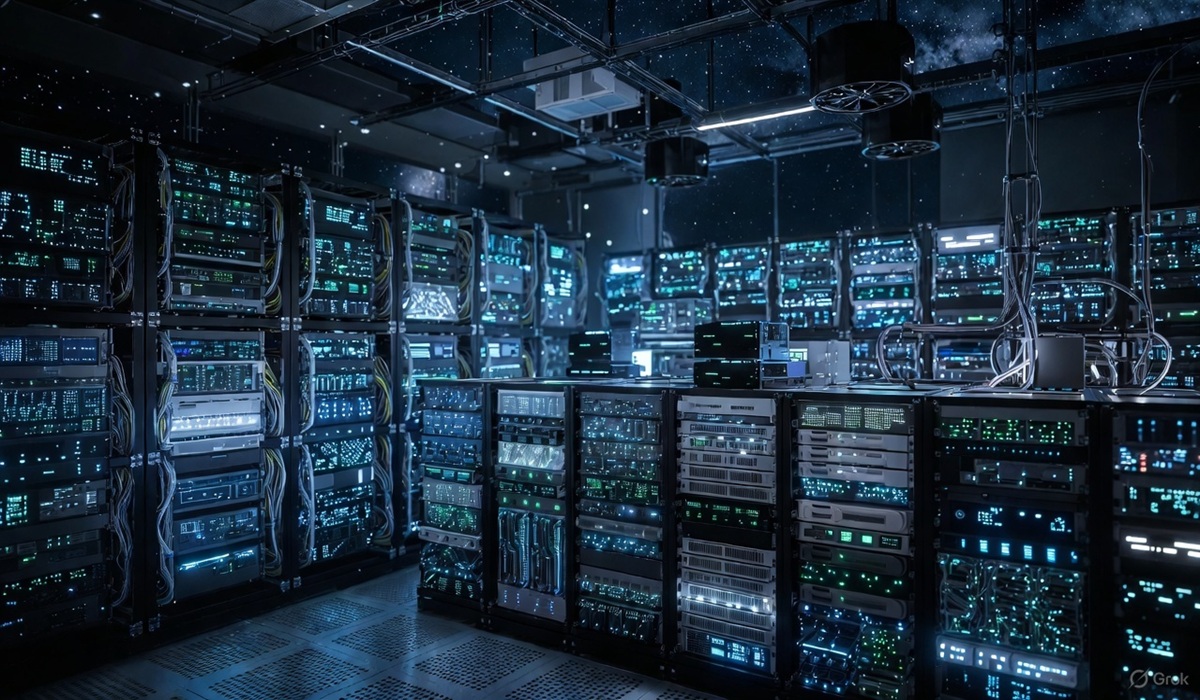
At its most basic level, an AI data center in outer space performs the same function as one on Earth. It processes enormous volumes of data, trains large-scale models, and runs continuous inference. What changes is not the purpose but the environment. Space strips away many of the constraints that dominate terrestrial infrastructure while introducing new ones that force a fundamentally different design philosophy. Energy becomes abundant rather than scarce. Cooling becomes passive rather than resource-intensive. Human presence becomes optional rather than essential. The result is not just a relocation of servers, but a rethinking of how intelligence is produced, maintained, and protected.
One of the strongest arguments for space-based AI infrastructure is power. On Earth, data centers are locked into competition with homes, hospitals, factories, and cities for electricity. As AI models grow larger, the strain becomes visible in grid failures, rising energy prices, and political backlash. In space, particularly in orbit or on the Moon, solar energy is nearly constant and unobstructed. Without an atmosphere or weather, solar arrays can operate at efficiencies impossible on the ground. On the Moon’s polar regions, sunlight can be available almost continuously, providing a level of energy reliability unmatched by any terrestrial grid. Mars, while further and less efficient, still offers solar viability when paired with nuclear systems for redundancy.
Cooling, the second great limitation of AI infrastructure, shifts just as dramatically. Earth-based data centers rely on massive water consumption, chillers, and complex HVAC systems to prevent overheating. These systems are expensive, environmentally damaging, and increasingly controversial. In space, heat does not need to be absorbed by water or air. It can be radiated directly into the vacuum using large thermal radiators. This changes the economics of compute density entirely. The hotter and more powerful the system, the more efficiently it can shed heat, without drawing from rivers, aquifers, or municipal water supplies.
The absence of humans is not a drawback in this context; it is a design feature. Space-based AI data centers would be built to operate autonomously, monitored and maintained by AI systems themselves. Faulty components would be detected early, workloads rerouted automatically, and robotic systems deployed for repairs or replacements. In this sense, AI does not merely run on the infrastructure; it becomes the infrastructure’s caretaker. This level of autonomy, while extreme, is already being developed for deep-space probes, satellites, and autonomous industrial systems on Earth.
Building such facilities would not resemble traditional construction. There would be no single launch carrying a finished structure. Instead, modular components would be sent into orbit or delivered to the lunar surface and assembled robotically. Compute modules, power arrays, communication systems, and cooling radiators would be designed to snap together, scale outward, and be replaced individually as technology advances. Over time, manufacturing would shift away from Earth. The Moon’s low gravity and abundant raw materials make it an ideal site for producing structural components and radiation shielding, drastically reducing launch costs. Mars, further away and far more expensive to reach, represents not efficiency but permanence, a planetary-scale archive and computational backbone for a multi-planet civilization.
The costs are undeniably enormous. Even with falling launch prices, the upfront investment required for space-based AI data centers would reach into the tens or hundreds of billions of dollars. Radiation-hardened hardware, redundancy, robotics, and autonomous systems all add layers of expense. Yet this framing misses a larger context. Earth-based AI infrastructure carries its own hidden costs: escalating energy demand, water depletion, land use conflicts, regulatory battles, climate impact, and social resistance. Space-based systems front-load cost but dramatically reduce long-term operating expenses and environmental trade-offs. For governments and multinational coalitions, this shifts AI infrastructure from a recurring liability into a strategic asset.
The beneficiaries of such systems would be diverse, but unevenly distributed without careful governance. Governments would gain access to energy-independent computation for climate modeling, defense simulations, disaster prediction, and scientific research. Corporations would benefit from virtually unlimited compute power insulated from local regulations and energy markets. Humanity as a whole could benefit if the most energy-intensive workloads were moved off-planet, reducing environmental strain while accelerating innovation. Perhaps most importantly, space-based AI centers could function as continuity vaults, preserving knowledge, culture, and intelligence beyond Earth-bound risks such as war, climate catastrophe, or planetary-scale disasters.
Whether this is a good idea depends less on engineering and more on control. An AI infrastructure untethered from Earth concentrates power in unprecedented ways. Questions of ownership, access, accountability, and ethics become existential rather than theoretical. Who decides what runs on these systems? Who benefits from their output? Who is excluded? Avoiding these questions does not prevent progress; it merely ensures that answers will be decided by those with the most resources rather than the most foresight.
The benefits to life on Earth would be indirect but profound. Offloading the heaviest computational workloads reduces pressure on power grids, lowers emissions, and decreases water usage. Cities regain energy capacity for human needs rather than server farms. Beyond infrastructure, the quality of insight improves. Climate models become more precise. Medical research accelerates. Large-scale simulations that are currently constrained by cost and energy become routine. The planet gains thinking space, both literally and figuratively.
Comparing space-based data centers to their Earth-bound counterparts highlights an evolutionary trajectory rather than a replacement. Ground-based centers are cheap and accessible but increasingly unsustainable. Underground facilities offer security and thermal stability but remain geographically limited and environmentally dependent. Underwater data centers introduce innovative cooling but face corrosion, maintenance complexity, and ecological concerns. Space-based systems demand the highest upfront cost but offer unmatched energy access, minimal environmental impact, and strategic resilience. Each reflects a stage in humanity’s relationship with computation.
Beneath the technical discussion lies a deeper question about civilization itself. Moving AI data centers into space is not simply about efficiency or innovation. It is about whether human intelligence, augmented by machines, has outgrown the physical and ecological limits of a single planet. Space has always forced humanity to think in long time horizons. AI does the same. Together, they demand responsibility, restraint, and clarity of purpose.
The path forward will not be sudden. The next decade is likely to see experimental orbital platforms, small and specialized, serving as proofs of concept rather than full-scale replacements. Lunar installations will follow as infrastructure and governance mature. Mars remains distant but no longer imaginary. The most difficult work ahead is not technical but institutional. International frameworks, ethical boundaries, and shared access must be built alongside solar arrays and server racks.
If done carelessly, AI data centers in space could become symbols of inequality and unchecked power. If done wisely, they could become quiet guardians of knowledge, running silently above a planet that finally learned how to think sustainably. The question is no longer whether humanity can build them. It is whether humanity understands why it should.
About The Author