Unitree Robotics Stuns the World at the Chinese New Year Gala
- TDS News
- Breaking News
- China
- East Asia
- February 17, 2026
By: Donovan Martin Sr, Editor in Chief
There are moments in technology when progress inches forward quietly, and then there are moments when it leaps onto a global stage and makes the entire world stop scrolling. What unfolded at China’s New Year Gala was not a product demonstration, not a controlled lab reveal, and not a polished investor pitch. It was a cultural spectacle watched by billions, and at its center stood machines that moved with such precision, fluidity, and awareness that the line between mechanical and human felt thinner than ever before.
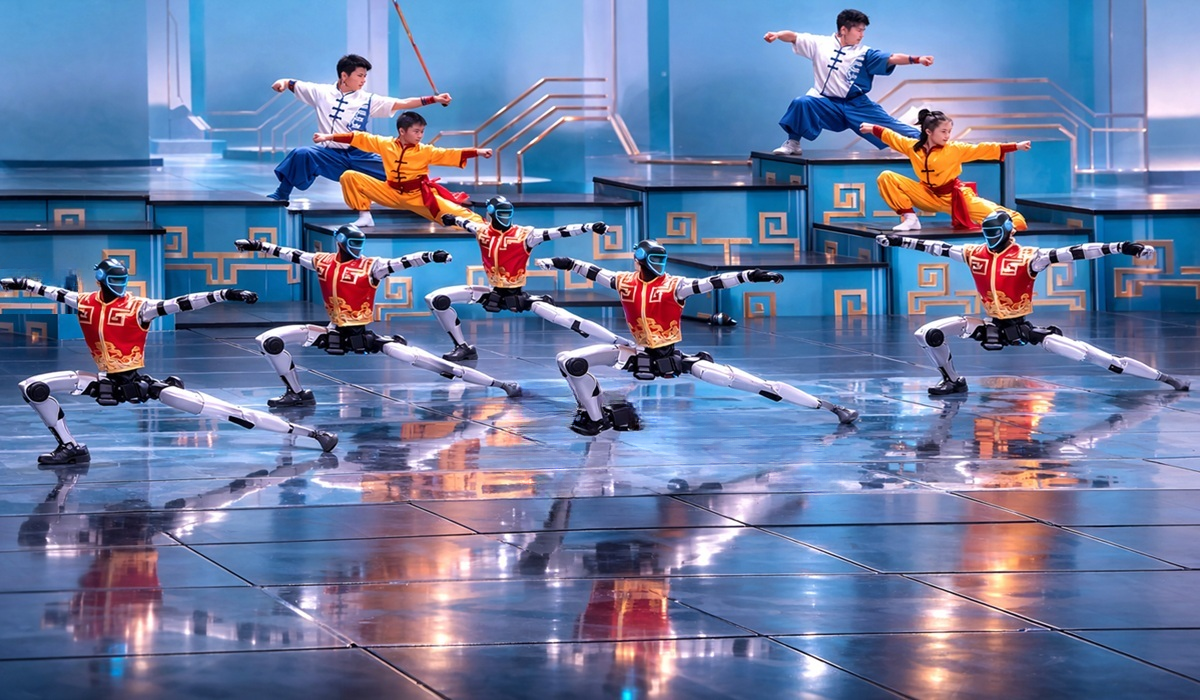
Unitree Robotics did not merely showcase hardware. They delivered a performance that redefined what the public believes autonomous systems are capable of. In a breathtaking display of choreographed martial arts, humanoid robots moved with balance, coordination, and timing that would have seemed implausible only a few years ago. Their footwork was sharp. Their transitions were seamless. Their posture reflected disciplined programming blended with astonishing real-time adaptability.
What elevated the performance beyond technical brilliance was context. These robots shared the stage with children. In any culture, placing advanced machines in close proximity to children during a live broadcast is the ultimate statement of confidence in safety engineering. It is one thing to demonstrate strength, agility, or dexterity in isolation. It is another to demonstrate trust. The symbolism was unmistakable. These were not experimental prototypes hidden behind barriers. They were stable, aware, and integrated into a performance built on harmony rather than spectacle alone.
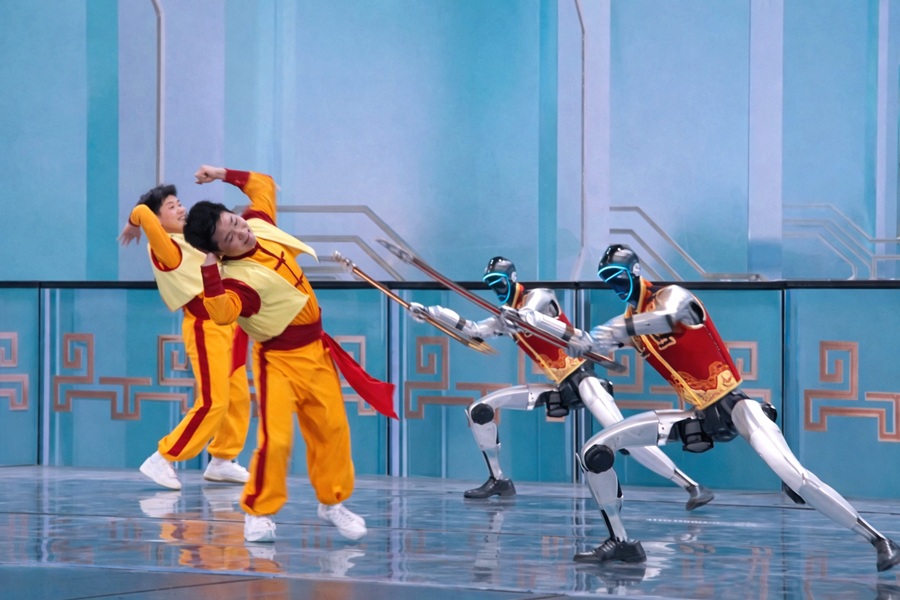
Then came the swords.
Blades in motion, synchronized arcs, controlled spins, and perfectly timed stops sent a clear message to engineers and skeptics alike. Precision at that level demands not only advanced actuation and control systems but extraordinarily refined sensing and balance algorithms. One miscalculation would be visible to the entire world. There were none. Every movement was measured, confident, and exact. The choreography did not feel like a gimmick. It felt like a declaration that robotics has entered a new era of coordination and control.
For viewers encountering Unitree Robotics for the first time, the reaction was immediate and visceral. Social media feeds filled with astonishment. Engineers dissected clips frame by frame. Casual viewers expressed disbelief that this was not CGI. Overnight, a company that many outside Asia may not have followed closely became impossible to ignore.
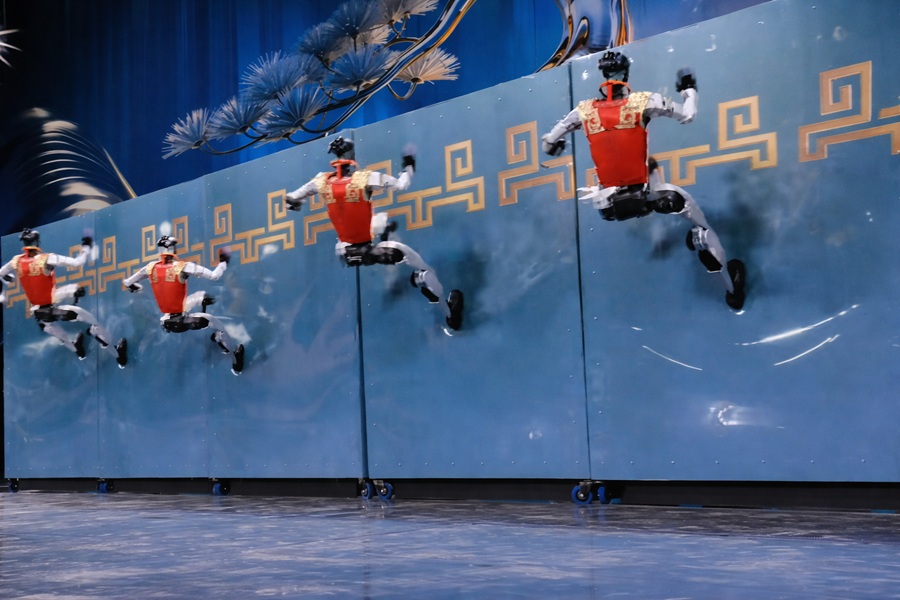
The comparison conversations began instantly. In Western discourse, humanoid robotics often centers on familiar names such as Tesla and its Optimus project, or Boston Dynamics and its widely recognized mobility platforms. Yet what was seen on the Gala stage suggested something operating on a different trajectory. This was not a cautious prototype walking across a factory floor or performing isolated tasks. This was expressive, synchronized, culturally embedded robotics operating live before one of the largest television audiences on Earth.
The distinction matters. Innovation is not only about mechanical function. It is about integration into society. When robots can participate in cultural ceremonies, execute complex martial arts routines, and safely coordinate with human performers, they are no longer novelties. They are systems approaching real-world readiness in ways that feel tangible rather than theoretical.
There is also a broader narrative at play. For many North American viewers, exposure to technological breakthroughs abroad is filtered through narrow channels. The result can be an incomplete picture of how quickly the global innovation landscape is shifting. Watching Unitree Robotics at the Gala felt less like observing incremental progress and more like stepping into a preview of the next decade. The fluidity of motion, the stability under dynamic load, the responsiveness to choreography cues, and the visible refinement of design suggested a maturity that challenges outdated assumptions about where the cutting edge resides.
To describe this as a new gold standard would be insufficient. Gold implies an established benchmark. What Unitree Robotics demonstrated was a redefinition of the benchmark itself. The bar did not move upward slightly. It was replaced entirely.
Equally compelling was the sense of acceleration. If this is the present state of publicly demonstrated capability, what arrives in twelve months could be transformative. In five years, the implications extend far beyond stage performance. Industrial collaboration, elder care assistance, emergency response support, educational engagement, and even artistic expression stand to be reshaped by systems capable of such balance, coordination, and safe human interaction.
Excitement spread not because of hype, but because the evidence was visible. Billions watched it unfold in real time. The performance did not rely on dramatic narration or exaggerated claims. It relied on execution. The mannerisms were deliberate. The pauses were intentional. The recovery from motion was smooth. Every detail signaled rigorous engineering beneath the surface.
This is what leadership in robotics looks like when it steps into the spotlight. It is confident enough to perform live. It is precise enough to wield blades without incident. It is trusted enough to stand alongside children in celebration. It signals not just technical advancement, but systemic maturity.
For our readers across North America, stories like this matter deeply. They challenge assumptions. They broaden perspective. They remind us that the future is not emerging in isolation, and that the global race toward advanced autonomy is accelerating faster than many realize.
If this Gala performance is any indication, Unitree Robotics has not simply joined the upper tier of global robotics innovators. They have carved out a position that demands serious attention from engineers, investors, policymakers, and competitors alike. The future no longer feels abstract. It was on stage, moving with discipline, grace, and astonishing control, and it has already reshaped the conversation about what is possible.
About The Author