Trump and Netanyahu’s Weekening Complex Web in Global Politics
- Naveed Aman Khan
- Trending News
- Middle East
- March 29, 2026
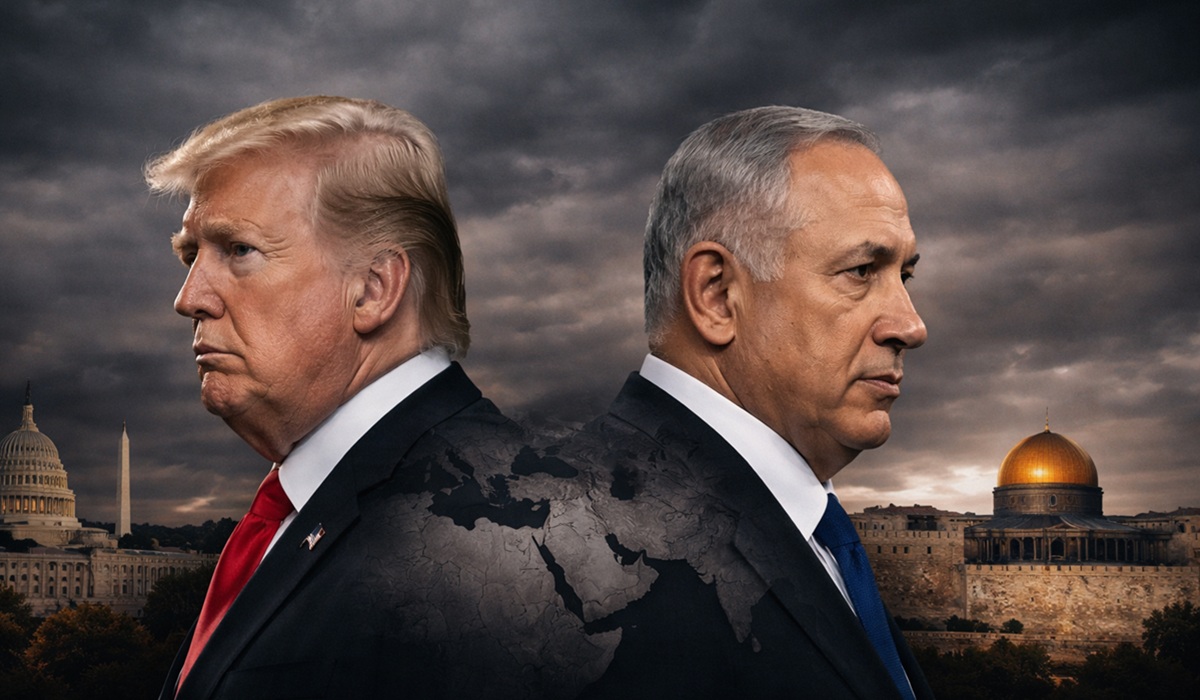
International politics is neither simple nor one-dimensional; rather, it resembles a multidimensional chessboard in which power, security, economics, diplomacy, and domestic politics are deeply intertwined. No country’s foreign policy decision is the result of a single event or an individual’s preference. Instead, it reflects long-term strategy, institutional consultation, and the cumulative pressure of global dynamics. The actions of Donald Trump and Benjamin Netanyahu must be understood within this broader framework, where not only strategic and security concerns but also domestic political motivations play a significant role.
The US and Israeli policy toward Iran is rooted in decades of strategic thinking. Since the end of the Cold War, the United States has pursued policies aimed at protecting its allies in the Middle East, ensuring access to energy resources, and maintaining global dominance. In this context, Iran’s nuclear program, its expanding regional influence, and its involvement in proxy conflicts have remained persistent sources of concern for Western powers.
Iran is widely regarded as a comparatively strong military and strategic power in the region and is seen as a significant obstacle to Israel’s expansionist ambitions. For Israel, Iran’s growing capabilities represent a potential existential threat. Consequently, Iran has consistently occupied a central place in Israel’s national security doctrine, shaping both its overt and covert strategies aimed at containing Tehran’s influence.
At this point, the concept of “deterrence” becomes critically important. Powerful states often use or demonstrate force to send a clear message to potential adversaries, discouraging them from aggression. This strategy is not limited to military means; it also includes economic sanctions, diplomatic pressure, and technological superiority. Sanctions imposed on Iran, nuclear negotiations, and periodic military signaling all form part of this broader deterrence framework.
The geopolitical and economic importance of the Middle East further intensifies these dynamics. The region holds some of the world’s largest oil and gas reserves and serves as a vital corridor for global trade. Any instability in this region has immediate repercussions for the global economy. As a result, major powers remain actively engaged in maintaining their influence there. Iran, as a key regional actor, naturally becomes a focal point in these strategic calculations, with efforts often directed at limiting its reach.
However, viewing international politics solely through external factors presents an incomplete picture. Domestic politics frequently shape foreign policy decisions in profound ways. In the case of Donald Trump, some narratives suggest that a hardline stance or potential military action against Iran could serve as a means to divert attention from internal political pressures, including controversies linked to Jeffrey Epstein. That said, such claims require solid, verifiable evidence—something that is often lacking in public discourse.
The Epstein scandal itself represents a complex legal and moral controversy involving serious allegations and high-profile individuals. While it has been widely investigated and discussed, directly linking it to major foreign policy or military decisions remains speculative without concrete proof. In global politics, such narratives can be compelling but often rest on assumptions rather than substantiated facts.
Similarly, Israel’s domestic political landscape plays a crucial role in shaping its external behavior. Benjamin Netanyahu has been a dominant figure in Israeli politics for years, operating within a parliamentary system where governments often depend on fragile coalition arrangements. In such an environment, external conflicts can sometimes serve to consolidate domestic political support and stabilize governing coalitions.
In the United States, foreign policy is also not entirely insulated from domestic considerations. Elections, public opinion, media pressure, and party strategies all influence decision-making. However, it is important to recognize that in a system like that of the United States, foreign policy is not dictated by a single individual. It is shaped through institutional processes involving bodies such as the Pentagon, the Central Intelligence Agency, the US Department of State, and Congress. This institutional framework acts as a check, limiting the impact of purely personal or short-term political motivations.
In global affairs, conspiracy theories often emerge when information is incomplete or when complex realities are simplified for public consumption. While such theories may sometimes contain fragments of truth, accepting them as definitive explanations can be misleading and even dangerous. It is therefore essential to evaluate all claims through evidence-based, analytical reasoning.
In today’s fast-paced information environment, the flow of news is constant. Social media platforms, digital outlets, and 24/7 news cycles provide continuous updates, but they also facilitate the rapid spread of misinformation. In such a context, the responsibility of journalists and analysts becomes even more critical. They must prioritize verified information and avoid amplifying unsubstantiated claims.
Understanding the ongoing tensions among Iran, the United States, and Israel requires a comprehensive and multidimensional perspective—one that takes into account not only security and strategic considerations but also economic, diplomatic, and domestic political factors.
The central lesson of international politics remains clear: power and interest are inseparable, but their expression varies. Major decisions are rarely driven by a single cause; rather, they emerge from a convergence of multiple factors. For both the public and policymakers, it is essential to rely on critical thinking and evidence-based analysis rather than emotion, ensuring a clearer understanding of global politics and more informed decision-making.
About The Author