Football asks for more than power and toughness, even if those traits dominate the sport’s mythology. The modern game rewards athletes who accelerate in tight spaces, redirect without losing balance, stay fresh late in the fourth quarter, and avoid the soft-tissue injuries that quietly reshape depth charts every fall. Training can either build those capacities or merely rehearse familiar discomfort. In this training guide, we’ll break down the areas of athleticism that football players should focus on during training to dominate the gridiron.
A smart football training focus starts with the reality that football is not a continuous endurance sport and not a single-rep strength contest. Players repeat bursts of near-max effort—accelerate, collide, decelerate, reset—layered over a long season where fatigue compounds and minor limitations become major problems. Players who lift heavy but cannot decelerate cleanly invite knee and ankle issues.
Players who run gassers all summer but lack true speed mechanics arrive conditioned to be slow. Players who drill skills endlessly but neglect strength and tissue capacity can flash early and fade when the schedule tightens. Training must respect the sport’s physics: force production, force absorption, and the ability to repeat both under stress.
Strength remains foundational, but it functions best as a tool rather than a trophy. Absolute strength gives players the raw capacity to generate force into the ground, to dominate the point of contact, and to maintain posture while moving. Yet strength training only transfers when it supports the shapes and speeds the field requires.
Lower-body work must build hips and legs that can extend powerfully and stabilize instantly. Upper-body work must strengthen the shoulders, back, and trunk for contact without sacrificing mobility. The best programs pursue strength through ranges of motion that athletes can own, because unstable strength does not survive game speed.
Power and explosiveness sit on top of strength, but they demand different intent. A player can grind through slow reps and grow stronger while still struggling to express force quickly. Football rewards rapid force, not just high force.
Jump training, Olympic-lift variations, medicine ball throws, and sprint starts can help, but only if athletes chase crisp execution instead of fatigue. The body learns what it practices. When every “explosive” rep turns into a slow, sloppy rep, training teaches the nervous system to move slowly under strain.
Speed deserves its own category as a training area of focus for football players because too many athletes train it indirectly and hope it appears. True speed work requires full recovery and high-quality mechanics. Players should learn how to project the body forward, strike the ground under the hips, and keep the torso organized while the limbs cycle fast.
Sprinting at 85 percent because the group must stay together does not build speed; it rehearses mediocrity. Even players who do not consider themselves “track fast” benefit from speed sessions, because faster acceleration widens every option: a lineman closes space sooner, a linebacker beats the angle, a receiver threatens cushion, a defensive back recovers. Speed also protects athletes. When players can hit positions early, they avoid the awkward reaches and late collisions that strain hamstrings and groins.
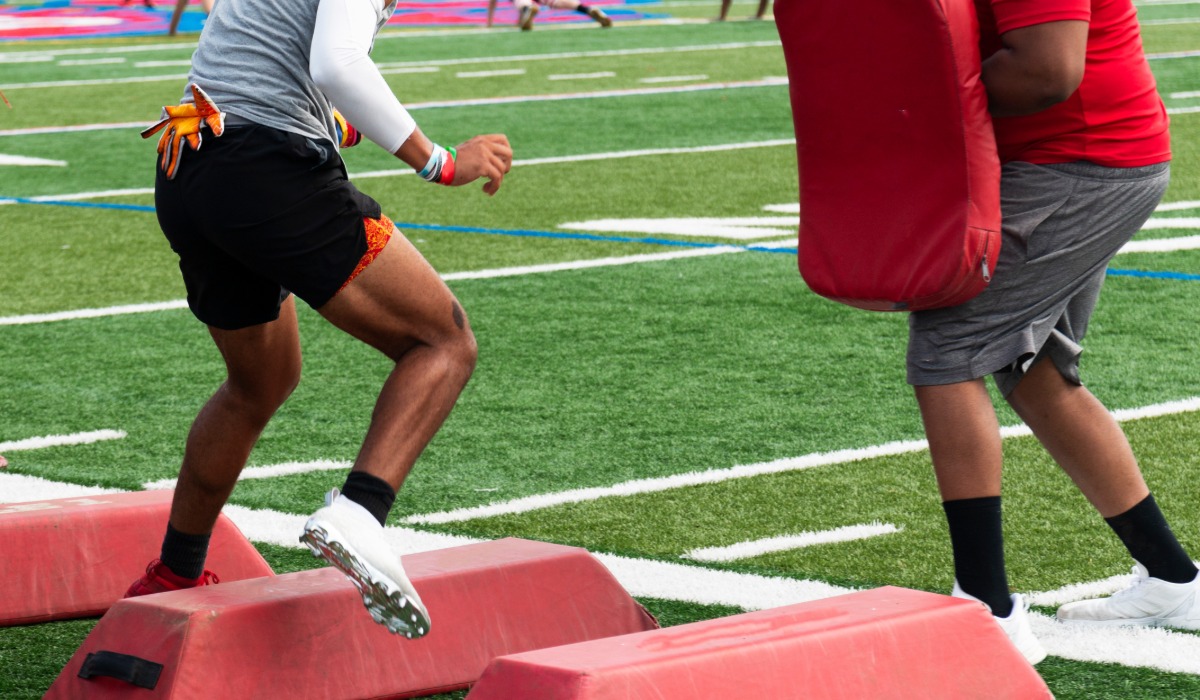
Agility and change of direction separate good athletes from game-changers, yet many programs treat it as a bag-drill performance instead of a physical skill. Real agility starts with deceleration: the ability to slow down and redirect without the knee collapsing inward, without the trunk whipping off-line, and without the foot landing far outside the center of mass. Cutting at speed punishes weak braking capacity.
To improve football athletes’ change of direction speed, they must practice acceleration and deceleration. Players who never train deceleration usually compensate by slowing down before they cut, which looks “safe” in practice but fails in games. Effective training teaches athletes to lower the center of gravity, load the hips, and create strong foot contacts that redirect momentum.
Conditioning remains essential, but it must match the sport’s energy demands and the player’s role. Football conditioning is not just suffering; it is the capacity to repeat high-quality efforts with minimal drop-off. Linemen must repeat short bursts with long rests and the ability to recover between plays. Skill players need the ability to sprint, stop, and sprint again with incomplete recovery, then do it again after a long drive.
Special teams demand all-out effort under chaos. The wrong conditioning can sabotage the right adaptations. Endless long runs can reduce power and speed, while random high-rep circuits can flood athletes with fatigue without building the specific repeatability the game requires. Players should earn conditioning through a mix of sprint-based work, position-appropriate intervals, and practice tempos that reflect actual play cadence.
Mobility and joint health do not belong in a separate “optional” corner of the program; they sit inside performance. Football positions demand hips that rotate, ankles that dorsiflex, shoulders that move overhead and across the body, and spines that can stabilize without becoming rigid. Mobility work should not become a long, passive stretch session that athletes resent. It should become a daily routine that restores positions they need for strength, sprinting, and contact.
Injury prevention sounds like a slogan until a season turns on a pulled hamstring or a rolled ankle. Prevention does not mean avoiding hard work; it means building tissues that tolerate hard work. Eccentric hamstring strength, calf, and Achilles capacity, groin resilience, and trunk control reduce common breakdowns. So does intelligent workload management.
Many non-contact injuries occur when athletes jump too quickly from low volume to high volume, or when they stack intense sessions without recovery. A program that respects progression, sleep, nutrition, and recovery tools becomes a competitive advantage because availability is a skill. Teams rarely win with the best roster on paper; they win with the best roster still standing at the end of the season.
Mental performance and decision-making also belong in training, even if they do not fit neatly into a spreadsheet. The sport asks players to process formation cues, communicate adjustments, and execute technique under threat. Athletes can train this by practicing with constraints: timed calls, changing looks, situational periods, and honest feedback.
Confidence grows when preparation looks like the game. Players who only train in controlled settings freeze when variables appear. Players who train with uncertainty learn to stay calm and respond.
Finally, players should align training with the calendar. Offseason work should build the base: strength, tissue capacity, movement quality, and speed mechanics. Preseason should sharpen: more position-specific conditioning, more reactive agility, and more practice-like intensities while still protecting the body. In-season should maintain: enough strength and speed exposure to keep qualities from decaying, with careful management of soreness and collisions.
The simplest way to evaluate training is to ask whether it produces a body that moves better and a player who performs longer. When players adopt a football training focus rooted in the sport’s true demands—force, speed, deceleration, repeatability, skill precision, and resilience—they stop chasing fatigue and start chasing readiness. That shift does not just improve performance. It keeps athletes healthier, more consistent, and more valuable to the people relying on them every Friday, Saturday, and Sunday.
About The Author