The Delusion of a Singular Winner: The True Prize in the AI Arms Race is Fragmentation, Not Supremacy
- Xuemei Pal
- Middle East
- Trending News
- December 4, 2025
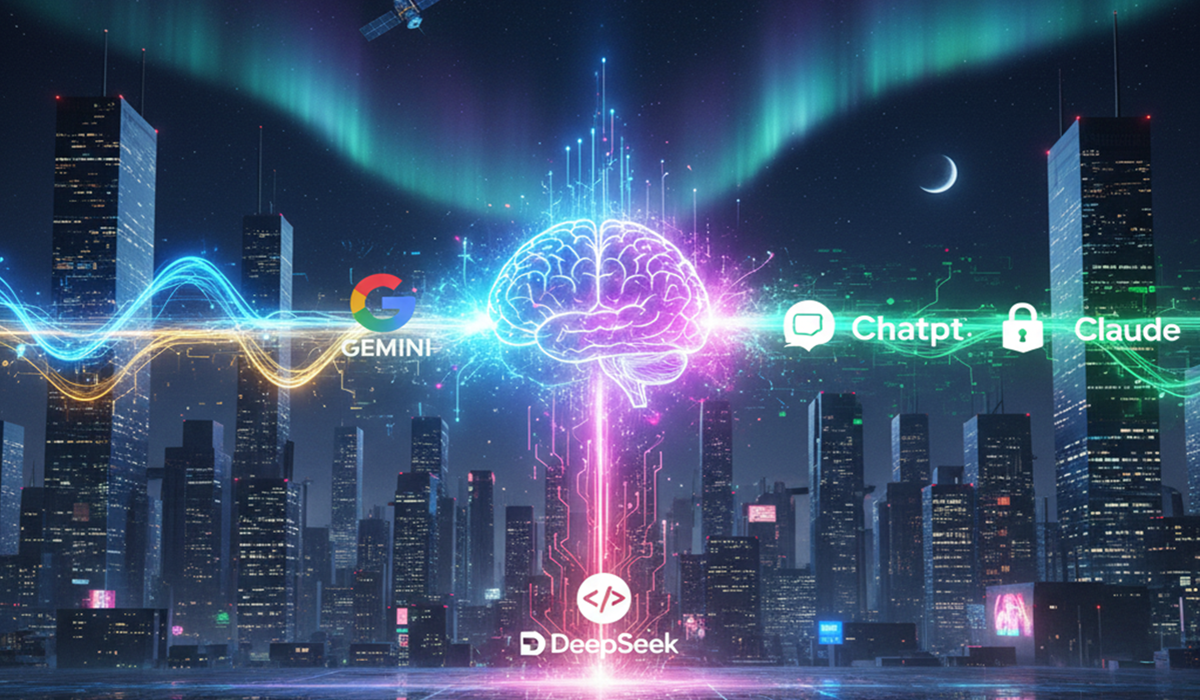
The breathless news cycle demands a champion, a single, dominant victor in the so-called “AI Arms Race.” Is it the sheer computational power of Google’s Gemini, the sophisticated reasoning of Anthropic’s Claude, the established ubiquity of OpenAI’s ChatGPT, or the sudden, potent challenge from DeepSeek and the wave of efficient, open-source models? The very premise of the question is flawed. The current state of artificial intelligence is not a monolithic race to a single finish line, but a rapid, multi-front war where the most significant outcome is not absolute supremacy, but unprecedented diversification and fragmentation.
To ask who is winning—Gemini, ChatGPT, or DeepSeek—is to mistake a highly competitive ecosystem for a simple drag race. In late 2025, the picture is complex, defying any clear linear ranking. Google’s Gemini 3 has certainly delivered a seismic shock, reportedly triggering an internal “Code Red” at OpenAI by surpassing its rivals in critical benchmarks like advanced reasoning and multimodal integration. Its native ability to process and synthesize text, code, images, and video within a single architecture represents a genuine architectural leap that challenges the bolted-on multimodal capabilities of its competitors. It carries the immense institutional weight of Google’s entire knowledge base, a formidable, almost unfair advantage in certain real-world applications.
Yet, this power is counterbalanced by the rise of the specialized and the open. Anthropic’s Claude maintains a reputation for meticulous accuracy, long-context analysis, and ethical caution, making it the preferred partner for organizations operating in highly regulated or security-sensitive sectors. Its focus on thoroughness over speed ensures its niche as the most trustworthy model for deep research and authoritative content generation.
The challenge from the East, personified by DeepSeek, is perhaps the most destabilizing force. DeepSeek has demonstrated the capacity to create models that rival the performance of proprietary Western giants like GPT-5 and Gemini 3 Pro in areas like elite math and coding, but with the critical differentiator of being cheap to run and often open-source. This democratizing factor fundamentally alters the economics of the race, making state-of-the-art AI capabilities accessible not just to three or four tech behemoths, but to startups, researchers, and nation-states globally.
Meanwhile, OpenAI’s ChatGPT continues to dominate in user adoption, API integration, and sheer momentum. While its latest models may occasionally be edged out on pure technical benchmarks by newer rivals, its established enterprise integration, vast user base (now reportedly over 800 million weekly active users), and consistent performance in general versatility make it the incumbent that cannot be ignored. The overall winner in any given performance test often depends on the specific use case: Gemini for multimodal tasks, DeepSeek for developer productivity, Claude for deep-dive analysis, and ChatGPT for all-around versatility.
The critical introspective work lies in understanding what this splintered, hyper-competitive landscape truly signifies. The prize is not a singular, all-knowing AGI—at least not yet—but rather sovereignty and control over the foundational technology.
This is a geopolitical and industrial struggle with three dimensions:
Industrial Dominance: The billions poured into infrastructure by Google, Amazon, and Meta are not merely for better chatbots; they are investments in securing the cloud, the data centers, and the compute capacity that will underpin all future economic activity. The winner here will own the digital rails of the 21st century.
Geopolitical Rivalry: The Sino-American AI competition remains the central conflict. China’s advances, evidenced by models like DeepSeek, are a direct challenge to U.S. technological supremacy, forcing governments to view AI not just as a commercial product but as a core component of national defense and economic security. The race is less about which model is marginally “smarter” and more about which nation can maintain control over the critical supply chains, particularly advanced semiconductors, that fuel the entire endeavor.
The Agentic Future: The current race is accelerating past simple large language models and into the era of AI Agents—systems that can act autonomously in the real world, planning and executing multi-step workflows. The competition is rapidly shifting from the quality of an output to the efficacy of an action. Whichever model family can best orchestrate complex, real-world tasks—from securing a corporate network to managing a business campaign—will unlock exponential new value.
In this context, the idea of a single “winner” is a comfortable delusion. We are not watching a coronation; we are witnessing a ** Cambrian explosion** of intelligent systems. Every new model, whether proprietary or open-source, raises the bar across the board. The temporary lead of a Gemini 3 or a GPT-5.1 is just that—temporary—because the cycle of innovation has compressed from years to mere months.
The true significance of this “arms race” for the world is that it is simultaneously centralizing power (in the hands of the companies with the compute budgets) and decentralizing capability (through open models that proliferate state-of-the-art tools). The consequence is a world that is technologically advancing at a terrifying speed, but which is growing increasingly fractured in its ethics, governance, and control. The current lead is less important than the architectural choice: the one that wins will not just be the one that is smarter, but the one that is most effectively embedded—in our businesses, our national security, and the very operating system of our digital lives.
About The Author