The Day the Unthinkable Happened: F-35 Shot Down By Iranian Missle
- Naomi Dela Cruz
- U.S.A
- March 20, 2026
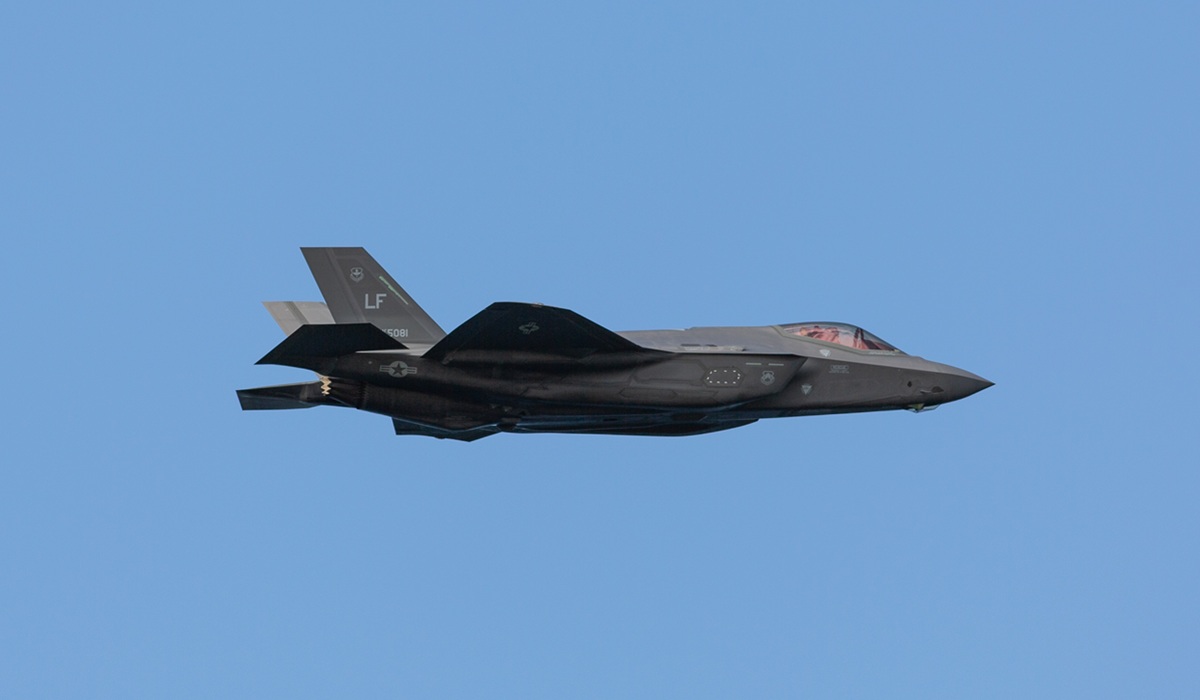
The United States military has long relied on the F-35 Lightning II as the cornerstone of its air dominance strategy. Built to evade detection, penetrate the most heavily defended airspace, and strike with precision, the aircraft has been widely regarded as the most advanced fighter jet ever deployed. For years, it symbolized a near-unquestioned technological edge—stealthy, elusive, and, in the eyes of many, nearly untouchable.
That perception has now been shattered. In a development that is already reverberating throughout military and political circles worldwide, an F-35 has been shot down by an Iranian missile. What was once considered the “holy grail” of U.S. military firepower has now been proven vulnerable in active combat. The implications are immediate, far-reaching, and impossible to ignore.
At its core, this moment represents more than the loss of a single aircraft. It marks a turning point in how modern warfare is understood. The F-35 was designed specifically to survive in environments like the one it encountered—dense with radar systems, layered air defenses, and advanced missile technology. The fact that it was successfully engaged and brought down raises urgent questions about how those defenses were able to track and target it in the first place.
Iran’s success in striking the aircraft points to a significant evolution in air defense capability. Rather than relying on traditional radar systems alone, modern defensive networks are increasingly built on a combination of technologies—integrated radar arrays, infrared tracking, electronic surveillance, and coordinated missile systems working together in real time. This type of layered approach does not depend on seeing an aircraft clearly at all times. It only requires enough data, at the right moment, to create a targeting solution.
What has now become evident is that such a moment was found. For the United States, this development forces an immediate reassessment of assumptions that have guided military operations for decades. The F-35 was never meant to operate as just another fighter jet. It was designed to lead, to enter contested zones first, and to create openings for other forces. If that role is now compromised—even partially—it changes how missions are planned, executed, and supported.
The impact extends beyond the battlefield. The F-35 program is not just an American project. It is a global one. Allied nations across Europe, Asia, and the Middle East have invested billions into acquiring the aircraft, structuring their future air forces around its capabilities. A confirmed shootdown introduces a new layer of scrutiny. These countries are not only buying a jet; they are buying into a doctrine of warfare built around it. Now, that doctrine faces its first major real-world challenge.
Equally significant is the likelihood that whatever method was used to successfully engage the F-35 will not remain isolated. Military knowledge, especially when it shifts the balance even slightly, has a way of spreading—whether through formal alliances, strategic partnerships, or indirect channels. If Iran has identified a repeatable way to detect or track stealth aircraft, even under specific conditions, that information becomes valuable far beyond a single engagement.
For U.S. military planners, the focus now turns to adaptation. The immediate response will involve dissecting every aspect of the incident—flight conditions, support systems, electronic signatures, and the configuration of enemy defenses. Understanding not just what happened, but how it happened, becomes critical. From there, adjustments will follow. Tactics will evolve. Support systems will be strengthened. Greater emphasis will likely be placed on neutralizing air defenses before deploying high-value assets like the F-35.
This is how military power sustains itself—not by avoiding setbacks, but by responding to them faster than adversaries can capitalize on them.
Still, the symbolic impact cannot be understated.
For decades, U.S. air superiority has rested on a combination of technology, training, and the perception of overwhelming capability. Moments like this challenge that perception. They signal to adversaries that the gap can be narrowed. They signal to allies that even the most advanced systems are not immune.
But they also signal something else. They signal the beginning of the next phase. Because if there is one constant in modern warfare, it is that no advantage lasts forever. Every system invites a counter. Every breakthrough is eventually tested. The F-35 was never the end of that cycle. It was simply the latest chapter.
Now, a new chapter has begun—one where stealth is no longer a guarantee, where detection is becoming more sophisticated, and where dominance must once again be earned under changing conditions. The shootdown of an F-35 does not end American airpower. But it does redefine the environment in which that power must now operate.
About The Author