The Bill Comes Due: France’s Debt Crisis and the End of Africa’s Silent Subsidy
- TDS News
- Trending News
- Africa
- January 3, 2026
By: Donovan Martin Sr, Editor in Chief
France’s looming decision to borrow more than €300 billion in a single year is not just a fiscal headline or a technocratic budgetary maneuver. It is a quiet alarm bell. It forces an uncomfortable question that France, and much of Europe, has avoided for decades: what happens when a country that built stability on external extraction is finally cut off from it?
For generations, France projected an image of itself as a modern republic, a steward of enlightenment values, a pillar of European stability. Yet beneath that image sat an economic reality that was far less noble. France’s prosperity, liquidity, and financial flexibility were not sustained by domestic productivity alone. They were quietly reinforced by an unequal system that tied dozens of African nations to Paris long after formal independence was declared.
This is not ancient history. It is present tense.
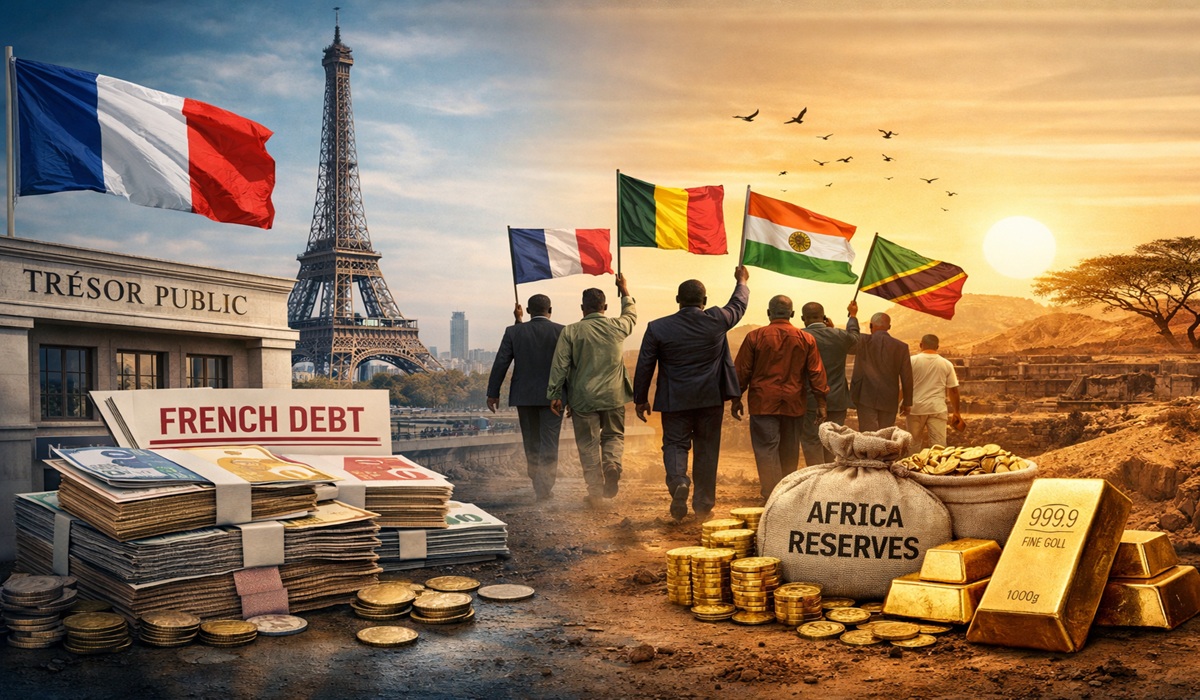
At the center of that system sits one of the least discussed but most consequential mechanisms of post-colonial control: the requirement that certain African nations deposit a significant portion of their foreign exchange reserves into accounts overseen by the French Treasury. For decades, this arrangement meant that African states were technically “independent,” yet financially subordinated. Their currencies, their reserves, their monetary sovereignty were filtered through Paris. The arrangement ensured stability for France first, liquidity for France always, and constraint for Africa by design.
That money did not sit idle. It strengthened France’s balance sheet. It reduced borrowing pressure. It helped sustain low-cost financing. It quietly propped up the French economy during downturns, recessions, and global shocks. Meanwhile, African nations were forced to borrow externally, often at higher rates, sometimes from the very system holding their own money hostage.
This is why today’s moment matters.
Across West and Central Africa, former French colonies are no longer speaking in diplomatic half-sentences. They are expelling French troops. They are rewriting mining contracts. They are nationalizing strategic resources. They are repatriating gold. They are refining locally instead of shipping raw materials abroad. And most importantly, they are openly rejecting the idea that their wealth must be parked in Paris to be considered “safe.”
To France, these moves are often framed as political instability, military realignment, or ideological rebellion. But at their core, they are economic acts of self-defense. They represent a refusal to continue subsidizing a foreign economy while domestic populations remain underdeveloped, indebted, and structurally constrained.
The connection to France’s current debt situation is direct, even if it is rarely acknowledged.
When African nations begin pulling reserves out of French control, France loses more than influence. It loses liquidity. It loses leverage. It loses a hidden stabilizer that softened the impact of deficits for decades. Suddenly, borrowing €300 billion is not just about funding public services or rolling over bonds. It is about replacing money that used to arrive quietly, predictably, and without political cost.
France’s debt did not explode overnight. It grew gradually, buffered by systems that masked its true vulnerability. But as those systems unravel, the cost of maintaining the illusion rises. Borrowing becomes larger. Interest sensitivity increases. Credit scrutiny tightens. The margin for error shrinks.
What makes this moment particularly revealing is how quickly the narrative flips. For decades, African nations were described as financially irresponsible, poorly governed, or incapable of managing their own resources. Now, as they assert control, France is forced to borrow at historic levels to sustain its own commitments. The contrast is stark. It raises a question that cannot be easily dismissed: who was really subsidizing whom?
The truth is uncomfortable. Even after independence, many former colonies were never allowed to fully exit the French economic orbit. Their labor, minerals, energy, and monetary reserves flowed outward, while development lagged behind. France spoke the language of partnership while enforcing rules that guaranteed imbalance. It was not classical colonialism, but it was not freedom either. It was dependency by design.
That design is now failing.
As African nations collectively say “no more,” France faces a future where its economy must stand on what it produces, not what it controls abroad. There will be no silent reserve accounts in Paris filled with African earnings. No preferential access to underpriced raw materials. No monetary scaffolding built on someone else’s sovereignty.
This transition will not be smooth. It will not be cheap. And it will not be framed honestly at first.
There will be talk of global instability, rising borrowing costs, geopolitical realignment, and market pressure. But beneath all of it lies a simpler reality: an old system is ending. And systems that depend on extraction always struggle when extraction stops.
For Africa, this moment represents risk and opportunity. Repatriating gold, nationalizing resources, and breaking monetary dependency does not guarantee prosperity. Governance still matters. Institutions still matter. Corruption still matters. But for the first time in decades, the rewards of getting it right will not be siphoned elsewhere by default.
For France, the reckoning is quieter but profound. A nation that once acted as arbiter, gatekeeper, and beneficiary of African wealth must now confront the cost of standing alone. €300 billion in borrowing is not just a budget line. It is a signal that the old math no longer works.
And when the last remnants of the French franc system disappear from Africa, when reserves are fully repatriated, when refining happens on African soil, and when monetary sovereignty becomes non-negotiable, the question will no longer be whether France can adapt.
It will be whether it ever truly believed it would have to.
About The Author