Somali Canadians Say Trump’s Rhetoric Is Fueling Fear Beyond U.S. Borders
- Emma Ansah
- Canada
- December 17, 2025
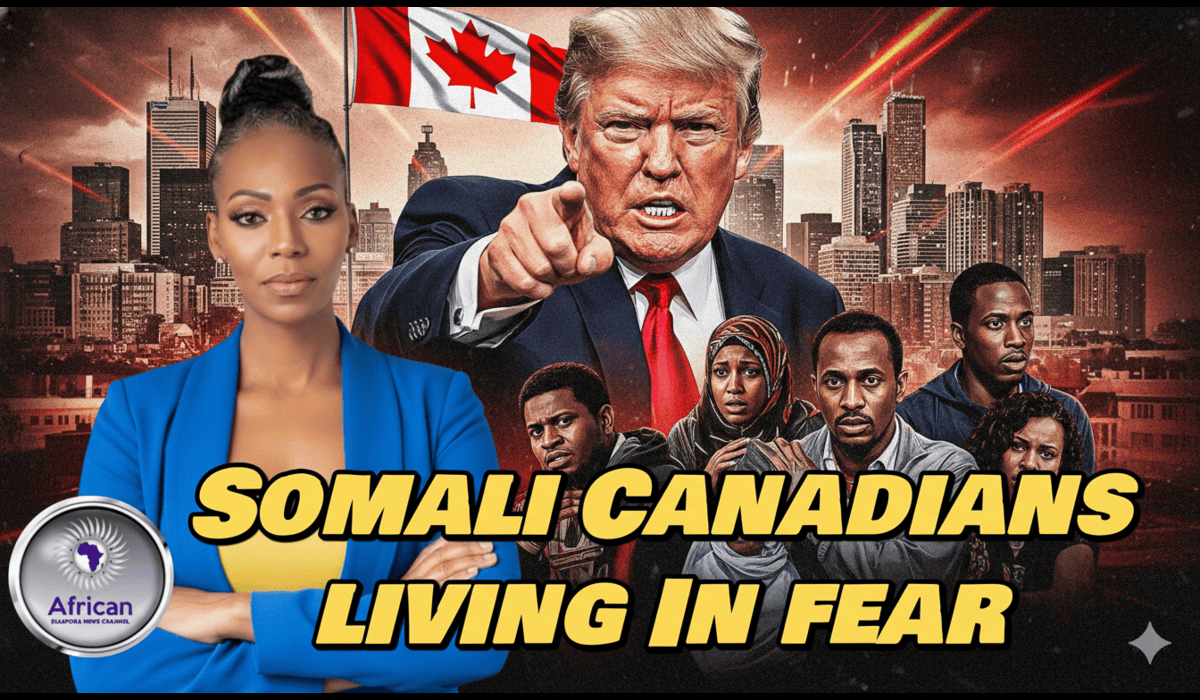
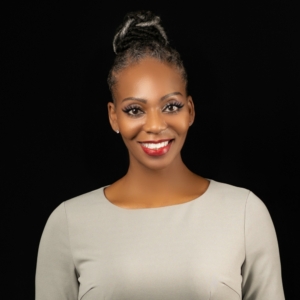
Emma Ansah goes live with a report on Somali Canadians across the country who say they are holding their breath in fear following Donald Trump’s latest tirade targeting Somali immigrants. While the former U.S. president’s comments were made south of the border, community members say the impact does not stop there. They warn that rhetoric like this travels fast, crosses borders easily, and lands hard on Somali families living in Canada.
Across cities with large Somali populations, including Toronto, Ottawa, Edmonton, and Calgary, Somali Canadians say Trump’s words have reopened old wounds. Many describe a familiar pattern: dehumanizing language, sweeping generalizations, and dog whistles that frame Somali people as outsiders or threats. Community leaders say this kind of language does not exist in a vacuum. It shapes public perception, emboldens extremists, and gives permission to people already inclined toward hate.
Business owners brace for backlash that can range from verbal harassment to vandalism. For many, it is not fear rooted in imagination but memory, informed by past spikes in anti-Black and Islamophobic incidents following high-profile political statements.
Community advocates stress that Trump’s rhetoric is especially dangerous because of his global reach. When a former U.S. president uses inflammatory language, it is amplified through social media, replayed on news networks, and repackaged in online spaces where hate thrives. Somali Canadians say they have already seen the consequences of this ecosystem before, where words escalate into threats, and threats turn into action.
There is also frustration that Somali communities are once again being forced into a defensive posture. Many say they are tired of having to prove their humanity, their contributions, and their right to belong.
Somali Canadians have been part of the fabric of this country for decades, contributing as healthcare workers, entrepreneurs, educators, public servants, and community builders. Yet moments like this remind them how quickly they can be reduced to a talking point in someone else’s political agenda.
At the same time, there is resolve. Emma urges the Somali community to stop delineating, denying their blackness and looking down on Black Americans and Canadians.
The message from the community is clear: rhetoric may start on a stage or a screen, but its consequences are felt in real lives, real homes, and real neighborhoods across Canada.
And they are watching closely to see who is willing to stand with them when it matters most, but, most black people are saying we will only stand with them when they stop looking down on the rest of the Black community.
Watch the livestream: https://www.youtube.com/live/Bbq64klPhfg?si=Kbh9IgDwc-yGrMzh
About The Author