Social Media’s Societal Impact: By 1985s Norms We’ve Lost Our Minds
- Nick Kossovan
- Culture
- April 9, 2026
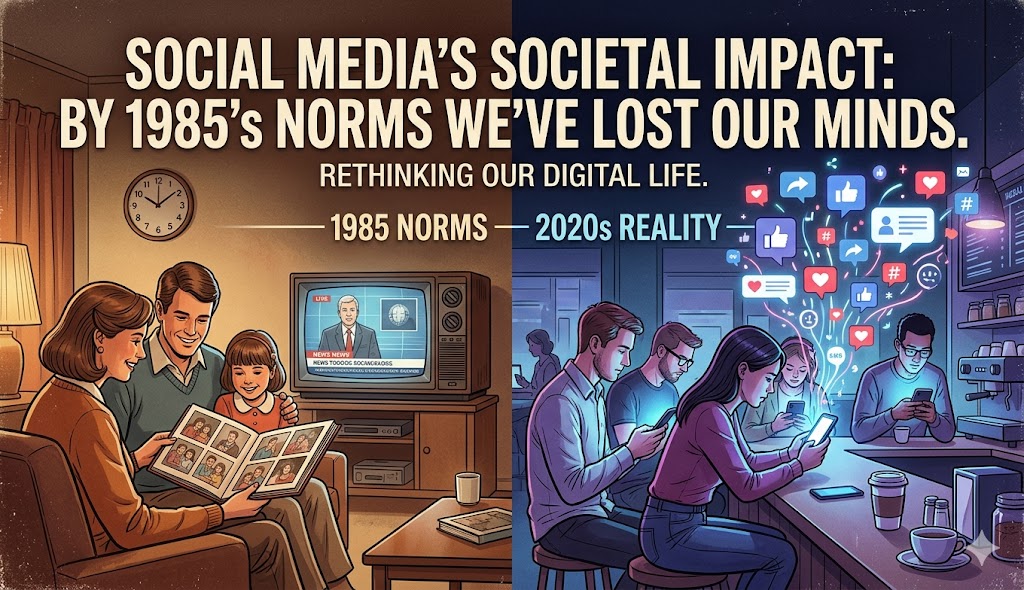
I’ve spent more time than I care to admit contemplating how our personal and professional lives have been transformed by digital technology. Often, I find myself staring at my smartphone as if I were looking through the ‘looking glass,’ wondering how my 1985 self, when my wardrobe was Miami Vice influenced, I was listening to Phil Collins, Madonna, Dire Straits, and Bruce Springsteen, dared to eat sushi, and was strategically bar hopping on Friday nights, would make of this glass-and-metal slab, the size of a chocolate bar, that’s always with me.
In 1985, I was connected to the world by being in it, not by scrolling through it.
If I had the chance to tell 1985-Nick what 2026 would look like, give young me a ‘heads up’, I imagine 1985-Nick would respond:
“Let me get this straight. Everyone carries a glowing glass slate and stares at it all day, even when with family and friends. Furthermore, when they eat out, they take pictures of their food and anxiously wait for strangers to ‘like’ them. You’re telling me everyone has a phone, but they only use it to type because talking to someone causes anxiety, yet these same people post their private moments for the world to see, and some get paid for it? You’re telling me everyone is connected 24/7, yet loneliness is an epidemic? Does anyone ever just sit in silence? Like, ever?”
1985-Nick would be right. If someone in 1985 had told me that we’d be carrying a supercomputer in our pocket, which we’d use to seek attention or argue with strangers about ‘who’s right’ or ‘who’s morally superior’ and look at pictures of other people’s staged life events, I’d have told them to ease up on the science fiction. But here we are, with social media having become the dominant form of human interaction, a party line for the entire world, with everyone shouting at once.
Back in the ’80s, sharing a photo of your dinner was a logistical marathon involving a Kodak Disc camera, a trip to the nearest Shoppers Drug Mart to develop the film, and a physical trek to a friend’s house just to show them a grainy 4×6 of a Salisbury steak. Today, we do this instantly. Why? Because we’ve collectively decided that if a kale salad isn’t uploaded to Instagram, it doesn’t actually contain any nutrients.
In 1985, ‘following’ someone meant you were either a private investigator like Thomas Magnum or a serial killer. Today, someone with 10,000 followers is considered an “influencer.” In contrast, in the ’80s, an influencer was your friend who convinced you and everyone else that flip-up sunglasses were ‘high fashion.’ As for ‘Likes,’ imagine walking through the Eaton Centre and slapping a ‘thumbs up’ sticker on a stranger’s forehead because you admired their perm. You’d be arrested. Now, we crave those digital thumbs-ups like oxygen, trading genuine human validation for a dopamine hit delivered by a server that consumes more electricity than a small Canadian town.
Back in the 80s, I was just a kid who spent too much time in neon-drenched arcades, feeding quarters into Pac-Man and BurgerTime machines sweating to get a high score that would be wiped-out the moment the power flickered.
What’s most distressing is the death of the ‘Unrecorded Moment.’ In the 80s, if you did something stupid at a party, such as breakdancing and kicking over the punch bowl, the only evidence was the collective memory of six people too drunk on Boone’s Farm and Southern Comfort to remember it the next day. Now, seventeen high-definition angles of your failure are uploaded to TikTok before you’ve picked yourself up. Gone are the days of being an idiot in private.
Additionally, we ‘Doomscroll.’ In the 80s, if you wanted to feel depressed about the world, you had to wait for the six o’clock news with Knowlton Nash. Today, we carry misery in our pockets, scrolling through a never-ending feed of global catastrophes and high school acquaintances lying about their success. Everyone’s a brand, everyone’s a critic, and nobody’s listening. We’ve traded the backyard barbecue for the digital coliseum.
If I could time-travel back to the era of New Coke and Tab, I’d tell 1985-Nick to cherish his rotary phone. Sure, it took three minutes to dial, and the coiled cord was a tripping hazard, but when it wasn’t ringing, the world was quiet. You weren’t being ‘notified’ that a stranger in Saskatoon hates your take on The Breakfast Club. You weren’t being stalked by an algorithm that’s already sold your interest in a front-loading VCR to three different retailers before you’ve even walked into a RadioShack.
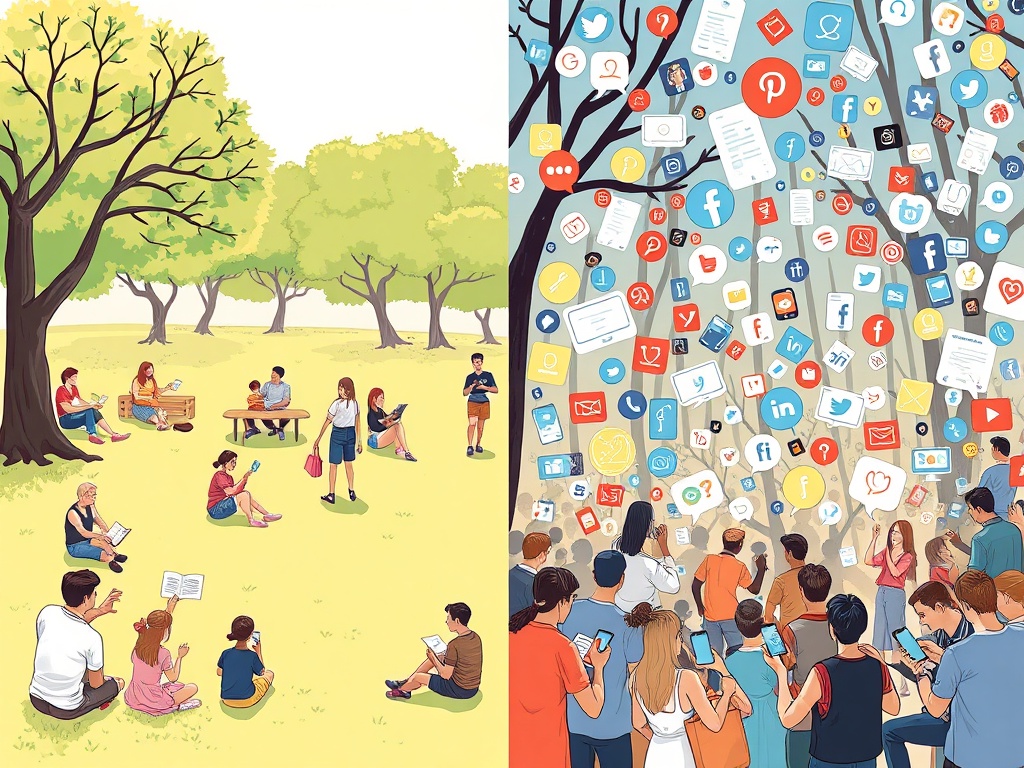
Most of all, I’d advise 1985-Nick to make the most of his time when the community he was growing up in was rooted in physical reality, not digital performance. While we’re more connected than any generation in human history, we’re also, ironically, more isolated than ever. Sadly, we’ve allowed ourselves to be rewired to value ‘the look of a life’ over ‘the substance of life.’
About The Author