Runway Collision at LaGuardia: Air Canada Crash Kills Two Pilots, Injures Dozens, Grounds Hundreds of Flights
- TDS News
- Breaking News
- March 23, 2026
By: Donovan Martin Sr, Editor in Chief
The investigation into the Air Canada Express crash at New York’s LaGuardia Airport is now underway, as officials work to determine how a landing aircraft and a ground vehicle came to occupy the same active runway at the same time.
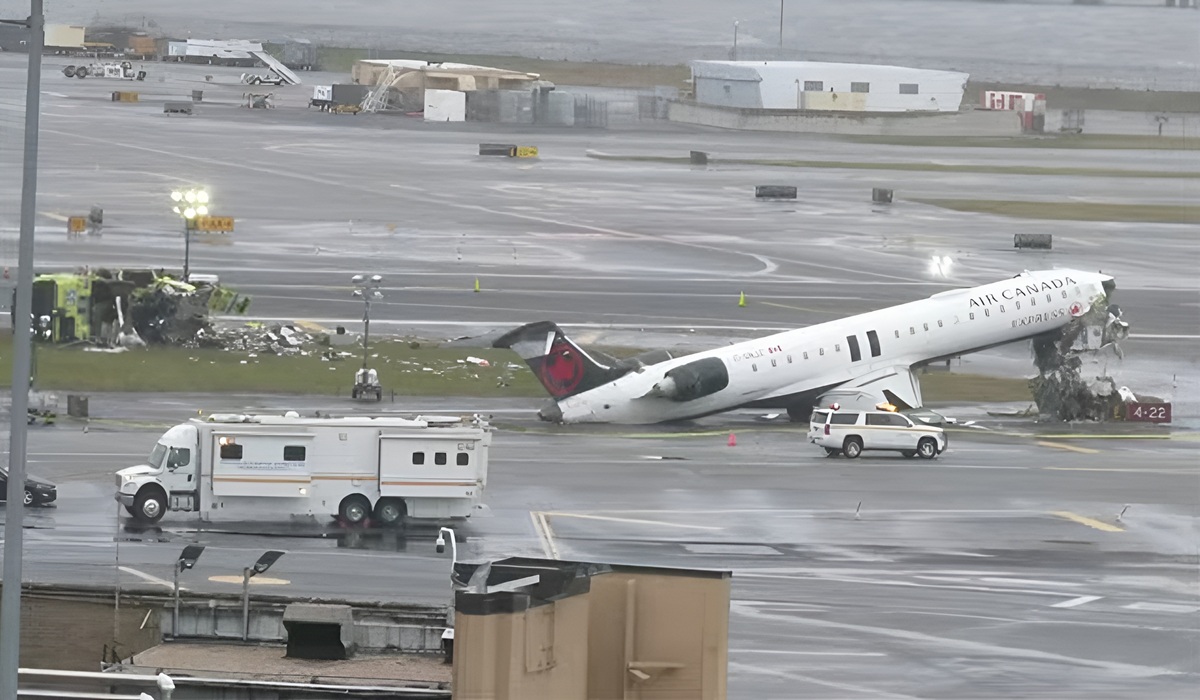
The crash occurred late Sunday night when an Air Canada Express CRJ 900 arriving from Montreal had already landed and was rolling out on the runway when it collided with a fire response vehicle. The impact destroyed the cockpit area and resulted in the deaths of both pilots, while passengers were evacuated as emergency crews responded on the ground. A total of 41 people were taken to hospital following the crash, as first responders worked through the night to treat injuries and secure the scene.
The incident also triggered an immediate shutdown of LaGuardia Airport, halting operations and leading to hundreds of flight cancellations and delays as one of New York’s busiest airports was effectively brought to a standstill.
As investigators begin reviewing communications, sequencing, and runway movements, early thoughts from individuals with aviation experience are helping frame possible scenarios based on what is currently understood.
Captain Ross Aimer, a leading and renowned aviation expert, shared his perspective on what may have been unfolding inside the tower. He said, “I’ll bet the Tower/Ground Controller was fatigued and perhaps working several frequencies and positions by himself. He realized the mistake a little too late and you can hear him yelling ‘STOP, STOP, STOP!’” His comments point to the possibility of workload and timing playing a role as the situation developed in a very short window.
Don Chapman, a retired pilot with decades of experience, offered his thoughts based on what he described as limited knowledge of the situation. He pointed to what he believes could have been two breakdowns occurring at the same time, saying the issue appeared to involve both the tower issuing clearance for the fire truck to cross the runway and the vehicle not ensuring the runway was clear before proceeding.
He also addressed the moment the aircraft was already on the ground, noting, “It would seem the Air Canada plane had landed and was at a speed that it could not do a ‘go around.’ Hence, when the Fire truck pulled out in from there was nothing the pilots could do.” That observation places focus on timing and distance, as once an aircraft is committed to the landing roll, the ability to avoid an unexpected obstacle becomes extremely limited.
Chapman further pointed to standard runway practices, emphasizing that aircraft operate with bright landing lights while on the runway and questioning how such a situation could develop without visual awareness. He also suggested that, in his view, the fire truck may have acted on tower instructions without independently confirming the runway was clear.
Beyond the immediate sequence of events, Chapman spoke more broadly about pressures within the system, including workload, stress, and the tools used in air traffic control, raising concerns about how those factors can contribute to situations where mistakes occur.
He concluded by returning to the fundamentals of runway safety, emphasizing the importance of visually clearing a runway before crossing and the routine checks pilots and crews are trained to perform before entering any active runway.
As the investigation continues, officials will examine the exact sequence of clearances, the actions taken on the ground, and the timing between the aircraft’s landing and the vehicle’s entry onto the runway. The findings will ultimately come from recorded communications, operational data, and a detailed reconstruction of those final moments.
For now, the focus remains on understanding how those movements converged, and why the safeguards in place did not prevent the collision.
About The Author