Preemptive Bombing in the Name of Decapitation: America and Israel Cross a Dangerous Line
- Hami Aziz
- Breaking News
- Middle East
- February 28, 2026
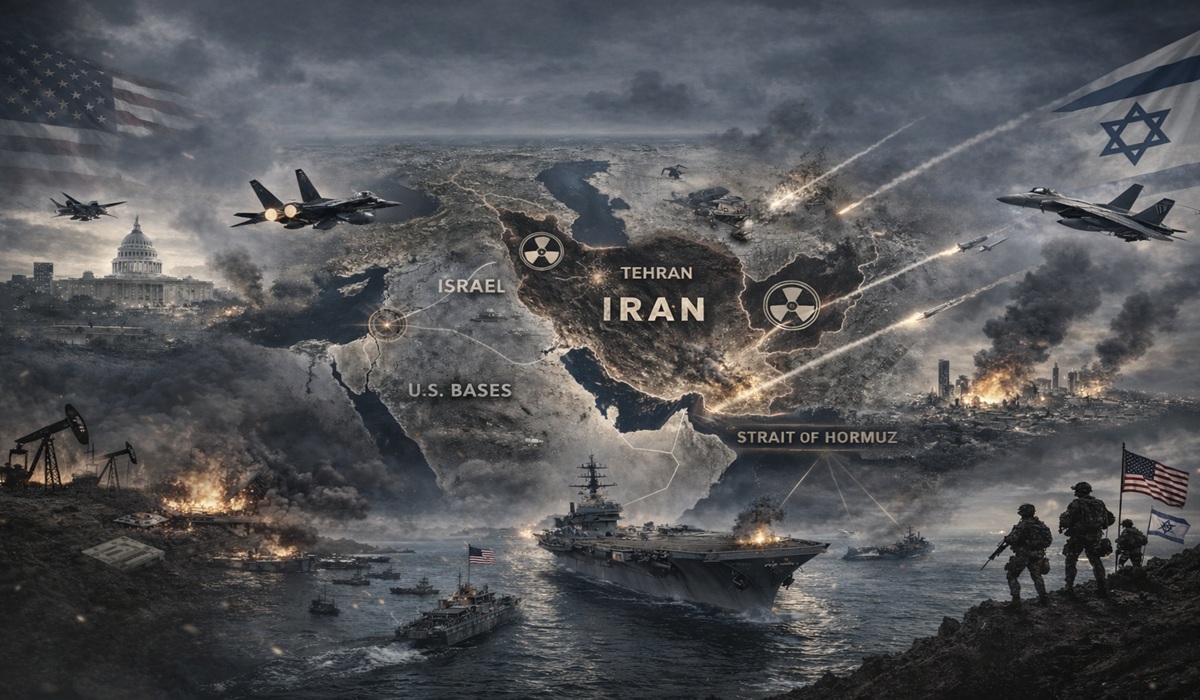
The world woke up to language that was meant to sound precise but instead landed like a thunderclap. Washington and Jerusalem described their joint action against Iran as a “decapitation strike,” a phrase designed to communicate surgical necessity and strategic clarity. The objective, officials said, was to cripple leadership, dismantle command structures, and permanently halt Iran’s alleged path to nuclear weapons capability while also degrading its ballistic missile arsenal. The message was framed as preemptive defense. The implications are far more complex.
For nearly five decades, Americans have been told that Tehran is inching toward a nuclear weapon. Under President Barack Obama, the United States and several world powers negotiated the Joint Comprehensive Plan of Action, an agreement that limited uranium enrichment, imposed inspection protocols, and slowed nuclear development timelines. The deal was controversial, but inspectors repeatedly confirmed compliance during its enforcement period. Critics argued it postponed rather than eliminated the threat. Supporters argued it constrained it measurably.
When President Donald Trump withdrew from that agreement, sanctions returned at full force, covert operations intensified, and regional tensions escalated. At various moments, U.S. and Israeli officials described their actions as having significantly crippled Iran’s enrichment infrastructure and military capacity. The language was confident, even triumphant. Now, years later, the argument returns that Iran remains close enough to nuclear capability to justify a fresh round of preemptive force. The contradiction is unavoidable. If prior operations destroyed the capability, why is it necessary to destroy it again? Either earlier assessments overstated success, or the strategic objective has expanded beyond nuclear containment into a broader attempt at deterrence recalibration or regime pressure.
The demands now being articulated go further than enrichment limits. Washington has publicly insisted that Iran must not only permanently abandon nuclear weapons capability but also dismantle its ballistic missile program. From Tehran’s perspective, those missiles serve as deterrent in a region where Israel maintains overwhelming air superiority and sophisticated weaponry. No sovereign state willingly surrenders both strategic deterrence and defensive capacity under open threat of military action. Imagining another country demanding that the United States eliminate its missile systems as a precondition for talks illustrates the asymmetry. Diplomacy framed around unilateral disarmament does not feel like negotiation; it feels like coercive leverage.
None of this excuses Iran’s own destabilizing regional activities or internal repression. It does, however, require intellectual consistency when evaluating escalation. Military logic demands clarity about objectives and exit strategies, not repetition of claims that shift over time.
The phrase “decapitation strike” also carries assumptions that deserve scrutiny. Iran’s political structure is not built around a single figure whose removal guarantees ideological transformation. Power resides across institutions including the Supreme Leader, elected bodies, and the Islamic Revolutionary Guard Corps. Removing high-ranking individuals does not dissolve entrenched networks or long-standing ideological commitments. External attack frequently strengthens hardline factions and discredits moderates. Nationalist sentiment tends to surge under bombardment, not fragment.
Israel’s security doctrine must be understood in its own historical context. Shaped by geography and existential conflict, it has long embraced preemption as survival strategy. That doctrine explains a willingness to strike perceived future threats before they materialize. However, international law draws a sharp distinction between preemptive action against imminent attack and preventive war against potential future capability. If Iran was not on the verge of deploying a nuclear weapon, the operation moves closer to preventive war, which carries weaker legal justification under established norms. That distinction influences global perception and diplomatic fallout.
An additional complexity that cannot be ignored involves Israel’s own nuclear posture. While maintaining official ambiguity, Israel is widely understood by defense analysts and former officials to possess nuclear weapons. It has not signed the Nuclear Non-Proliferation Treaty, and its facilities are not subject to the same inspection regime imposed on signatory states. Iran’s enrichment sites have been scrutinized by the International Atomic Energy Agency under negotiated frameworks, yet Israeli nuclear infrastructure remains outside comparable oversight. This disparity fuels accusations of double standards. If one state faces military action over suspected nuclear ambition while another retains undeclared capability without inspection, global perceptions of fairness erode. Non-proliferation depends not only on enforcement but on credibility. When enforcement appears selective, compliance weakens internationally.
Escalation rarely unfolds all at once; it climbs. Retaliation could emerge through Hezbollah in Lebanon, drawing northern Israel into sustained conflict. Militias in Iraq could target U.S. bases, prompting further American strikes. Houthi forces in Yemen could intensify maritime disruption in the Red Sea. Cyber retaliation could hit civilian infrastructure far from the battlefield. Each rung on that ladder increases unpredictability.
The most immediate economic flashpoint is the Strait of Hormuz, a narrow maritime corridor between Iran and Oman through which a substantial share of global oil supply transits daily. Even limited disruption would send energy markets into shock. Gasoline prices in North America would rise rapidly. European economies already strained by inflation would absorb additional pressure. Asian markets heavily dependent on Gulf energy would feel immediate impact. Insurance premiums for tankers would spike, compounding global shipping costs. Iran has invested in asymmetric maritime capabilities designed precisely for confined waters, including anti-ship missiles, drones, and mines. These systems are not meant to defeat superior navies outright; they are designed to impose cost. A single successful strike on a major naval vessel would reverberate economically and psychologically across markets.
Military campaigns demand endurance. Sustained operations strain industrial capacity, personnel morale, and political patience. Reports in recent years have highlighted logistical pressures within Western defense structures. Even perception of overstretch shapes adversary calculation. War is not decided only by hardware but by resilience.
Global powers are watching closely. China relies heavily on Gulf energy imports and will weigh its diplomatic and economic response carefully. Russia benefits strategically from elevated oil prices and Western distraction. Neither may intervene directly, but both can exploit instability. Sanctions regimes become harder to enforce when geopolitical fractures widen.
Arab governments in the region have reportedly shown reluctance to host offensive staging operations. Their calculus is straightforward. Retaliation would not discriminate neatly between military and civilian infrastructure. Ports, energy facilities, desalination plants, and airports could become targets in broader confrontation.
The United States carries historical memory that tempers confidence. Afghanistan consumed two decades and concluded with Taliban return. Iraq destabilized the region for years after regime change. Vietnam remains emblematic of overreach. Empires often strain under cumulative commitments rather than singular defeat. The United States faces significant national debt and domestic polarization. A prolonged regional war layered atop economic fragility magnifies systemic stress. Israel, too, would confront sustained pressure on its reserve-based military model and internal cohesion if conflict expanded across multiple fronts.
The most pressing strategic question remains unanswered: what is the endgame? If leadership is removed, who governs on day one? Fragmentation risks civil conflict. Power vacuums invite proxy wars. Regime change without structured transition planning historically produces instability rather than resolution.
War reshapes societies long after initial objectives fade. It alters families in Tehran, Tel Aviv, Haifa, and in American towns whose service members deploy into uncertainty. Economic shock does not discriminate between ideologies. Energy spikes strain working households. Markets react immediately, while conflicts rarely conclude quickly.
There are legitimate concerns about Iran’s nuclear ambitions and missile programs. Those concerns are shared across multiple capitals. However, addressing them through escalating force while ignoring contradictions, double standards, and historical precedent carries enormous risk. Military power can destroy infrastructure, but it cannot erase nationalism, geography, or consequence. Once conflict expands, it follows its own logic, indifferent to early assurances of precision. History offers a consistent lesson: war rarely unfolds according to briefing-room timelines, and its ultimate cost extends far beyond the battlefield.
About The Author