Occupation Without End: Trump Declares Indefinite American Rule Over Venezuela
- TDS News
- Breaking News
- January 3, 2026
By: Donovan Martin Sr, Editor in Chief
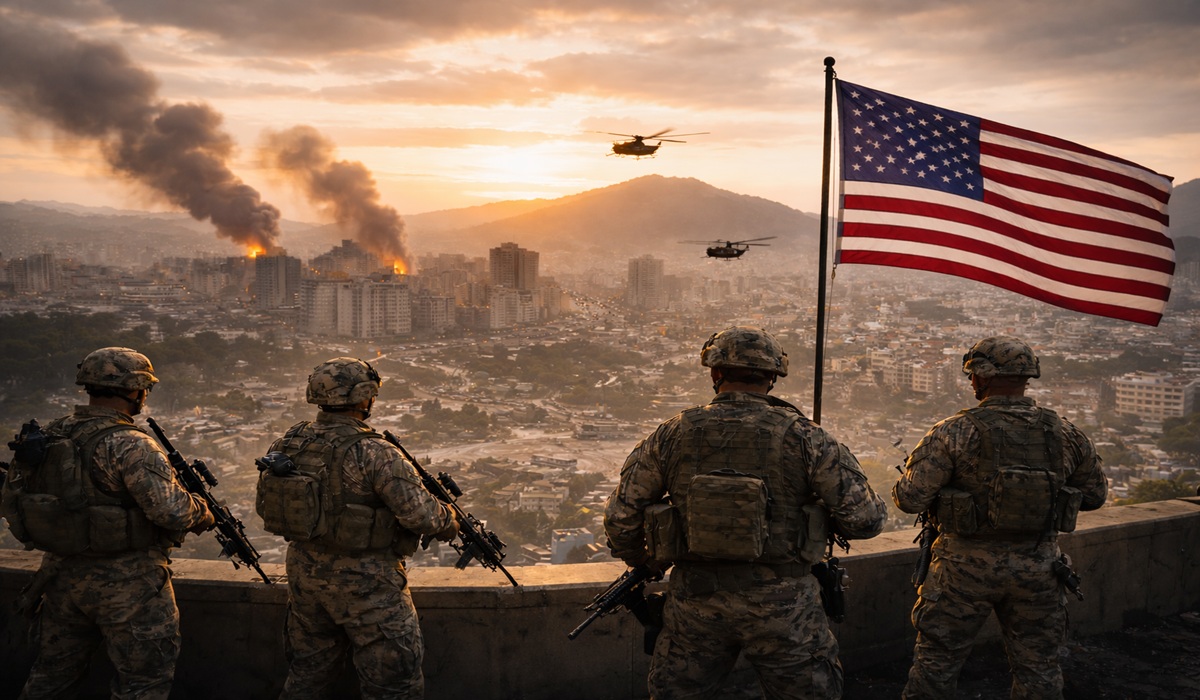
What unfolded earlier today marks one of the most consequential and destabilizing moments in modern international relations. The United States, under the direct order of President Donald Trump, launched a large-scale military operation in Venezuela that resulted in the removal of Venezuelan President Nicolás Maduro and his wife, Cilia Flores, from power. Following the operation, President Trump publicly stated that the United States would run Venezuela indefinitely and assume control over the country’s governance while restructuring its oil sector under American oversight and corporate management.
This declaration was not framed as a temporary stabilization mission, nor as a multilateral intervention, nor as a narrowly defined counterterrorism or counternarcotics action. The language used was explicit. The United States, according to the president, will administer Venezuela for an open-ended period, and American companies will be involved in operating the country’s vast oil reserves. The permanence implied by those remarks represents a sharp break from decades of diplomatic norms and postwar international legal standards.
Maduro and Flores are now in U.S. custody and are expected to face charges in the United States related to narcotics trafficking. That legal justification has been presented as the basis for the operation. However, the scope of what followed goes far beyond extradition or targeted law enforcement. Military force was used to remove a sitting head of state, and the administration of an entire sovereign nation was claimed by a foreign power.
This is not an argument in defense of Nicolás Maduro. Venezuela under his leadership has endured severe economic collapse, widespread shortages, allegations of corruption, repression of dissent, and mass emigration. Millions of Venezuelans have suffered, and calls for accountability are not without merit. But international law does not grant one nation the authority to depose another nation’s government and assume indefinite control over its territory and resources based on those failures alone. If it did, no state would be safe from the political judgments of more powerful ones.
What makes today’s events especially alarming is not only the use of force, but the clarity with which it was justified. This was not couched in the language of reluctant necessity or constrained intervention. It was presented as a matter of control, management, and outcome. Venezuela’s oil, among the largest proven reserves in the world, was openly referenced as part of the post-operation plan. That candor removes any lingering ambiguity about motive.
History offers little comfort in moments like this. Every major U.S. intervention framed as liberation or stabilization has followed a familiar trajectory. Afghanistan was entered under the promise of dismantling terror networks and building a functional state. It ended with decades of war, massive resource surveying, and a withdrawal that left the country fractured. Iraq was invaded under claims of security and democracy and became a proving ground for privatized warfare, oil restructuring, and long-term instability. Libya’s intervention, sold as humanitarian protection, dismantled the state and left a vacuum filled by militias and trafficking networks. Syria’s oil infrastructure has been repeatedly entangled in foreign military objectives rather than national recovery.
In none of these cases did the local population ultimately control the benefits of their own natural resources. In each, foreign interests extracted value while ordinary citizens paid the price in instability, violence, and lost sovereignty. To believe Venezuela will somehow be different under foreign military administration requires ignoring every modern precedent.
The global reaction has been swift and severe. Governments across Latin America and beyond have condemned the operation as a violation of international law and a threat to regional stability. Even among U.S. allies, concern is growing over the implications of a doctrine that openly endorses regime removal and indefinite foreign governance. Within the United States itself, lawmakers from both parties have raised questions about the absence of congressional authorization and the constitutional implications of launching such an operation without legislative approval.
There is also the matter of political legitimacy within Venezuela. Opposition leader María Corina Machado, who was awarded the Nobel Peace Prize earlier this year, has long advocated for international pressure against Maduro. But any endorsement, explicit or implicit, of a foreign invasion and forced regime change raises serious ethical questions. Peace is not achieved by bypassing a nation’s political process through military power. A leader who welcomes external force to install authority does not strengthen democracy; they undermine it at its foundation.
Beyond legality and ethics lies the broader and more dangerous issue of precedent. When a superpower declares that it can remove a foreign government, administer a nation indefinitely, and restructure its economy under military protection, it erodes the very framework it relies on to defend its own sovereignty. Once such actions are normalized, the distinction between lawful authority and raw power begins to dissolve.
The administration has argued that this action will make Americans safer. That claim does not withstand scrutiny. History shows that interventions of this magnitude expand, rather than reduce, the number of actors willing to retaliate asymmetrically. They increase the likelihood of economic blowback, cyber retaliation, proxy conflicts, and long-term entanglement. They also invite other powerful nations to justify similar actions under their own definitions of security and justice.
The seizure of Venezuelan oil may appear advantageous in the short term. But oil markets are interconnected. Disrupting supply chains, alienating trade partners, and triggering retaliatory measures will have global consequences. Countries that depend on Venezuelan crude will not quietly absorb this shift. Economic pressure, diplomatic isolation, and strategic realignments will follow.
Perhaps the most unsettling aspect of today’s events is the ease with which they were articulated. The language of indefinite control was delivered without hesitation, as though it were a reasonable extension of executive authority. That should concern every American, regardless of political affiliation. When foreign governance becomes a matter of presidential declaration rather than legal process, the boundary between external action and internal precedent grows thin.
This moment is not just about Venezuela. It is about whether the international system will continue to be governed by law, imperfect as it is, or by power exercised without restraint. It is about whether resource control is once again being normalized as a legitimate outcome of military force. And it is about whether democratic nations can still credibly argue that sovereignty and self-determination matter.
No credible evidence suggests that ordinary Venezuelans will benefit from American companies controlling their oil under military oversight. There is no historical model that supports that belief. What history does show is that once a nation loses control over its resources, reclaiming them becomes extraordinarily difficult, and the political consequences last for generations.
The United States has crossed a threshold today. By declaring indefinite administration of another sovereign nation, it has stepped beyond intervention and into occupation by definition, regardless of the language used to soften it. The long-term consequences of that choice will not be confined to Caracas. They will echo through global diplomacy, international law, and America’s own democratic institutions.
This is not a moment that can be walked back with clarifications or rebranding. It is a moment that will be studied, cited, and invoked by others for years to come. And once the principle is established that power alone determines legitimacy, no nation can credibly claim immunity from that logic.
What was done today will shape the world that follows. Whether that world is more stable or more dangerous will depend not on rhetoric, but on whether restraint, accountability, and law are allowed to reassert themselves after the force has been applied.
Digital Image Generation
About The Author