Nunavut MP Lori Idlout Crosses the Floor as Liberals Move Closer to Majority
- Kingston Bailey
- Breaking News
- March 11, 2026
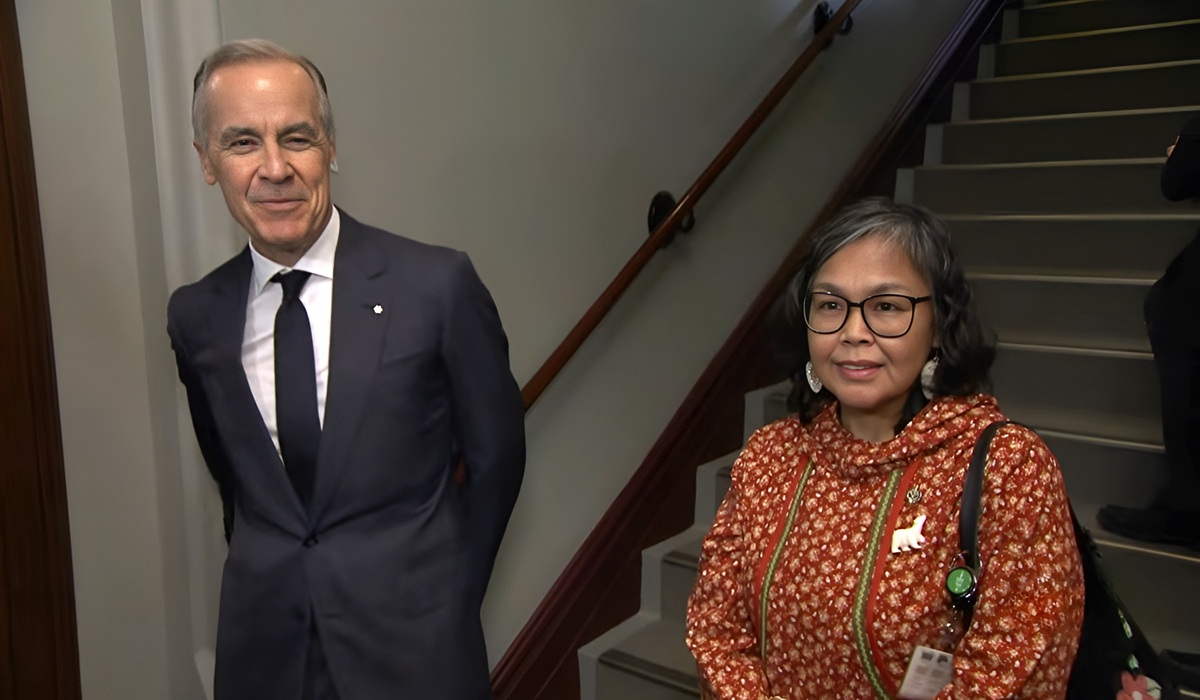
Canadian politics took another dramatic turn this week as Nunavut Member of Parliament Lori Idlout walked alongside Prime Minister Mark Carney into the Liberal caucus room after announcing she was leaving the New Democratic Party to join the governing Liberals. The move instantly shifted the balance of power in the House of Commons and brought the government to the very edge of majority control.
Idlout’s decision is notable not only because she represents Nunavut, but also because she is the fourth opposition MP in recent months to cross the floor and join the Liberal benches. The previous defections came from Conservative MPs, making Idlout the first New Democrat in this recent wave to abandon her party and align herself with the government.
In parliamentary politics, numbers matter above all else. Canada’s House of Commons has 343 seats, and a party must hold 172 seats to form a majority government capable of passing legislation without relying on opposition support. After Idlout’s switch, the Liberals now sit at roughly 170 seats, placing them just two seats shy of the majority threshold.
That narrow gap has turned the next few weeks into one of the most closely watched political moments in Ottawa. Three federal by-elections scheduled for April could determine whether the Liberal minority quietly becomes a majority government. The races are set to take place in Scarborough Southwest and University–Rosedale in Toronto, along with Terrebonne in Quebec. Two of those ridings were previously held by Liberal MPs and are widely seen as favourable territory for the governing party, while the Quebec contest is expected to be more competitive.
If the Liberals manage to win two of the three by-elections, they would reach the magic number of 172 seats and secure a majority in the House of Commons.
For the New Democratic Party, Idlout’s departure is another blow to a caucus that has already been reduced in size since the last federal election. Losing an MP in the middle of a parliamentary session weakens the party’s influence and raises uncomfortable questions about internal stability and long-term strategy.
Floor crossings are not unheard of in Canadian politics, but they rarely occur without careful political calculation. Members of Parliament often explain such moves by saying they want to better represent their constituents or have a stronger voice within government. Critics, however, tend to see something else at play.
The reality is that politics in Ottawa can be remarkably cutthroat. Governments do not gain MPs by accident, and crossing the aisle usually comes with serious political negotiations behind closed doors. The promise of influence, committee roles, policy concessions, or future opportunities can make the government benches look far more appealing to MPs sitting in opposition.
Canadians should not underestimate the strategic instincts of a prime minister determined to strengthen his position in Parliament. A minority government constantly has to negotiate with opposition parties to survive confidence votes and pass budgets. A majority government, on the other hand, can set the legislative agenda with far greater control.
By steadily adding MPs to the Liberal caucus through defections and positioning the party for potential by-election victories, the government has moved closer to transforming a fragile minority into a stable majority without ever calling a national vote.
The image of Idlout walking with the prime minister into the Liberal caucus meeting was more than symbolic. It represented a quiet but powerful shift in the political math of Parliament.
With only two seats now separating the Liberals from majority power and three key by-elections approaching, the next few weeks could determine whether Canada’s minority government remains dependent on opposition cooperation or becomes a majority administration with the numbers to govern on its own.
In Ottawa, the arithmetic of power can change quickly. And when it does, it often reveals just how relentless the struggle for political advantage can be behind the scenes of Canada’s parliamentary democracy.
About The Author