Low-Cost Marketing Ideas You Can Implement to Jumpstart Sales in 2026
- Kevin Toney - the Marketing Coach
- Business
- January 5, 2026
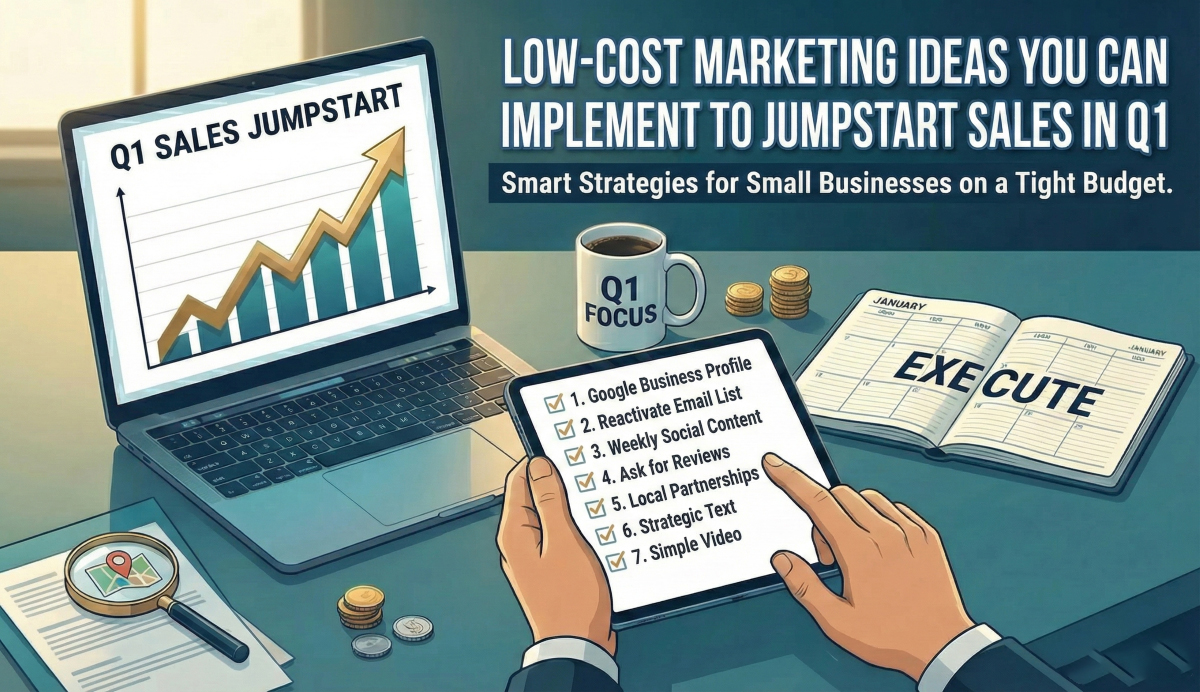
You just survived the holidays. Your cash flow is tight, bills are stacked on your desk, and you’re staring down Q1 with one question burning in your mind: How do I bring in more customers without spending a fortune?
Here’s the uncomfortable truth most small business owners face in January: Your competitors are thinking the same thing. The difference between businesses that thrive this quarter and businesses that barely survive often comes down to one thing—knowing exactly which marketing levers to pull when money is tight and time is limited.
Introduction: The Q1 Marketing Trap Most Small Businesses Fall Into
If you’re running a small local business with 15 employees or fewer, you know the drill. You’re juggling payroll, customer service, inventory, and somewhere in that chaos, you’re supposed to be marketing your business too.
The common misconception? That effective marketing requires a big budget and a dedicated team. Business owners see their competitors posting on social media constantly, running ads, sending emails, and assume they can’t compete without spending thousands of dollars.
Here’s what’s actually true: The businesses winning in Q1 aren’t the ones spending the most money. They’re the ones executing the right strategies consistently. They’re pulling specific, proven marketing levers that don’t require massive budgets—just focus and follow-through.
This matters because Q1 sets the tone for your entire year. While your competitors are waiting to “see how things go,” you can be capturing customers who are actively looking for solutions right now. The businesses that move fast and smart in these first 90 days own their market by summer.
Why Q1 Marketing Actually Matters More Than You Think
Let’s address the elephant in the room: Q1 feels slow for most local businesses. The holiday rush is over, customers are watching their wallets, and it’s tempting to coast until things “pick up.”
But here’s what the data actually shows. Nearly half of small businesses (49%) are planning to increase their marketing budgets in 2026, while only 16% are planning to decrease them. That means your competition is ramping up, not slowing down.
The Real Challenges You’re Facing
The struggle is real, and it’s not just you. 75% of small businesses cite rising costs of goods and services as a top financial challenge, 56% struggle with paying operating expenses, and 51% deal with uneven cash flow.
You can’t throw money at marketing when you’re watching every dollar. That’s exactly why low-cost, high-impact strategies matter so much right now.
Here’s the misconception that’s killing small businesses: They think marketing requires a choice between “expensive and effective” or “cheap and worthless.” That’s completely false. The seven strategies in this article prove you can get serious results without breaking the bank—but only if you stop making excuses and start executing.
The risk of doing nothing? 45% of small businesses say getting new leads and customers will be challenging in 2026. While you’re waiting for business to come to you, your competitors are out there capturing the customers who should be yours.
The opportunity? While everyone else is stuck in this mindset, you can be the business that shows up consistently, builds trust, and captures market share at a fraction of what larger competitors spend.
The 7 Marketing Levers That Actually Move the Needle (And What They’ll Cost You)
Lever #1: Optimize Your Google Business Profile (Cost: $0, Time: 2 Hours)
This is the single biggest missed opportunity for local businesses. Here’s a stat that should wake you up: 97% of people look for local businesses on the internet, and 34% of local businesses are found in over 1,000 discovery searches each month.
Your Google Business Profile is often the first thing potential customers see before they ever visit your website. Verified Google Business Profiles with complete data are 80% more likely to appear in search results. That’s not a small advantage—that’s the difference between being found or being invisible.
Most local businesses set up their profile once and forget about it. That’s leaving money on the table. Here’s what to do this week:
- Verify your profile if you haven’t already (this alone increases your visibility)
- Update your winter hours and add any Q1 specials or promotions
- Upload 10-15 recent, high-quality photos (exterior, interior, products, team)
- Write a complete business description using keywords customers actually search for
- Respond to every review—positive and negative—within 24-48 hours
- Post weekly updates about what’s new in your business
Why this works: 86% of Google Business Profile views come from category-based searches like “plumber near me” or “best bakery in [city].” Most customers don’t know your business name when they start searching. They’re looking for what you do, not who you are.
One more critical fact: 80% of consumers don’t trust businesses that display inconsistent contact details online. Make sure your name, address, and phone number are identical everywhere online—your website, Facebook, directories, everywhere.
Lever #2: Reactivate Your Dormant Email List (Cost: $0-$50, Time: 3 Hours)
Email isn’t dead. It’s one of the most profitable marketing channels available to small businesses. Email marketing delivers an average ROI of $36 for every dollar spent. For the cost of lunch, you could generate thousands in sales.
81% of small businesses use email as their primary customer acquisition channel, and 80% use it for retention. The businesses that master email marketing have a massive advantage over those that ignore it.
The best part? You already have the customers. They’re sitting in your email list or customer database right now, waiting for you to reach out.
Here’s your Q1 reactivation plan:
Week 1: Send a “We miss you” email to customers you haven’t seen in 3+ months. Keep it personal. Write like you’re talking to a friend.
Week 2: Share a customer success story or testimonial. Show people the results others are getting from your product or service.
Week 3: Make a specific offer with a deadline. Give people a reason to act now—15% off, free upgrade, early access to something new.
The numbers don’t lie. Welcome emails achieve 68.6% open rates, and personalized subject lines generate 50% higher open rates. People want to hear from businesses they’ve bought from before—you just have to reach out.
Real-world proof: A furniture and home decor company was making $0 from email marketing despite running a successful business generating $63K monthly. After implementing a proper email strategy, they increased their monthly revenue to $289K—all from customers who were already on their list.
Lever #3: Create One Strong Piece of Social Content Per Week (Cost: $0, Time: 4 Hours/Week)
Here’s what you need to understand about social media: 52% of small businesses use social media marketing, followed by 47% using social media ads. But here’s the key—you don’t need to be everywhere. You need to show up consistently on one platform.
Pick where your customers actually spend time. For most local businesses, that’s Facebook or Instagram. Don’t spread yourself thin trying to conquer TikTok, LinkedIn, Twitter, and Pinterest. Master one platform first.
What to post each week:
- Customer results with permission – Nothing sells better than real results from real people
- Behind-the-scenes content – Show your team, your process, what makes you different
- Answer common questions – The questions customers ask you every day? Answer them publicly
- Quick tips related to your industry – Give away valuable knowledge for free
- Local community involvement – Show you’re invested in your community
Why this matters: 78% of marketers said social media has become consumers’ preferred customer service channel. Your posts aren’t just marketing—they’re relationship building. When someone comments, reply within a few hours.
Real-world example: A small all-natural beauty products company generated 54,874 total fans in just 11 months through consistent social media marketing. They didn’t have a massive budget. They had a strategy and they executed it every single week.
For local businesses specifically, join 3-5 active local Facebook groups and contribute genuinely. Answer questions, share helpful information, and build relationships. When people know and trust you in these groups, they buy from you.
Lever #4: Ask Happy Customers for Reviews Right After Service (Cost: $0, Time: 1 Hour/Week)
Reviews aren’t nice to have—they’re essential. Only 13% of consumers would consider engaging with a business that had a 1- or 2-star average rating. Your reviews either build trust or destroy it before potential customers ever contact you.
The problem? Most business owners wait for reviews to happen naturally. That’s like waiting for customers to walk through your door without any marketing. You have to ask.
Here’s the simple system that works:
- Right after delivering great service or completing a sale, send a text message thanking them
- Include a direct link to your Google review page (make it one click away)
- Follow up with email 2-3 days later if they haven’t left a review
- Make it as easy as humanly possible—no extra steps, no complicated forms
Critical stat: 91% of consumers are more likely to do business with a brand that replies to all reviews, whether positive or negative. Reviews aren’t a one-way street. Your responses show future customers how you treat people and handle feedback.
Set a specific goal: Get 5 new Google reviews by the end of January. Then 10 more in February. Businesses with higher rankings often have many more reviews on Google than businesses who ranked lower, with top-ranking positions having over 200 reviews on average.
Lever #5: Partner with Complementary Local Businesses (Cost: $0, Time: 2 Hours Setup)
Your best marketing partner might be right down the street. Find 2-3 businesses that serve the same customers but aren’t direct competitors.
Examples: A wedding photographer and a florist. A gym and a smoothie shop. A hair salon and a boutique. A plumber and an electrician. A restaurant and a local brewery.
Create simple cross-promotions that benefit both businesses:
- Display each other’s business cards, flyers, or brochures prominently
- Offer a joint discount: “Show your receipt from [Partner Business] and get 10% off today”
- Share each other’s social media posts and tag each other
- Create a bundled service package that combines what you both offer
- Refer customers to each other when appropriate
Why this works: You’re reaching customers who already trust the business referring them. It’s warm introductions at scale, not cold outreach.
Set up one coffee meeting this week with a potential partner business. Come prepared with specific ideas for how you can help each other. Make it about mutual benefit, not just “promote my business.”
Lever #6: Send One Strategic Text Message Per Month (Cost: $20-$100, Time: 30 Minutes)
Nearly a third of the public look up information about local businesses online at least once a day, but here’s the difference with text—messages get opened within 3 minutes, 90% of the time. Email might sit in an inbox for days. A text gets seen immediately.
You don’t need a complicated system. Start simple:
- Collect phone numbers at checkout or point of sale (with clear permission)
- Send ONE message per month with a time-sensitive offer or update
- Keep it short and personal: “Hi [Name], it’s [Your Business]. We’re running a special this week: [Offer]. Reply STOP to opt out.”
- Always include an easy way to unsubscribe
Text marketing works especially well for:
- Appointment-based businesses (dentists, salons, contractors)
- Time-sensitive promotions (“Flash sale ending tonight”)
- Last-minute availability (“We have 3 openings tomorrow—want one?”)
- Exclusive VIP offers for loyal customers
The key: Don’t abuse it. One strategic text per month can drive serious revenue. Ten texts per week will get you blocked and hated.
Lever #7: Create One Simple Video Per Month (Cost: $0, Time: 2 Hours)
Video marketing is exploding, and you’re already behind if you haven’t started. 89% of businesses do video marketing, and 68% of marketers who currently don’t use video plan to start incorporating it in 2026.
Here’s the good news: You don’t need fancy equipment. Your smartphone is plenty. 21% of marketers say short-form videos deliver the highest ROI, and most marketers agree that videos should be less than 10 minutes long, with 1-3 minutes being optimal.
Simple video ideas anyone can execute:
- Quick 60-second tutorial related to your service or product
- Customer testimonial (just press record on your phone while they’re talking)
- Behind-the-scenes look at how you work or what you do
- Answer the top 3 questions customers always ask you
- Before-and-after showcase of your work
Post your video on Facebook, Instagram, your Google Business Profile, and in emails. The same video works across multiple channels. You’re creating it once and using it everywhere.
Video doesn’t have to be perfect. In fact, authentic, slightly imperfect video often performs better than overly polished corporate content. People connect with real humans, not production studios.
Comparison: DIY Marketing vs. Hiring Help—What Makes Sense for Your Business?
Let’s be honest about what executing these strategies actually requires. You have two options: do it yourself or get help. Here’s how to decide which makes sense for your business.
The DIY Approach
Time Investment: 5-8 hours per week to execute all seven strategies well
Monthly Cost: $20-$200 (mostly for text messaging platform and any tools you need)
Best For:
- Business owners who have the time and willingness to learn
- Companies in their first year who need to conserve every dollar
- Owners who genuinely enjoy marketing and want hands-on control
The Reality: Most small businesses with 10 or fewer employees already spend between 1 and 10 hours per week on marketing activities. If you’re going to spend that time anyway, you might as well spend it on strategies that actually work.
The biggest challenge with DIY? Consistency. It’s easy to post on social media twice, send one email, and update your Google profile once. It’s hard to do it every single week for six months straight when you’re also running your business. That’s where most DIY marketing efforts fail—not from lack of knowledge, but from lack of consistent execution.
Hiring Professional Help
Time Investment: 1-2 hours per week for collaboration and approval
Monthly Cost: $300-$2,000 depending on services (a fraction of what a full-time employee costs)
Best For:
- Business owners who are maxed out on time and can’t add more to their plate
- Companies that have tried DIY marketing but can’t maintain consistency
- Businesses ready to scale and need expert execution
Services you can typically outsource:
- Email campaign creation and management
- Social media content and scheduling
- Google Business Profile optimization and monitoring
- Text message marketing setup and campaigns
- Video creation and editing
- Website development, updates and maintenance
- Review management and response
The Reality: You’re not hiring a full marketing department. You’re getting focused help on the specific strategies that drive results for local businesses. A good marketing partner knows your budget is tight and makes every dollar count.
The Hybrid Approach (Often the Sweet Spot)
Many successful small businesses start with a hybrid model:
- Handle some tasks yourself (like responding to reviews or being on camera for videos)
- Get professional help with time-intensive tasks (like email campaigns, video editing, or social media scheduling)
- Gradually shift more to a professional as revenue increases
Bottom Line: If spending 5-8 hours per week on marketing sounds impossible given everything else you’re juggling, professional help isn’t an expense—it’s an investment in growth you couldn’t achieve alone.
Real Examples: Small Businesses That Pulled These Levers and Won
Case Study #1: Family Restaurant Increases Revenue 40% with Google Business Profile Optimization
A family-owned restaurant was struggling despite having great food and loyal customers. They had a Google Business Profile, but it hadn’t been updated in over a year.
What They Did:
- Optimized their Google Business Profile with fresh photos of daily specials
- Started posting 3 times per week about chef specials and behind-the-scenes content
- Analyzed performance insights and discovered posts featuring their chef’s specials received the most engagement
- Set up automated responses for common customer inquiries
- Responded to every single review within 24 hours
Results: Within six months, the restaurant saw a 40% increase in reservations and a 25% boost in overall revenue.
Key Takeaway: The restaurant didn’t spend a dollar on advertising. They just optimized the free tool Google provides and used it consistently. The performance insights showed them what content their customers actually wanted to see, so they created more of it.
Case Study #2: Furniture Retailer Goes from $0 to $289K Monthly with Email Marketing
A mid-century modern furniture company had a successful online store generating $63K in monthly revenue. Their website was solid, their social media was active, and they had influencer partnerships. But their email marketing? A big fat zero.
What They Did:
- Segmented their existing email list based on browsing and purchase behavior
- Created a welcome sequence for new subscribers
- Implemented abandoned cart emails with strategic timing
- Set up browse abandonment flows to re-engage window shoppers
- Personalized email content based on customer interests
Results: The company went from making $0 from email marketing to generating $289K in monthly revenue—a complete game-changer for their business. They didn’t need more website traffic or more social media followers. They just needed to properly engage the customers they already had.
Key Takeaway: This proves you can be successful without email marketing, but imagine how much more successful you can be with it. Many businesses have a goldmine sitting in their customer database—they just haven’t tapped into it yet.
Case Study #3: Beauty Products Brand Builds 54,874 Fans in 11 Months Through Consistent Social Media
A small company selling all-natural beauty products needed to build brand awareness but had a limited marketing budget. They couldn’t compete with big beauty brands on advertising spend.
What They Did:
- Picked Facebook and Instagram as their primary platforms (not trying to be everywhere)
- Posted consistently 4-5 times per week with authentic, educational content
- Shared customer testimonials and before-and-after results with permission
- Engaged genuinely with their community—responding to comments within hours
- Ran small, targeted ad campaigns ($50-100 per week) to amplify their best organic content
- Built relationships with micro-influencers in their niche
Results: The company generated 54,874 total fans in just 11 months. More importantly, they built a highly engaged community that regularly purchased from them and referred friends.
Key Takeaway: Success came from consistency and authenticity, not huge ad budgets. They showed up every single week with valuable content, engaged with their audience like real humans, and built genuine relationships. You can’t fake that or buy it with ads alone.
Your Q1 Action Plan: Exactly What to Do and When
You don’t need to tackle everything at once. Here’s how to prioritize based on impact and what you can realistically handle.
Week 1: The Foundation
- Day 1-2: Fix your Google Business Profile completely (2 hours)
- Day 3: Send your first reactivation email to customers from the last 6-12 months (1 hour)
- Day 4: Ask 3 recent happy customers for Google reviews (30 minutes)
- Day 5: Research and reach out to one potential business partner (1 hour)
Week 2: Building Momentum
- Day 1: Create and post your first piece of social media content (1 hour)
- Day 2: Set up your review request system (1 hour)
- Day 3: Follow up with your potential business partner prospect (30 minutes)
- Day 4: Plan your second email campaign (1 hour)
- Day 5: Respond to all reviews and comments from the week (30 minutes)
Week 3: Expanding Your Reach
- Day 1: Send your second email to a different customer segment (1 hour)
- Day 2: Record your first simple video on your smartphone (1 hour)
- Day 3: Edit and post your video (1 hour)
- Day 4: Update your Google Business Profile with new photos or posts (30 minutes)
- Day 5: Create week 3 social media content (1 hour)
Week 4: Optimization and Growth
- Day 1: Send your first strategic text message to customers (30 minutes)
- Day 2: Post week 4 social media content (1 hour)
- Day 3: Review all your metrics—what’s working? What needs adjustment? (1 hour)
- Day 4: Plan your month 2 strategy based on results (1 hour)
- Day 5: Double down on whatever performed best this month (2 hours)
The Key to Success: Block specific times on your calendar for these activities. Tuesday and Thursday mornings for 2-3 hours each. Treat marketing like any other important business appointment—because it is.
Track everything. What got the most engagement? Which email had the highest open rate? What video got the most views? Use that data to inform what you do next month.
Conclusion: The Difference Between Businesses That Grow and Businesses That Struggle
Here’s what separates winning businesses from struggling ones in Q1: It’s not budget size, market conditions, or luck. It’s consistent execution of proven strategies.
The seven levers in this article work. They’re not revolutionary or complicated. They’re practical, proven, and profitable when you actually do them week after week.
Let’s recap what matters most:
You don’t need a big budget. You need focus. Pick 3-5 levers from this list and commit to them for 90 days. Don’t try to do everything at once.
You don’t need to be perfect. You need to be consistent. An imperfect social media post that goes live is infinitely more valuable than a perfect post that never gets published.
You don’t need more time. You need better priorities. Most small businesses with 10 or fewer employees already spend between 1 and 10 hours per week on marketing. Make those hours count by focusing on what actually drives results.
The businesses that win in Q1 aren’t doing 50 things poorly. They’re doing 3-5 things consistently well. They show up every week. They engage with their customers. They optimize based on what’s working.
45% of small businesses say getting new leads and customers will be challenging in 2026. Challenges create opportunities for businesses willing to take action while their competitors make excuses.
Your competitors are waiting to see what happens in Q1. Don’t wait with them.
Start with three levers. Work them consistently for 30 days. Track your results. Adjust and improve. You’ll be surprised how much momentum you can build with very little money and a solid plan.
Q1 is your opportunity to own your market. While everyone else is making excuses about slow season and tight budgets, you can be capturing reviews, building relationships, and showing up where your customers are actually looking.
The strategies in this article aren’t theory. They’re proven. They work for local businesses just like yours because they focus on what actually matters: being visible, building trust, and making it easy for customers to choose you.
Ready to stop spinning your wheels and start getting real results? Primetime Promotions specializes in low-cost, high-impact marketing for small local businesses with 15 or fewer employees. From email campaigns and social media management to text message marketing and video creation, we help businesses like yours turn marketing plans into actual revenue—without the enterprise-level price tag.
If you’re maxed out on time and can’t add 5-8 hours of weekly marketing to your plate, let’s talk about which levers will work best for your specific business. You don’t need a full marketing department. You need focused help on the strategies that actually drive customers through your door.
Contact Kevin Toney, the Marketing Coach today to discuss how we can jumpstart your 2026 sales with marketing that fits your budget and actually works. Book your Free 40-Minute Marketing Coaching Session today.
About The Author