James Naismith: Canadian Roots, American Citizenship: So Was Basketball Invented By An American?
- TDS News
- Sports
- February 23, 2026
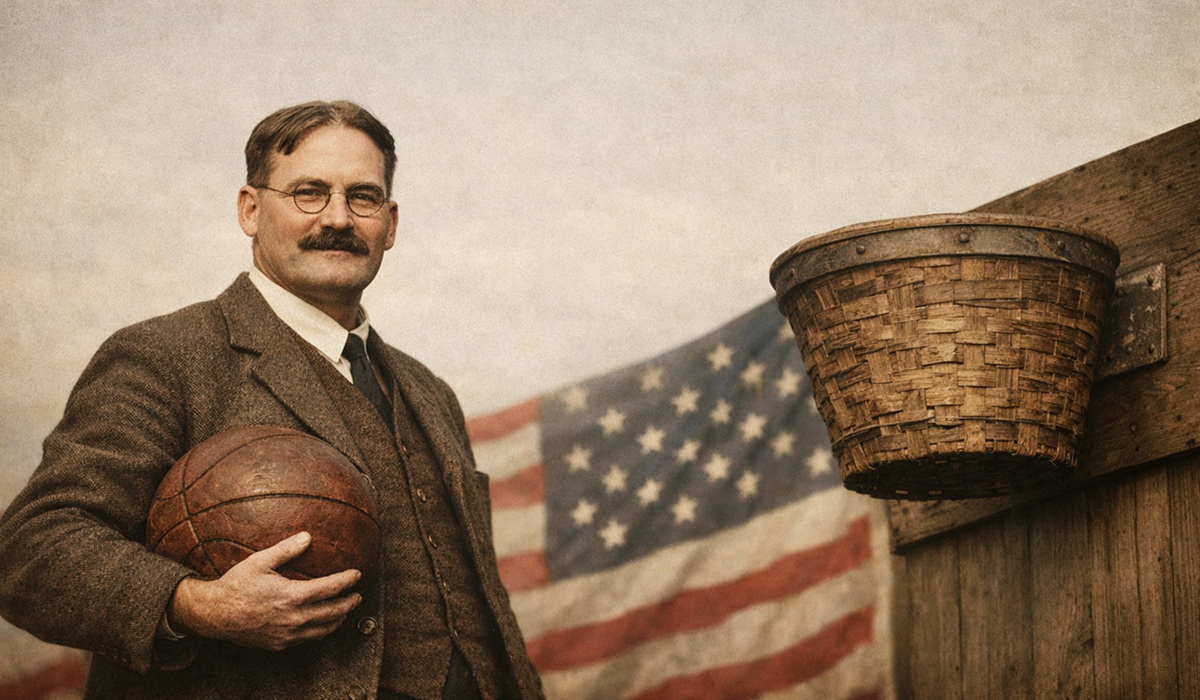
By: Donovan Martin Sr, Editor in Chief
Basketball was invented by a Canadian.It’s a statement repeated so often that people stop checking its validity. It is easy to repeat, it flatters Canadian national pride, and has become a “fact” people accept without question. But if you stop treating nationality like a vibe and begin to question the legality of that status, the claim starts to break down.
Not because James Naismith’s Canadian birthplace in1861 is in dispute, and not because anyone is trying to erase that fact. It breaks down because of Canada’s insistence that Canadian citizenship did not exist before 1947, and James Naismith was born on November 6, 1861, in Almonte, Ontario.
So, what was his legal identity at birth and throughout his life? Was James Naismith really a Canadian? That is no longer a fact that basketball fans can hang their hats on because of the Canadian government’s position that by statute, there were no actual Canadian citizens prior to1947. Canada was a British colony in 1861when Naismith was born, and its residents were classified only as British subjects. That was the governing framework—the only honest starting point if you want this argument to be about law rather than emotion.
Now move forward to the one date that matters most to the story of basketball. Naismith invented the game in 1891, in Springfield, Massachusetts, at the YMCA Training School. That is no minor detail. The invention did not occur in a local gym north of the border, nor was it shaped by Canadian institutions or governed by Canadian law. It was created in the United States, within an American environment, and it took root as an American development before spreading to the rest of the world. In 1891, Naismith was a British subject; it is only his Canadian citizenship status that’s in question.
Whenever people sense reality pushing back against a popular slogan, it is tempting—if not understandable—to reach for a clever-sounding escape hatch. One such move is to argue that because Naismith was not yet a U.S. citizen in 1891, and because citizenship in his birthplace wasn’t defined in modern terms either, he must have been in some kind of legal no-man’s-land. The flaw in this argument is straightforward: it imposes modern assumptions on a nineteenth-century legal world that did not function that way.
Now back to that other mitigating complication, where the Canadian government says that citizenship did not begin until January 1, 1947 on the day that their prime minister was ceremoniously recognized as its first citizen. By that definition, Naismith was never Canadian at all.
So what, then, was he? Naismith was not stateless, nor was he legally undefined. His status was clear, recognized, and entirely ordinary for the era. A British subject by birth, he was living and working lawfully in the United States when basketball was created. That reality demolishes the “purgatory” claim. It also reinforces the American conclusion by underscoring a point too often overlooked: an invention does not need to be created by a formal citizen of a country to belong to that country. Place matters. Institutions matter. Adoption matters. Basketball was created within American life, inside an American institution, for an American purpose—and it became an American game because that is where it was born and embraced.
This is where the timeline becomes the steel frame of the argument—one that cannot be bent without breaking reality. If Canadian citizenship did not exist, then it is impossible for a “Canadian” to have invented the game.
Now place that beside Naismith’s life. Basketball was invented in 1891. He died in 1939. He did not live to see 1947. That single fact ends the debate if the debate is about law. A person cannot hold a citizenship status that did not exist until after they were gone. No amount of pride can make a statute work backwards.
And the record does not stop there. Naismith later took out American citizenship. People sometimes mention that softly, as if it is a side note, but it matters greatly if the argument being made is about legal membership. He died before the Canadian government said citizenship existed in law. He was American in the only sense that counts when you are making a strict, legal claim about nationality.
This is also where the conversation becomes bigger than basketball. Because once you accept how late and technical citizenship is in legal history, you start seeing the uncomfortable truth underneath the slogans. The public talks as if belonging has always been obvious and automatic, but the law shows something far more rigid. Citizenship is not just identity. It is a legal instrument, and it has been written and rewritten in ways that do not always reflect human reality.
That mismatch is exactly how Lost Canadians exist. A Lost Canadian, as we define it, is someone who belongs by birthright, family connection, and lived reality, yet is denied recognition on paper because technical rules and shifting legislation have the power to exclude what should never have been excluded. It is the clearest example of how the country’s citizenship story can look neat in public, while quietly producing absurd results when applied to real lives.
That is why this argument matters. Because the same impulse that stretches definitions to win a bragging right is often missing when families need fairness, clarity, and recognition. When pride is on the line, people want flexibility. When people are on the line, the law suddenly becomes strict, narrow, and unforgiving. That contradiction is the real scandal here.
So here is the conclusion, stated plainly and without room for word games. Basketball was invented in the United States, in 1891, inside an American institution and taking Canada at its word, its citizenship did not exist. Naismith died in 1939, in America, as an American citizen. If we are serious about legal definitions, we have to accept that basketball is an American game, an American invention, and the man who created it belongs to American history. In the exact way that matters when nationality is treated as a legal argument. The only reason this still gets debated is because it forces people to confront a truth they would rather avoid, that citizenship is not always as timeless, clean, or fair as the national mythology pretends, and that same legal rigidity is what keeps producing Lost Canadians to this day.
About The Author