Feckless Leadership in a Burning World: How Carney and Anand Echo a Selective Moral Order
- TDS News
- Trending News
- March 12, 2026
By: Donovan Martin Sr, Editor in Chief
Across the Middle East, devastation is no longer an abstraction softened through diplomatic phrasing or debated from the comfort of distant policy forums. Entire cities have been battered by sustained bombardment, neighbourhoods reduced to rubble, and the infrastructure that sustains civilian life torn apart with terrifying speed. Schools have been struck, hospitals damaged, and families forced to search through collapsed buildings for children who were alive only hours earlier. The destruction unfolding across the region is immense, and the political language used to describe it has struggled to match the scale of the suffering visible to anyone watching events unfold in real time.
In moments like these, the words chosen by governments carry enormous significance because language reveals whether leaders are prepared to confront reality with moral clarity or whether they prefer the safety of diplomatic choreography. Leadership should not sound sterile or rehearsed when entire societies are collapsing under the weight of war. It should reflect intellectual honesty, emotional seriousness, and a willingness to speak plainly about the causes and consequences of violence. Yet the official response emerging from Ottawa has sounded increasingly detached from the magnitude of the catastrophe now shaping global politics.
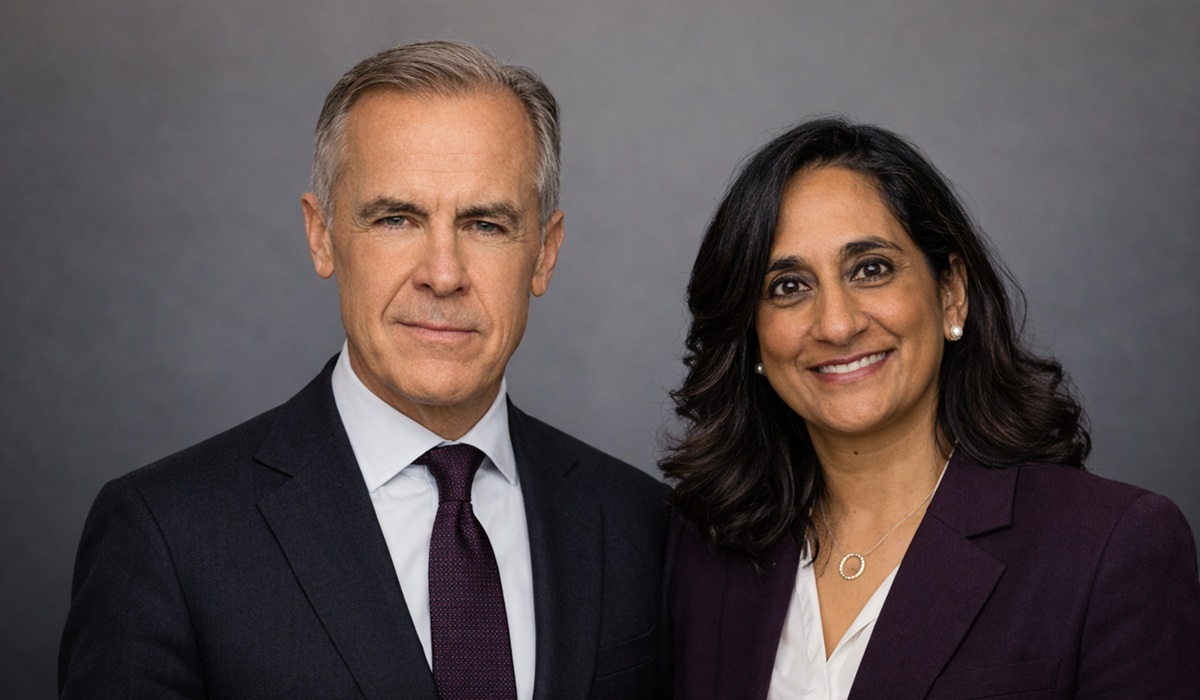
Prime Minister Mark Carney has condemned Iran for striking neighbouring Gulf states, framing those attacks as violations of international law and dangerous escalations that threaten regional stability. Foreign Affairs Minister Anita Anand reinforced that position by announcing that a strongly worded condemnation had been delivered at the United Nations, presenting the government’s response as principled and firm. The language was polished, careful, and almost identical to the messaging emerging from Western capitals.
The difficulty confronting the government is not that such condemnation exists but that the outrage appears highly selective. Iran’s actions are described in stark legal terms while the broader destruction across the region receives far more cautious treatment. When bombardments devastate civilian districts during Israeli military operations in densely populated areas, Ottawa’s language becomes noticeably restrained. When American military power has reshaped entire regions through air campaigns and invasions over the past two decades, Western capitals rarely respond with the same moral urgency now directed toward geopolitical rivals.
This imbalance is not theoretical because the historical record remains clear. The invasion of Iraq shattered a country and unleashed instability that continues to ripple across the region decades later. Libya collapsed into prolonged chaos following Western intervention that dismantled its governing structures. Afghanistan endured twenty years of war that devastated communities while producing little enduring stability. Military operations in Syria and repeated strikes across parts of Africa have also left deep scars on civilian populations struggling to rebuild amid fractured institutions and economic collapse.
What remains striking is how little sustained condemnation those wars produced from allied governments. When Western powers bombed cities, toppled regimes, or conducted extended military campaigns, the diplomatic reaction from many allied states rarely moved beyond cautious statements of concern or mild expressions of disapproval. The response often amounted to little more than a stern wagging of the finger accompanied by an eyebrow raised in polite discomfort, rather than the sweeping moral outrage that appears whenever geopolitical adversaries are accused of similar conduct.
A similar restraint appears in discussions of Israeli military actions in the current conflict. Even as bombardments have devastated densely populated areas and drawn accusations of indiscriminate force, the diplomatic language emerging from many Western governments remains measured and cautious. Leaders who speak passionately about defending international law often appear reluctant to apply that same legal framework when the actions in question involve close strategic partners.
At the same time, acknowledging the devastation inflicted on Palestinians does not mean ignoring the suffering now unfolding within Israel itself. In retaliation for strikes on Iran and the wider regional escalation, parts of Israeli cities have also come under attack, and civilians there are experiencing the terrifying reality of war arriving at their own doorsteps. Images of neighbourhoods burning and families taking shelter reveal a painful truth about armed conflict: once violence expands, it rarely respects borders or national narratives.
This is precisely why war ultimately produces only losers. When cities begin to resemble the destruction seen elsewhere in the region, the human cost becomes impossible to separate by nationality. Innocent people inside Israel are now dying as well, and their suffering deserves the same recognition as the suffering of civilians everywhere else. The cycle of retaliation only ensures that more families on every side will lose loved ones in conflicts driven by political leaders and strategic calculations.
Many Israelis themselves have said as much for years. Large segments of Israeli society have repeatedly called for an end to endless cycles of war, occupation, and retaliation. Those citizens are not seeking territorial expansion or permanent conflict but rather a genuine and durable two-state solution based on mutually recognized borders and security for both peoples. They are tired of watching their country become defined by war and exhausted by leadership that appears unwilling to pursue a genuine path to peace.
Recognizing those voices is essential because it reminds the world that ordinary people are not the architects of these conflicts. Civilians who want nothing more than stability and coexistence often find themselves trapped between political agendas they did not choose. When violence escalates, it is those individuals who suffer first and longest.
Another omission in the official narrative further complicates Ottawa’s position. When condemning Iranian strikes against neighbouring Gulf states, the government frequently presents those countries as innocent bystanders suddenly pulled into a conflict not of their making. That portrayal ignores a crucial strategic reality that many observers find impossible to overlook.
Several of those Gulf states host American military bases, radar systems, intelligence facilities, and logistical infrastructure that are deeply integrated into Western military operations across the region. These installations form part of a broader security network that supports surveillance, coordination, and operational planning in Middle Eastern conflicts. When territory is used to house radar installations, staging facilities, and command infrastructure linked to an active war effort, it becomes difficult to describe those states as entirely detached from the battlefield.
Acknowledging that reality does not justify attacks against them, nor does it diminish the danger faced by civilians living within their borders. However, ignoring the role these installations play in the military architecture of the conflict produces a narrative that feels incomplete. When political leaders omit those details while condemning retaliation against those locations, citizens are left with the impression that critical facts are being filtered out of the official story.
The omissions become even more complicated when considering the broader web of intelligence and military cooperation linking Western allies. Canada participates in the Five Eyes intelligence alliance, a partnership that involves extensive information sharing between allied governments. Surveillance data, communications analysis, and strategic intelligence circulate through that network in ways that inevitably influence military decision-making across allied operations.
Against that backdrop, the suggestion that Ottawa exists entirely outside the operational dynamics of the current conflict becomes difficult to accept without scrutiny. Allegations that Canadian personnel may be embedded within allied structures in places such as Bahrain, or that Canadian intelligence contributes to broader Western situational awareness, raise questions that the public rarely hears addressed directly. Even if those roles are limited or indirect, the assumption that Canada has no connection whatsoever to the military architecture of the region strains credibility.
Understanding these connections does not mean assigning blame for every action taken by allied forces. It does, however, complicate the narrative that Canada stands completely apart from the conflict it is now condemning so forcefully. When intelligence networks, logistical cooperation, and strategic partnerships tie governments together, the boundaries between observer and participant become less clear.
The broader intellectual framework underlying these contradictions is deeply rooted in Western strategic thinking. For generations, global order has reflected assumptions inherited from colonial governance, in which certain states claim authority to enforce stability while others are treated primarily as sources of disorder. The vocabulary used to describe conflicts may have changed over time, yet the hierarchy beneath that vocabulary remains visible in the way some acts of violence are condemned immediately while others are explained away.
Recent remarks by Marco Rubio praising aspects of colonial governance only reinforced the suspicion that these assumptions continue to shape modern diplomacy. Statements reflecting nostalgia for imperial stability emerged precisely as Western governments attempted to justify military campaigns that have left vast sections of the Middle East shattered.
Within this context, the rhetoric emerging from Ottawa increasingly appears less like independent diplomacy and more like an echo of alliance messaging. This dynamic became particularly visible following Prime Minister Carney’s widely discussed speech at the World Economic Forum in Davos. In that address, Carney spoke about the emergence of a new global order grounded in cooperation, stability, and credible leadership.
For a brief moment, that speech suggested the possibility of a more principled voice in global politics, one willing to confront uncomfortable truths rather than repeating established talking points. The world was changing rapidly, and many believed leadership capable of navigating that transition with honesty might finally emerge.
When war intensified again across the Middle East, however, the promise of that rhetoric quickly faded. The government’s response reverted to the familiar pattern of Western diplomatic alignment, with condemnation directed sharply toward one actor while the wider devastation remained only partially acknowledged. The gap between the ambition of Davos and the cautious messaging that followed has become increasingly difficult for the public to ignore.
Foreign Affairs Minister Anand represents another layer of disappointment in this unfolding moment. Her appointment initially generated genuine optimism after the tenure of her predecessor, whose time in the role was widely criticized as chaotic, ineffective, and frequently out of depth in navigating complex global crises. Anand entered the position with a reputation for competence and discipline, raising expectations that the country’s foreign policy might regain intellectual seriousness.
Those expectations were not unreasonable, yet the current crisis has revealed a ministry still operating within the same narrow narrative shaping Western diplomatic messaging. Iran’s actions are condemned forcefully while the broader architecture of violence devastating the region receives far less scrutiny.
This style of communication reflects a deeper problem in contemporary political culture. Statements are delivered with mechanical precision yet drained of emotional honesty and moral urgency. The rhetoric feels feckless and robotic, sounding less like the voice of leadership and more like the product of careful diplomatic calibration.
Citizens notice the difference immediately because leadership should inspire confidence and pride rather than indifference. A nation should be able to look at its leaders and see individuals willing to speak uncomfortable truths even when doing so disrupts political convenience. Instead, what often appears is a procession of carefully managed statements delivered whenever cameras appear, statements designed to satisfy diplomatic expectations rather than confront the moral gravity of the moment.
The devastation unfolding across the Middle East is not an abstract geopolitical contest but a human tragedy shaping the future of entire societies. Children growing up amid rubble and trauma will carry those experiences into adulthood, influencing global politics in ways that current leaders may struggle to comprehend.
If the promise of a new global order is to mean anything at all, it must begin with the courage to confront these realities honestly. Condemning one nation while ignoring the destructive actions of allies, or omitting the deeper strategic context behind military escalation, does not demonstrate moral leadership.
Until governments apply the same moral standard to every act of violence and speak openly about the alliances that shape global conflict, the rhetoric of international law will continue to sound hollow. What citizens increasingly demand is leadership capable of acknowledging the full human cost of war and recognizing that the suffering of innocent people, whether Palestinian, Israeli, Iranian, or anyone else caught in the crossfire, should never be treated as a secondary concern in the language of diplomacy.
About The Author