By: Donovan Martin Sr, Editor in Chief
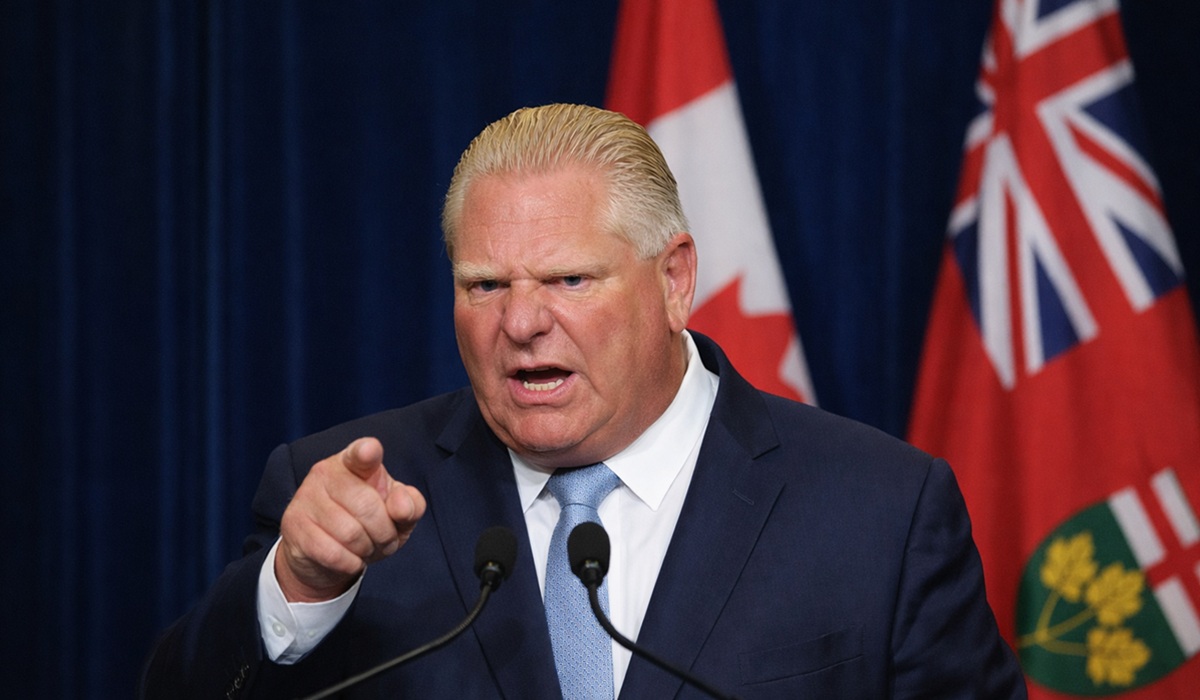
There are moments in public life when the volume of a reaction matters more than its content. When a premier suddenly raises his voice, sharpens his language, and draws a hard line where none existed before, the instinct is not to argue the point but to question the reason. Ontario’s head of government, Doug Ford, has reached one of those moments, and the intensity of his rhetoric around Chinese electric vehicles says far more than the words themselves.
Until recently, the working relationship between Queen’s Park and Ottawa had been broadly stable. Disagreements existed, but they were handled in the familiar, transactional way that keeps provinces and the federal government moving in the same general direction. Then the tone shifted abruptly. What emerged was not a measured critique of industrial policy but a public outburst, dismissing Chinese EVs as substandard and portraying engagement with China as economic recklessness. It was loud, categorical, and conspicuously light on substance.
That is where the unease begins, because this reaction did not come with a competing plan. It did not come with a roadmap for replacing lost manufacturing capacity. It did not come with announcements of new plants, new supply chains, or new partners waiting in the wings. It came as rhetoric, and rhetoric is a poor substitute for results.
What makes this moment especially difficult to ignore is the record it collides with. Under this government’s watch, Ontario’s auto sector has continued a long slide that has defined the last two decades, but the decline has accelerated rather than slowed. Manufacturing jobs have not stabilized. New large scale facilities have not materialized. Promised investments have collapsed quietly, leaving workers and municipalities to absorb the fallout. The most visible example remains the retreat of Stellantis, where tens of millions of dollars in anticipated investment evaporated, along with the subsidies and spin off employment that were supposed to follow.
This is not a theoretical critique. These are measurable losses. When a leader positions himself as a defender of jobs while presiding over their steady disappearance, scrutiny is not optional. It is inevitable.
What deepens the contradiction is what did not happen. When the Prime Minister Mark Carney traveled to China, the seat at the table was open. The opportunity to advocate directly for Ontario was there. This was the moment to press the case for factories, not finished imports. The moment to insist that access to Canadian consumers should come with Canadian production, Canadian labour, and Canadian tax revenue. The moment to do the hard work of industrial diplomacy.
That moment was declined. Instead of being present, Ontario’s premier chose absence, followed later by outrage. That sequence matters. Leaders who intend to shape outcomes show up early. Leaders who intend to posture show up after the fact. By not going to China, he voluntarily removed himself from the conversation and then criticized the conversation from the outside. That is not leverage. That is obfuscation.
The contrast with Saskatchewan is impossible to miss. Scott Moe did not opt out. He went. He made the case directly for his province’s interests, particularly agriculture. He did not pretend geopolitics was simple, nor did he grandstand. He showed up, argued for Saskatchewan jobs, and protected access to a critical market. That is what leadership looks like when the goal is tangible outcomes rather than applause lines.
The results speak for themselves. The lifting of the 100 percent tariffs on Chinese electric vehicles did more than reopen a conversation about manufacturing. It reopened Chinese markets to Canadian exports, including canola, pet food, meat, and other agricultural products that had been stalled by retaliatory measures. That is not an abstract benefit. That is income flowing back into Canada. That is stability for producers. That is trade doing what trade is supposed to do.
And yet, the rhetoric coming from Ontario suggests this broader context either does not matter or should not be discussed. That silence is revealing. If the concern were genuinely about protecting Canadian industry, the argument would focus on building here, not shouting there. It would focus on binding commitments, labour standards, local supply chains, and long term investment. Instead, the conversation has been reduced to dismissive language and warnings without alternatives.
This is where the adult conversation needs to happen, because the reality is uncomfortable. Ontario has not been able to keep auto jobs in place. It has not been able to attract enough new manufacturing to offset losses. It has lost tens of millions of dollars in subsidies tied to projects that never materialized or quietly walked away. These outcomes are not the result of Chinese competition. They are the result of strategic failure.
It is also worth remembering that American goodwill is not a plan. The United States has made its intentions clear under Donald Trump and those aligned with his approach. American industrial policy prioritizes American soil, American workers, and American political optics. Canadian plants are expendable when domestic pressure rises. That pattern has repeated itself enough times to qualify as a lesson.
Against that backdrop, the global shift to electric vehicles represents one of the last remaining opportunities to anchor large scale manufacturing in Canada. Factories do not care about rhetoric. They care about cost, stability, access, and policy coherence. When a province removes itself from negotiations and then denounces the outcome, it signals confusion rather than strength.
The irony is that public money has not been scarce when messaging was the priority. Nearly one hundred million dollars was spent on advertising campaigns aimed at opposing U.S. tariffs and sanctions, invoking American political figures and historical imagery. That money was real, immediate, and politically useful. The same urgency does not appear when investment requires negotiation, compromise, and long term commitment. That inconsistency invites skepticism.
Which brings us to the question that keeps resurfacing, quietly but persistently. What is not being said? Is there pressure from domestic interests that fear competition more than decline? Is there concern about optics in a polarized media environment where any engagement with China is framed as capitulation? Is there an assumption that someone else will eventually step in and solve Ontario’s manufacturing problem without Ontario having to negotiate uncomfortable deals? Whatever the answer, it has not been shared with the people who are paying the price.
This is why the rhetoric feels misguided. It is not grounded in outcomes. It is not grounded in a record of success. It is grounded in deflection. At moments like this, leadership requires an adult in the room. Someone willing to slow the conversation down, take the hand of a premier caught in reactive politics, and explain how industrial transitions actually work. They do not happen through slogans. They happen through presence, negotiation, and discipline. They happen when leaders choose to sit at the table rather than flip it over from across the room.
Ontario does not need louder speeches about substandard products. It needs factories. It needs jobs. It needs a strategy that acknowledges the world as it is, not as some might wish it to be. Until that happens, the volume of the rhetoric will continue to invite the same uncomfortable conclusion. Something is being obscured, and the cost of that obfuscation is being paid by workers who deserve better.
About The Author