By: Donovan Martin Sr, Editor in Chief
Did you know the term “banana republic” didn’t come from political theory, economics textbooks, or modern pundits trying to sound clever? It came from bananas. Literally. From fruit. And from what happened when small countries dared to interfere with the profits tied to that fruit.
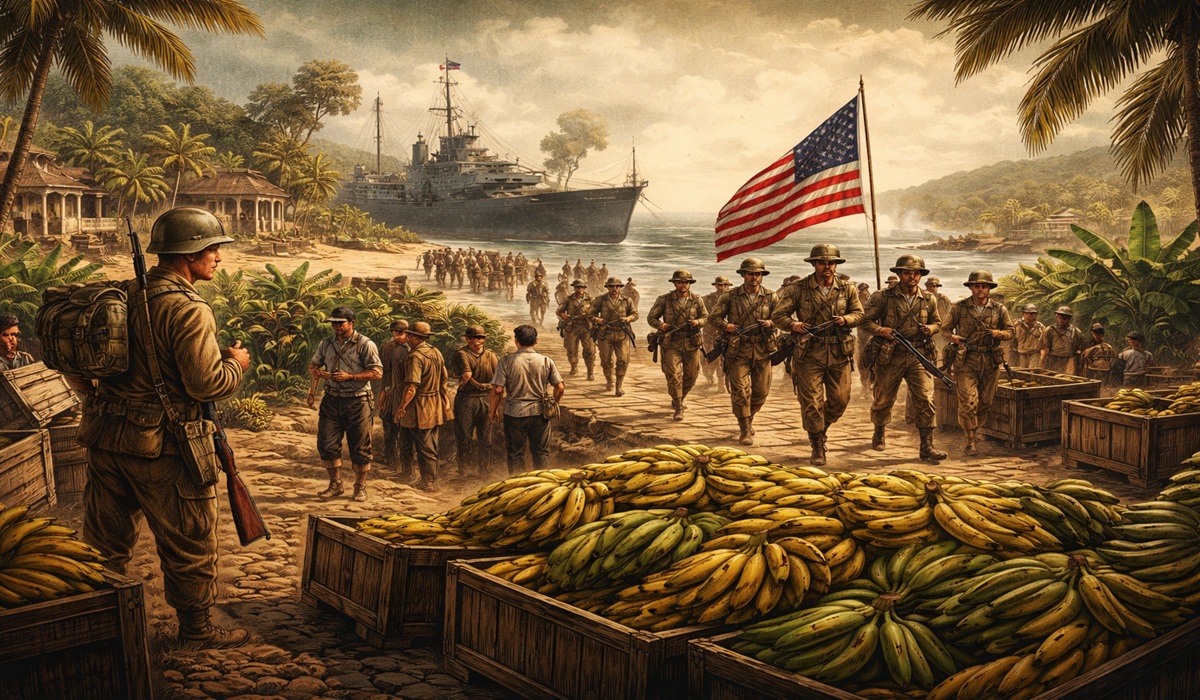
At the beginning of the twentieth century, bananas were big business for the United States. Not because Americans loved bananas more than anyone else, but because U.S.-based companies controlled vast stretches of land, railways, ports, and shipping routes across Central America and the Caribbean. Bananas weren’t just grown there; entire national economies were bent around them. Once that happened, political independence became fragile. A country could fly its own flag and hold elections, but the moment it tried to change the rules of the game, the consequences arrived quickly.
The phrase “banana republic” emerged to describe exactly that kind of place: a country that technically governed itself but was economically trapped, politically pressured, and repeatedly punished for asserting control over its own resources. It wasn’t a joke. It was a diagnosis.
Now here’s the part that still shocks people when they first hear it. The United States didn’t just complain or negotiate when governments interfered with banana profits. It invaded.
In Honduras, U.S. forces landed again and again in the early 1900s. Between 1903 and 1925, American troops intervened roughly seven separate times, often during internal political disputes, always with an eye toward protecting U.S. commercial interests and maintaining a friendly political order. Honduras became so entangled with foreign fruit companies that its national stability was treated as inseparable from corporate stability. Raise taxes. Revisit land concessions. Support labor rights. Each move carried risk, not just domestically, but internationally.
In Nicaragua, the pattern was even more entrenched. The United States invaded and occupied the country in two long phases. The first occupation began in 1912 and lasted until 1925. When resistance and instability resurfaced, U.S. forces returned in 1926 and remained until 1933. That’s more than two decades in which Nicaragua’s political direction was heavily shaped by foreign military presence. This wasn’t a single incident or misunderstanding. It was sustained control.
Guatemala presents the most infamous example because it happened later, when the language of democracy and sovereignty was supposedly more settled. In 1954, the United States backed and enabled one direct invasion that overthrew the democratically elected government of Jacobo Árbenz. His crime was not dictatorship or violence. It was land reform. He attempted to redistribute unused land, much of it held by a powerful U.S. banana company, and to modernize Guatemala’s economy. That was enough. The invasion succeeded, the government fell, and the message to the region was unmistakable.
This is where the popular shorthand comes from: governments raised banana prices or interfered with banana profits, sometimes by what amounted to pennies, and the response was force. But the deeper truth is more sobering. It was never about the pennies. It was about precedent. If one small country could successfully assert sovereignty over its economy, others might try. That possibility was treated as a threat.
Bananas were simply the earliest, clearest case where economic power turned into political power, and political power turned into military action. The fruit became a symbol because it was ordinary. Something you could hold in your hand. Something so mundane that it exposes the imbalance even more starkly. If this could happen over bananas, what wouldn’t happen over oil, minerals, shipping routes, or strategic influence?
The damage didn’t stop with invasions or coups. Repeated intervention hollowed out institutions. It taught populations that elections could be reversed, that reform could be dangerous, and that foreign approval mattered more than domestic consent. Over time, instability became self-reinforcing, then used as justification for further interference. A vicious loop dressed up as “stability.”
So when the term “banana republic” is used today as a casual insult, it misses the point. It wasn’t about incompetence or chaos. It was about countries being pushed into economic dependency and then punished for trying to escape it. It was about sovereignty with strings attached. About independence that worked only as long as it stayed profitable for someone else.
That’s the real history behind the phrase. Not metaphor. Not exaggeration. Just bananas, power, and a lesson the world keeps relearning, whether it wants to or not.
About The Author