Image Credit, Hosnysalah
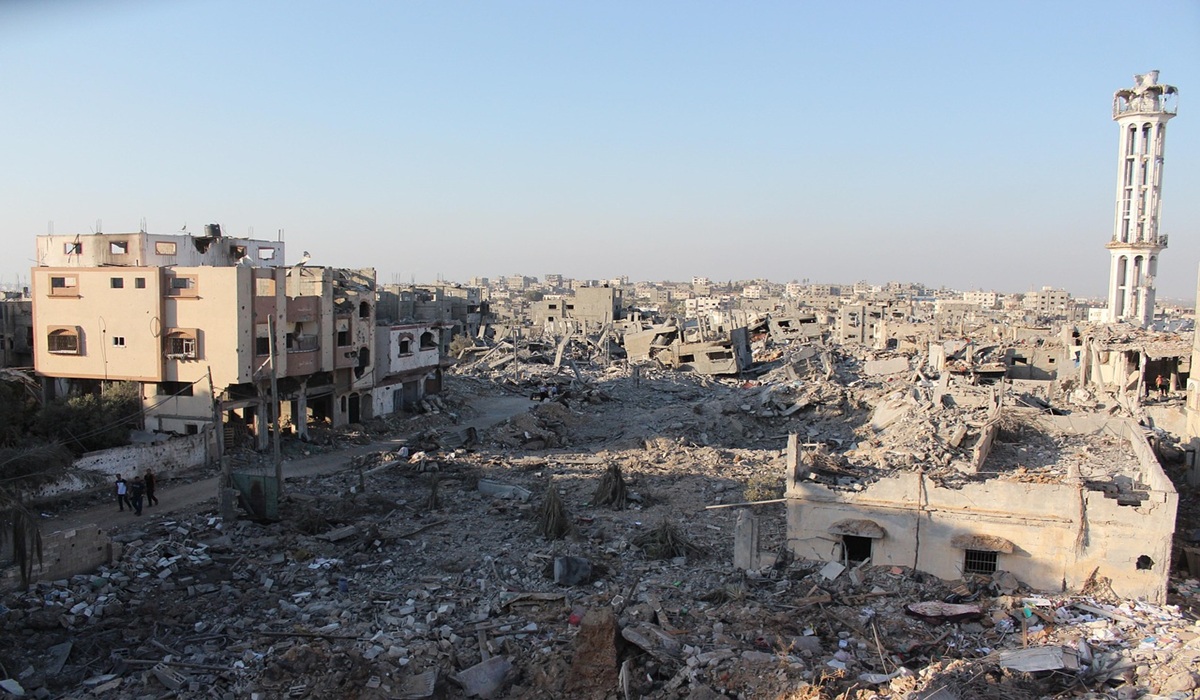
Gaza today stands as one of the starkest symbols of modern warfare and collective moral failure. Backed unequivocally by the United States and the United Kingdom, Israel has carried out a military campaign that has left more than one hundred thousand Gazans dead, over two hundred thousand injured, and an entire territory reduced to ruins. Hospitals, schools, mosques, churches, universities, and residential neighborhoods—nothing was spared. Gaza was not merely attacked; it was systematically dismantled. Entire families were wiped out in their homes, and access to basic necessities such as food, clean water, and electricity became almost non-existent during and after the attacks. Survivors now face not only physical and psychological trauma but also a complete collapse of social infrastructure.
What makes this catastrophe even more disturbing is the sudden reappearance of the very same actors—Israel, the US, the UK, and their allies—now proposing international boards and frameworks for the “reconstruction” of Gaza. The question is unavoidable: is it not the height of hypocrisy to first destroy a society and then present oneself as its benefactor? These plans, often promoted in the name of “humanitarian relief,” fail to address the root causes of Gaza’s suffering or the need for accountability, making reconstruction a façade for continued political control.
This was not collateral damage arising from a conventional conflict. The scale, precision, and pattern of destruction point to a deliberate strategy aimed at rendering Gaza unlivable. International humanitarian law was violated repeatedly, yet those responsible faced no meaningful accountability. Instead, Israel was shielded diplomatically, supplied militarily, and defended politically by Western powers that routinely lecture the world on human rights and the rule of law. The double standard is glaring: the world watches in silence as entire neighborhoods are flattened, yet discussions revolve around how to “assist” in rebuilding what has been intentionally destroyed.
The reconstruction narrative now being promoted must therefore be examined with deep skepticism. Reconstruction, in this context, is not a neutral humanitarian exercise; it is a political instrument. By controlling who rebuilds Gaza, how it is rebuilt, and under what conditions, powerful states seek to reshape Gaza’s future identity. The underlying objective is not recovery, but control—neutralizing resistance, engineering dependency, and reshaping political realities on the ground. Already, proposed plans often include strict oversight, restrictions on local governance, and conditional access to reconstruction funds, ensuring that Gaza remains under external influence for years to come.
Destruction followed by externally managed reconstruction often results in the erosion of sovereignty. Gaza risks becoming a laboratory for a new model of domination, where physical annihilation is followed by economic and administrative capture. Under the banner of rebuilding, Gaza may be transformed into a tightly monitored enclave—rebuilt in concrete but stripped of political agency and real autonomy. Beyond infrastructure, this also threatens cultural and societal continuity, as key institutions of education, media, and civic engagement are being reshaped or controlled by external interests.
There is also a glaring economic dimension to this tragedy. War and reconstruction are two sides of the same profit-driven system. The global corporations that benefit from arms sales, surveillance technologies, and military logistics are often the very entities that secure lucrative reconstruction contracts. Destruction generates demand; reconstruction generates profit. Within this cycle, Palestinian suffering is reduced to a commodity, and the promise of recovery is subordinated to the interests of international capital rather than local needs.
Strategically, Gaza’s geography adds another layer to the hidden agenda. Its location along the Mediterranean coast, proximity to regional trade routes, and potential offshore gas reserves make it geopolitically significant. Increasingly, reconstruction proposals are tied to ports, corridors, and economic zones that serve international and regional interests far more than local needs. Humanitarian language is employed to obscure a broader geostrategic recalibration. Meanwhile, ordinary Gazans remain trapped, facing severe unemployment, lack of housing, and limited access to healthcare and education, making them dependent on international aid while their autonomy erodes.
The moral contradiction at the heart of this process is undeniable. Can the architects of devastation be trusted as planners of recovery? Can justice be bypassed in the name of rebuilding? Without accountability for war crimes, reconstruction becomes an extension of violence by other means. It retroactively legitimizes destruction and establishes a dangerous precedent for future conflicts.
True reconstruction cannot occur in the absence of justice. Gaza does not merely need buildings and infrastructure; it needs dignity, self-determination, and guarantees against recurring annihilation. Any rebuilding process that excludes Palestinian leadership, civil society, and genuinely neutral international actors is destined to fail—both morally and politically.
The destruction of Gaza and the subsequent calls for its reconstruction are not separate events; they are components of a single, continuous strategy. First, erase a society through overwhelming force. Then, reassemble it under terms dictated by the very powers responsible for its ruin. This is not humanitarianism; it is managed domination. If the international community is truly committed to peace, it must confront this hypocrisy head-on. Otherwise, Gaza will be remembered not only as a victim of bombs, but as a testament to a world that watched destruction unfold—and then attempted to rebuild its conscience with empty promises.
About The Author