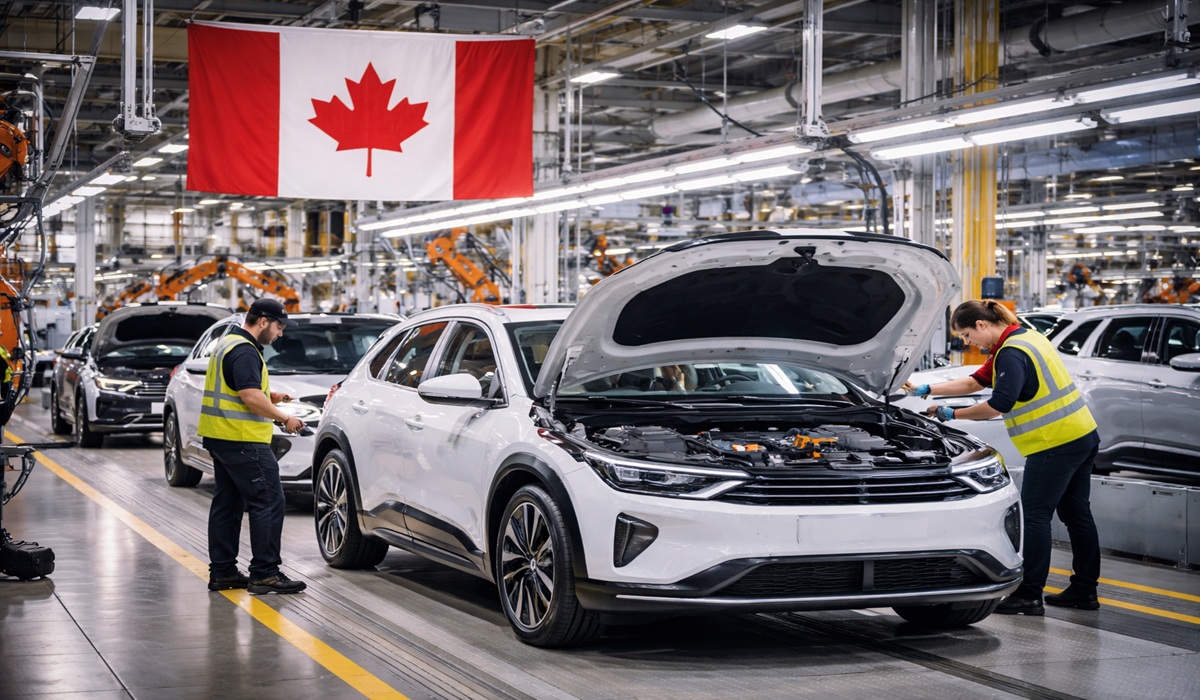
Canada Must Face Reality: The Trump Auto Doctrine Leaves No Room for Illusions
- TDS News
- Canada
- October 24, 2025

By: Donovan Martin Sr, Editor in Chief
For decades, Canada has been the dependable partner in North America’s automotive story. From Windsor to Oshawa, the hum of assembly lines, the smell of machine oil, and the pride of good union jobs defined not just the auto sector but Canada’s middle class. Yet, under President Donald Trump’s renewed protectionist vision — summed up by his unambiguous declaration, “We don’t want Canada building our cars, we want to build them ourselves” — the era of seamless cross-border production is quickly fading.
Trump’s words are not mere political theatre. They are policy. They are a vision for an America-first industrial economy that sees even close allies like Canada as competitors rather than collaborators. The implications are enormous — and Canada must now face that reality without illusions or nostalgia.
In his second administration, Trump has doubled down on reshoring initiatives that began during his first term. The “Made in America” doctrine, strengthened through aggressive tariff regimes and manufacturing incentives, effectively declares that any automobile built outside the United States — no matter how close to Detroit — is a lost opportunity for American workers. It’s the same philosophy that drove Trump to renegotiate NAFTA into the USMCA, a deal that tilted production requirements further toward the U.S.
The warning signs have been there for years. Even before Trump’s most recent statement, automakers were recalibrating their presence in Canada. Stellantis, one of the world’s largest automakers, has long operated facilities in Ontario, but its commitment to Canada has wavered amid global realignments and political uncertainty. The company’s decision to pause construction of its Windsor battery plant earlier in 2023 sent shockwaves through the industry. Although the project was later revived after Ottawa scrambled to match U.S. subsidies, the episode exposed Canada’s vulnerability — a reminder that even a multibillion-dollar project can be disrupted overnight when competing against the gravitational pull of the American manufacturing machine, only to announce full pullout as of this week.
Then there’s General Motors, which shuttered its Oshawa plant in 2019, citing “global restructuring.” The official line avoided politics, but the underlying reality was unmistakable: the U.S. market demanded production closer to home, and Trump’s nationalist rhetoric gave political cover to that shift. That plant, once the heart of GM Canada, employed thousands. It has since reopened at a fraction of its former capacity — primarily producing trucks and parts rather than full vehicle lines.
Ford, too, has trimmed Canadian operations, diverting future investments toward Michigan and Ohio. Toyota and Honda, while maintaining facilities in Ontario, have slowed expansion in Canada as uncertainty grows around cross-border trade stability. Meanwhile, newer entrants in the electric vehicle space — Rivian, Lucid, and Tesla — are building massive U.S.-based gigafactories rather than sharing capacity north of the border.
Trump’s economic nationalism plays well politically in the U.S., where decades of job losses and offshoring have left blue-collar communities bitter and restless. His administration has promised to “reclaim” auto jobs lost to Mexico, Canada, and Asia. But the practical effect of this doctrine is to isolate allies and dismantle the integrated supply chains that once made North America competitive on a global scale.
In the 1990s and early 2000s, Canadian plants were prized for their efficiency, quality, and cost advantages. The workforce was highly skilled, unionized, and capable of producing millions of vehicles annually. Canada’s stable political system, robust labor protections, and favorable exchange rate made it a cornerstone of the continental auto network.
Today, however, Trump’s America doesn’t value cooperation; it values control. His administration has made it clear that incentives and subsidies will flow primarily to companies that manufacture and assemble within U.S. borders. The Inflation Reduction Act’s electric vehicle tax credits were an early example — initially excluding vehicles built in Canada or Mexico from eligibility until Ottawa fought hard for an exception. But even with temporary relief, the writing is on the wall: America intends to dominate the entire EV supply chain, from mining to assembly.
This is where Canada must stop clinging to a past that no longer exists. For generations, Canadian industry has followed the lead of Detroit — waiting for U.S. automakers to dictate production needs, design trends, and investment flows. That relationship worked when free trade flourished and cross-border cooperation was profitable. But if the United States wants to decouple, then Canada must embrace the opportunity to evolve.
The electric vehicle (EV) revolution presents that chance. The global market for EVs is booming, driven by China, South Korea, and Japan — not America. Chinese automakers like BYD and NIO are dominating the global EV landscape with affordable, efficient, and increasingly sophisticated models. South Korea’s Hyundai and Kia have captured market share through innovation and speed to market, while Japan’s Toyota remains a pioneer in hybrid and hydrogen technologies.
Yes, there are tariffs. Trump’s administration has slapped steep tariffs on Chinese EVs, citing unfair trade practices and national security. But where Washington sees threats, Ottawa should see opportunity. Canada can position itself as the neutral, stable hub for EV manufacturing and research — a partner to Asian innovators seeking entry into Western markets. With abundant natural resources like nickel, lithium, and cobalt — essential for battery production — Canada is uniquely poised to lead in the next phase of global mobility.
There’s a misconception embedded in Trump’s rhetoric: that American workers can seamlessly replace the labor Canada provides. In truth, rebuilding an entire industrial base from scratch is not a one-term project — it’s a decade-long process. American labor costs are higher, environmental regulations are stricter, and the shortage of skilled trades is acute.
That’s why, despite nationalist promises, corporations continue to rely on lower-cost, high-skill regions. It’s the same reason U.S. firms still manufacture in Mexico, Bangladesh, and Vietnam. If building everything “in America” were simple, it would have been done long ago. Canada’s labor force — trained, disciplined, and bilingual — offers a middle ground: high skill, lower cost, and political reliability.
Now is the time for Ottawa to act with vision. The federal government must stop reacting to Washington’s mood swings and start leading. The prime minister should pursue comprehensive trade and investment agreements with Asian economies that are shaping the EV future — including China, South Korea, and Japan. While geopolitical tensions are real, economic diversification is not optional.
Canadian plants can be retooled for EV and battery manufacturing, supported by government incentives that mirror or exceed those offered in the U.S. Strategic partnerships with Asian automakers could create new ecosystems — from research hubs to battery recycling facilities — ensuring long-term stability. The transition from combustion to clean energy vehicles could redefine Canada’s industrial landscape if policymakers treat it not as a crisis, but as a chance to reset.
Trump’s America has made its stance clear: Canada is no longer seen as an equal manufacturing partner, but as a rival. That may sting, but it also liberates. The truth is, Canada has long lived in the economic shadow of its southern neighbor. Perhaps now, with the U.S. turning inward, Canada can rediscover its own industrial independence.
This is not about abandoning the United States, but about accepting that dependency is not partnership. Canada’s strength has always come from adaptation — from finding opportunity where others see loss. If the auto giants want to pack up and leave, let them. Canada has the resources, workforce, and innovation capacity to build something new, cleaner, and globally relevant.
In the end, Trump’s declaration — “We don’t want Canada building our cars” — may prove to be the best thing that ever happened to Canada’s auto industry. Because it forces the country to look east, to innovate, to invest, and to finally chart its own industrial destiny.
The message is clear: if the United States no longer values what Canada builds, then it’s time for Canada to start building for itself — and for the world.
About The Author