California’s $126 Billion Train to Nowhere: The Cost of Delays, Deals, and Dysfunction
- TDS News
- U.S.A
- April 10, 2026
By: Donovan Martin Sr, Editor in Chief
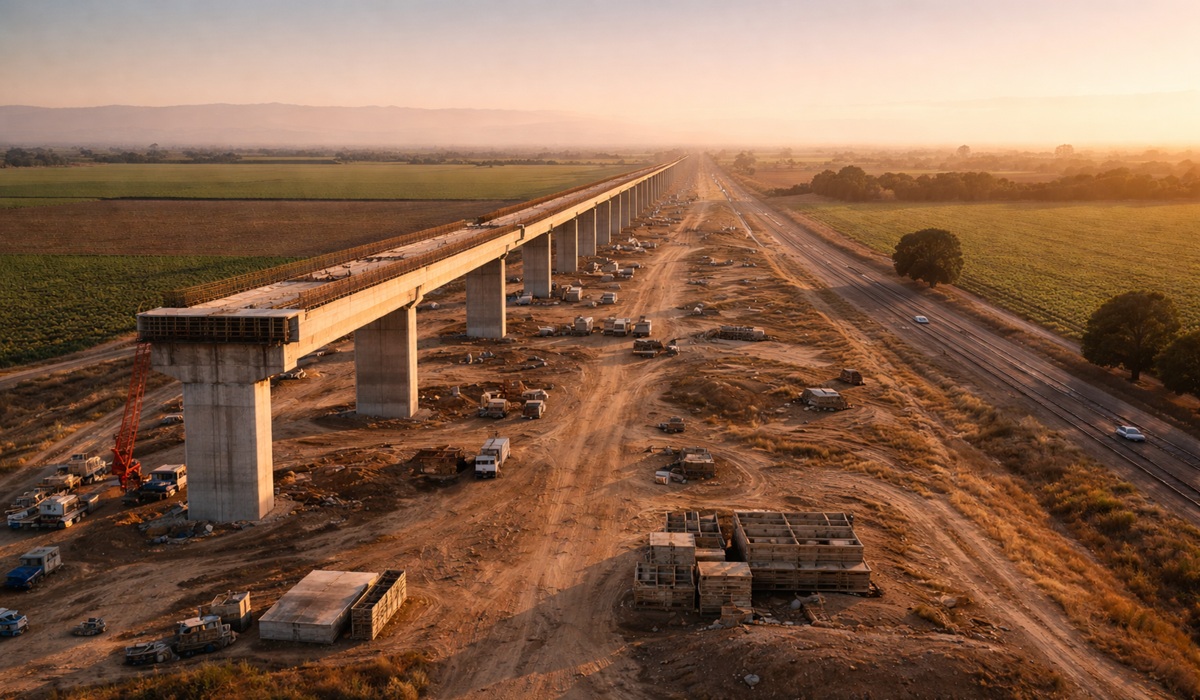
California’s high-speed rail project was once sold as a defining piece of modern infrastructure, a bold step toward connecting Los Angeles and San Francisco with fast, efficient, low-emission travel. When voters approved the initiative in 2008, the promise was ambitious but seemingly grounded. The estimated cost hovered around $33 billion, with a completion window that suggested Californians would be riding those trains within a decade. What has unfolded since then tells a far more complicated story, one that raises uncomfortable questions about cost control, accountability, and the broader way large-scale infrastructure is built in the United States.
Today, the projected price tag has ballooned to roughly $126 billion, placing it more than three times higher than what voters originally endorsed. Timelines have stretched repeatedly, segments have been scaled back, and the most visible progress remains concentrated in the Central Valley, far from the high-demand corridors the system was meant to serve first. For many observers, the issue is no longer simply about delays or miscalculations. It has become a case study in how large public works projects can spiral when political pressure, regulatory complexity, and fragmented contracting structures collide.
To understand just how stark the contrast is, it helps to look at how high-speed rail has been built elsewhere, particularly in China. Over the past two decades, China has constructed the largest high-speed rail network in the world, spanning more than 40,000 kilometers. The total cost of building that network is often estimated in the range of $500 to $900 billion depending on methodology, but what matters most is the cost per kilometer. In China, high-speed rail has frequently been built for between $17 million and $30 million per kilometer, even accounting for terrain and urban density in many regions.
By comparison, California’s system is projected to exceed $200 million per kilometer in some sections, with certain urban segments climbing even higher. Even allowing for differences in labor costs, environmental standards, land acquisition, and governance, the gap is not marginal. It is massive. When one system can build an entire national network for what another spends on a single state corridor, the conversation inevitably shifts from efficiency to structural dysfunction.
Part of the explanation lies in regulatory layers that, while often well-intentioned, create overlapping and sometimes conflicting requirements. Environmental reviews can take years, legal challenges can halt progress indefinitely, and each delay compounds costs through inflation, redesign, and contractual renegotiation. Land acquisition in California has proven particularly expensive and contentious, especially in densely populated or agriculturally valuable regions. These are not trivial issues, and they reflect a broader societal commitment to process and oversight. However, they also introduce a level of friction that dramatically alters timelines and budgets.
Another factor is the way contracts are structured and awarded. In large American infrastructure projects, work is often divided among numerous contractors and subcontractors, each responsible for specific segments or components. While this can encourage competition, it can also dilute accountability. When costs rise or timelines slip, responsibility becomes diffuse. No single entity owns the entire outcome, and that creates space for inefficiencies to persist without clear consequences.
China’s model operates very differently. Projects are typically coordinated through centralized planning, with state-owned enterprises handling large portions of the design and construction. Land acquisition is faster, regulatory hurdles are fewer, and financing is often backed directly by the state. This allows for speed and cost control that is difficult to replicate in a decentralized system. It would be overly simplistic to suggest that one model can be transplanted wholesale into another political and legal environment, but the contrast does highlight how structural choices shape outcomes.
The uncomfortable question that emerges is not simply why California’s project is more expensive, but who benefits from that difference. Rising costs create larger contracts, extended timelines generate ongoing revenue streams, and the sheer scale of the project ensures that billions of dollars continue to flow through a complex web of stakeholders. That does not imply widespread bad faith, but it does raise concerns about incentives. When delays and cost overruns do not meaningfully penalize those involved, the system can begin to reward the very inefficiencies it should be correcting.
There is also a cultural dimension that cannot be ignored. The idea of partnering with foreign firms, particularly from China, has become politically sensitive in the United States. Concerns about national security, intellectual property, and geopolitical competition have narrowed the range of acceptable collaborators. Yet this reluctance comes at a cost. China’s high-speed rail expertise is not theoretical; it has been proven at scale. Engaging that expertise, even in a limited or advisory capacity, could have accelerated timelines and reduced costs significantly. Instead, the project has remained largely domestic, navigating challenges without the benefit of the most experienced builders in the field.
Assigning blame in this situation is not straightforward, and it should not be reduced to a single culprit. Policymakers, contractors, regulators, and even voters all play a role in shaping the environment in which such projects unfold. The original estimates were optimistic, perhaps unrealistically so, and that set expectations that could not be met. Subsequent decisions, often made in response to evolving political and legal pressures, compounded the problem. Over time, the project became less about delivering a specific outcome and more about managing a process that had grown increasingly complex.
What is often missing from discussions like this is a clear articulation of accountability and reform. It is not enough to acknowledge that costs have risen or that timelines have slipped. The more important question is how to prevent the same pattern from repeating in future projects. That requires a willingness to rethink how infrastructure is planned, approved, and executed.
One part of the solution lies in streamlining regulatory processes without abandoning their underlying goals. Environmental protection and community input are essential, but they must be balanced with mechanisms that prevent indefinite delays. Establishing firm timelines for reviews and limiting the scope of legal challenges could help create a more predictable framework.
Another critical step is restructuring contracts to align incentives with outcomes. Performance-based agreements, where contractors are rewarded for meeting deadlines and staying within budget, could shift the dynamic significantly. Greater transparency in procurement and spending would also make it easier to identify where costs are escalating and why.
There is also a case to be made for greater openness to international expertise. This does not mean ceding control or ignoring legitimate concerns, but it does mean recognizing that infrastructure is a global field with shared knowledge. Strategic partnerships, technology transfers, and competitive bidding that includes experienced foreign firms could introduce new efficiencies and perspectives.
Ultimately, the California high-speed rail project reflects a broader challenge facing the United States. The ability to envision large-scale infrastructure remains intact, but the ability to deliver it efficiently has become increasingly uncertain. When a single corridor approaches the cost of building an entire national network elsewhere, it forces a reckoning. Not just with budgets and timelines, but with the systems and assumptions that produce them.
If there is a path forward, it begins with honesty about what has gone wrong and a willingness to confront it directly. The goal should not be to assign blame in a way that satisfies political narratives, but to build a framework that ensures future projects can succeed where this one has struggled. Without that shift, the risk is not just that costs will continue to rise, but that ambition itself will begin to shrink, constrained by the belief that large projects can no longer be delivered on time or on budget.
About The Author