Avi Lewis and the NDP Reset: Rebuilding a Party on Principle, Not Politics
- TDS News
- Canada
- March 31, 2026
By: Donovan Martin Sr, Editor in Chief
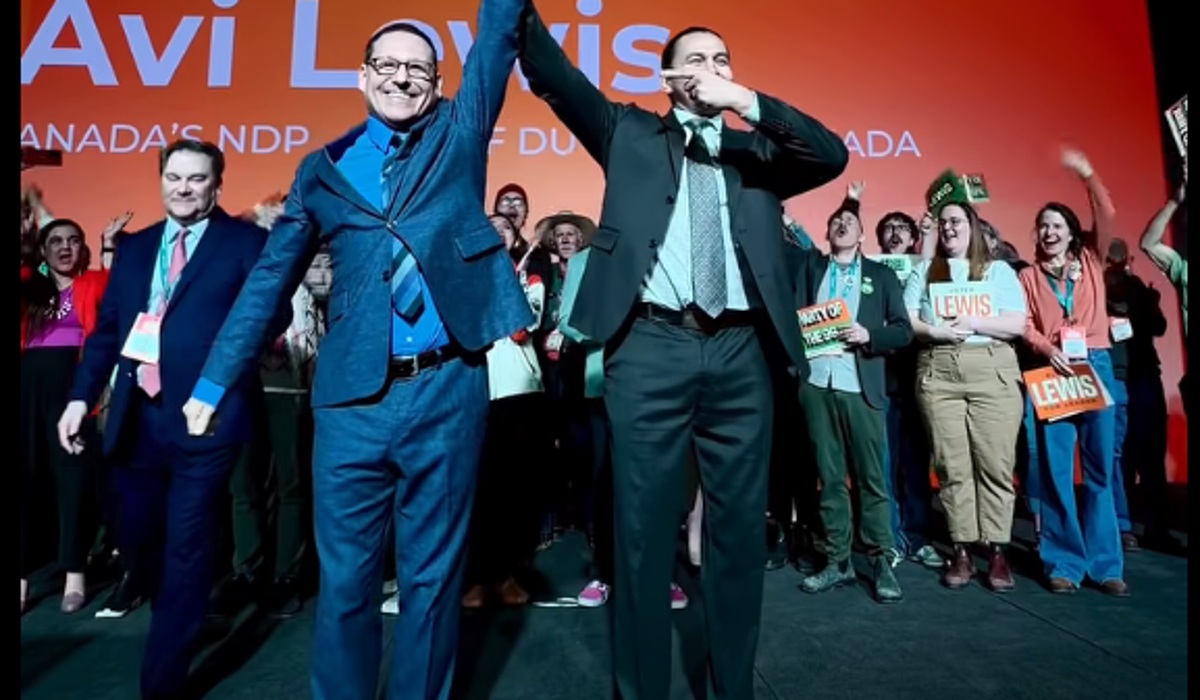
Canada’s New Democratic Party is no longer simply trying to survive. Under new leader Avi Lewis, it is attempting something far more difficult and, depending on perspective, far more necessary: a reset grounded not in political calculation, but in principle.
That reset has already drawn criticism, and not the quiet kind. Lewis has been outspoken in what he describes as a “pro-human” approach to global conflict, particularly in Gaza and Iran, choosing to frame his position not through ideology, identity, or partisan alignment, but through a consistent lens of human rights, international law, and opposition to war. In a political environment where language is often carefully hedged and positions are calibrated to avoid backlash, that clarity has made him both visible and vulnerable at the same time.
The criticism has been sharp and, in some cases, deeply personal. As a Jewish leader taking a stance that challenges the actions of Israel and its allies, Lewis has faced pushback from those who expect alignment based on heritage or identity rather than principle. Yet his position has remained rooted in a broader argument that right is right and wrong is wrong, regardless of who is responsible, and that international law cannot be selectively applied depending on geopolitical convenience.
For a party that has long positioned itself as anti-war and pro–human rights, this is not a departure. It is, in many ways, a return to form. The New Democratic Party (NDP) has historically been the only federal party in Canada willing to consistently oppose military escalation and speak in direct terms about civilian harm, displacement, and the erosion of international legal norms. That consistency has not always translated into electoral success, but it has defined the party’s moral framework in contrast to its competitors. In the current moment, that framework is no longer abstract. It is being tested in real time, and Lewis is choosing to lean into it rather than soften it.
What he is attempting to do is align leadership with that identity in a way that feels less reactive and more intentional. He is not simply echoing party policy. He is embodying it, and that matters at a time when many Canadians are increasingly skeptical of political messaging that shifts depending on the audience.
This approach also lands in a broader context of political frustration within the country. There is a growing sense among segments of the population that leadership at the federal level has become performative, that bold rhetoric is often followed by contradictory action, and that moments of global attention are too often squandered. There was a brief period when Canada appeared poised to take on a stronger role in shaping international discourse, when speeches captured attention and suggested a renewed sense of direction. That moment did not hold.
When the United States, alongside Israel, escalated military action against Iran, Canada’s alignment with those actions was seen by many as a continuation of a familiar pattern rather than a departure from it. For critics, it reinforced the perception of a government willing to speak in the language of diplomacy while supporting the mechanics of war, creating a widening gap between what is said and what is done. That gap is where trust erodes, and once it erodes, it becomes far more difficult to rebuild.
In contrast, the New Democrats’ position has remained relatively unchanged. It has continued to advocate for de-escalation, adherence to international law, and a focus on human consequences rather than strategic advantage. Whether one agrees with that stance or not, its consistency is difficult to ignore, and in politics, consistency can be as powerful as persuasion.
This is where the idea of a reset becomes more than a talking point. It becomes a potential opening. Lewis is not inheriting a strong party. He is inheriting one that has been reduced, financially strained, and pushed to the edges of parliamentary relevance following the departure of Jagmeet Singh. The path forward is not about maintaining momentum. It is about rebuilding from a position of weakness, and doing so in a way that feels credible to a public that has seen political promises come and go.
There are still structural challenges that cannot be ignored, and perhaps the most immediate one is the reality that Lewis does not currently hold a seat in the House of Commons. That absence is more than procedural. It defines what he can and cannot do in real time. He can lead the party’s vision, shape its national message, influence candidate selection, rebuild fundraising networks, and set the tone for how the NDP engages Canadians across the country. At the same time, he cannot stand in Parliament to question the Prime Minister, cannot introduce legislation, cannot vote, and cannot physically anchor the party’s presence in the chamber during the moments that dominate national attention.
That creates a dual-track leadership model where authority exists outside the House while representation happens within it, and maintaining coherence between those two fronts is not easy, especially for a party already operating with limited numbers and reduced visibility.
The most immediate solution is a by-election, but even that path is layered with risk. The NDP no longer has the luxury of easily identifiable safe seats where a resignation could be arranged without consequence, which means any decision by a sitting MP to step aside becomes a high-stakes calculation. Timing matters just as much as geography, because moving too quickly into a competitive riding could result in a loss that damages momentum before it has time to build, while waiting too long risks allowing the leader’s absence from Parliament to define him in the public eye.
A loss in a by-election would not simply be a setback. It would raise immediate questions about leadership viability and could trigger internal pressure at a moment when stability is essential. That reality makes what should be a routine step into one of the most consequential decisions of his early leadership.
Compounding these challenges is the financial condition of the party, which has been weakened not only in practical terms but also in perception. Reduced seats have meant reduced public funding, fewer donations, and a diminished ability to project strength nationally. Voters do not always separate financial health from political viability, and a party that appears financially strained can quickly be seen as organizationally fragile, which in turn affects whether voters believe it can realistically compete, let alone govern.
Rebuilding finances, then, is not simply about balancing books. It is about restoring confidence, both internally and externally, that the party has the capacity to operate, compete, and sustain itself over time.
There is also the internal reality that comes with any leadership transition, particularly one that follows a period of decline. Expectations are not uniform, and pressures do not disappear simply because a new leader is in place. Different wings of the party will have different ideas about direction, tone, and strategy, and managing that without allowing it to fracture the party further will require discipline and clarity from the top.
At the same time, the NDP is attempting to reassert itself in a political space that is not currently occupied in a consistent way by its competitors. While other federal parties shift their positions depending on circumstance, the party is positioning itself as firmly rooted in anti-war principles and adherence to international law, offering a contrast that is not built on tactical adjustment but on continuity. That distinction, if communicated effectively, has the potential to resonate with Canadians who are looking for something that feels less conditional and more grounded.
The question, as always, is whether that resonance can translate into support. At the federal level, the New Democratic Party has never formed government, and after its recent collapse, the idea of governing may feel distant. Yet political landscapes are not static, and moments of frustration, dissatisfaction, and disillusionment can create openings that did not previously exist. The challenge is not simply to be present in those moments, but to be prepared for them.
For Lewis, success in the short term will not be measured by sweeping victories, but by tangible signs of recovery. Securing a seat in Parliament, stabilizing the party’s finances, rebuilding grassroots engagement, and re-establishing the NDP as a voice that is heard and taken seriously in national conversations are all milestones that will determine whether this reset has substance behind it.
The comparison to Jack Layton remains unavoidable, not as a template to replicate, but as a reminder of what is possible when the party connects with the public in a meaningful way. That era was not built overnight, and it was not built without resistance, but it demonstrated that the NDP can move from the margins to the center of national attention when conditions align.
Whether those conditions can be recreated is uncertain, but what is clear is that the current moment is not defined by strength, but by opportunity. The criticism Lewis faces is not only about policy positions or political strategy. It reflects a deeper discomfort with a style of leadership that refuses to conform neatly to expectations, that prioritizes human outcomes over geopolitical alignment, and that challenges the idea that politics must always operate within predetermined boundaries.
This is not a moment of dominance for the NDP. It is a moment of recalibration, of testing whether principle can still compete in a system that often rewards compromise over clarity. And for a party that has spent years trying to be heard, that kind of discomfort might be exactly where its path back begins.
About The Author