Artemis II Returns: Humanity’s Next Giant Leap Comes Home to Earth
- Ingrid Jones
- Canada
- April 11, 2026
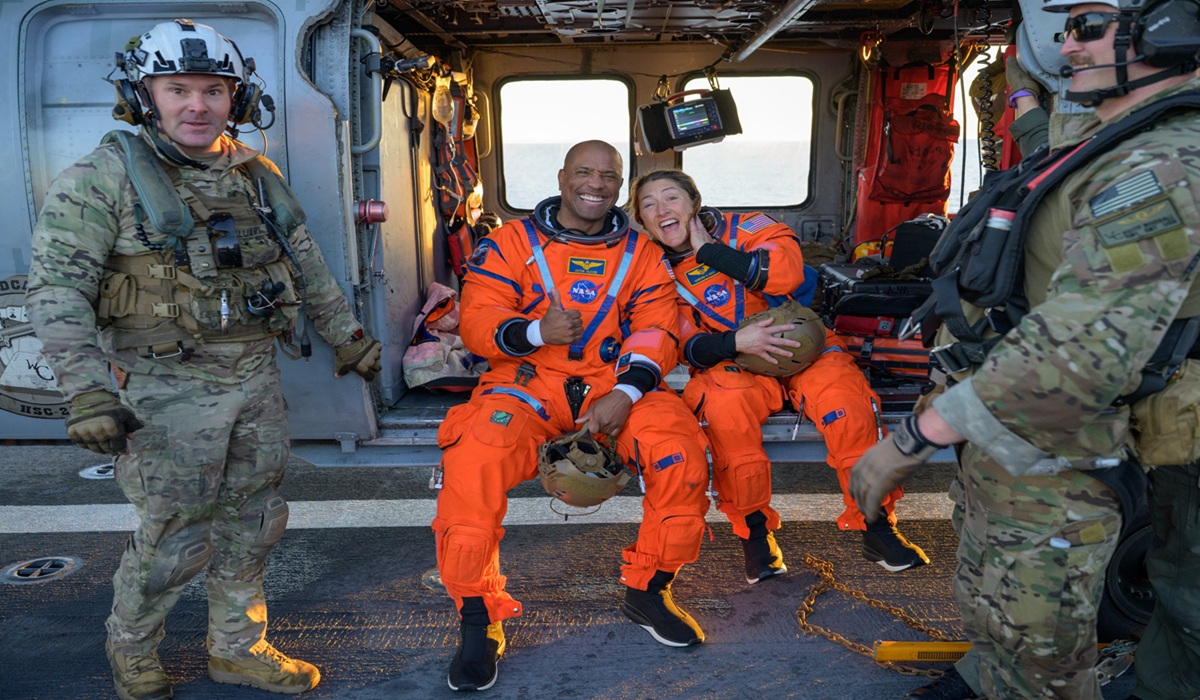
Image Credit: NASA
The world is watching as the crew of Artemis II returns from a mission that has quietly redrawn the boundaries of human exploration. After nearly ten days in space, circling Earth, pushing outward toward the Moon, and venturing farther than any humans before them, the astronauts are back on solid ground. Yet the significance of what they accomplished is only beginning to settle in.
Their journey ended with a dramatic splashdown in the Pacific Ocean off the coast of San Diego, marking the successful completion of the first crewed mission in NASA’s modern lunar program. Inside the Orion capsule were four astronauts who now carry a place in history: Jeremy Hansen, Reid Wiseman, Victor Glover, and Christina Koch.
For Canada, this mission represents something deeper than participation. Hansen became the first Canadian to take part in a lunar mission, a milestone that signals not just presence, but leadership in the next era of space exploration. His role connected millions across the country to a mission that felt both distant and deeply personal at the same time.
The mission itself was as ambitious as it was symbolic. Over the course of ten days, the crew circled the globe twice before committing to a four-day outbound journey toward the Moon. They executed a precise lunar flyby, observing regions never before seen directly by human eyes, and then began the long return home. By the time they re-entered Earth’s atmosphere—at speeds reaching 35 times the speed of sound—they had travelled more than 1.1 million kilometres.
What sets this mission apart is not just the distance, but the purpose behind it. Artemis II was designed as a proving ground. Every system aboard the Orion spacecraft was tested under real conditions, from navigation and life support to deep-space communication. The mission validated the technology and operational framework needed for the next phase: landing humans on the Moon once again.
Behind the scenes, Canada’s role extended well beyond a single astronaut. Jenni Gibbons served as capsule communicator from mission control, guiding the crew from Earth and acting as a critical link between space and ground operations. It was a dual presence—one astronaut in space, another directing from Earth—that underscored the depth of Canadian expertise.
That expertise has been built over decades, particularly in robotics and advanced space systems. Contributions like these secured Canada a seat on Artemis II, reinforcing its place among the nations shaping the future of exploration. This is not symbolic participation; it is a direct result of sustained investment and technical leadership.
The emotional weight of the mission is now unfolding as the crew prepares to be formally welcomed back. At Ellington Field in Houston, Jared Isaacman and Lisa Campbell are set to greet the astronauts in an event that will mark the first time the crew speaks publicly since returning. It is expected to be a moment of reflection as much as celebration, offering insight into an experience that even its participants have described as profound and humbling.
For those who followed along from Earth, the mission never felt entirely out of reach. Through live connections, daily updates, and direct communication from Hansen himself, the distance between planet and spacecraft seemed to shrink. It created a rare sense of shared experience, one where millions could feel connected to something unfolding hundreds of thousands of kilometres away.
What comes next is where the real impact of Artemis II will be measured. This mission lays the groundwork for future landings on the lunar surface and, ultimately, for human journeys to Mars. It transforms ambition into something tangible, proving that deep-space missions are no longer theoretical—they are operational.
The return of Artemis II is not the end of a journey, but the confirmation that humanity has begun a new one. For Canada, it marks a defining moment in its space history. For the world, it is a reminder that exploration still has the power to unite, to inspire, and to push beyond limits that once seemed unreachable.
About The Author