Artemis II Enters Critical Phase with Second SLS Fueling Test Ahead of Historic Lunar Mission
- Naomi Dela Cruz
- Canada
- February 19, 2026
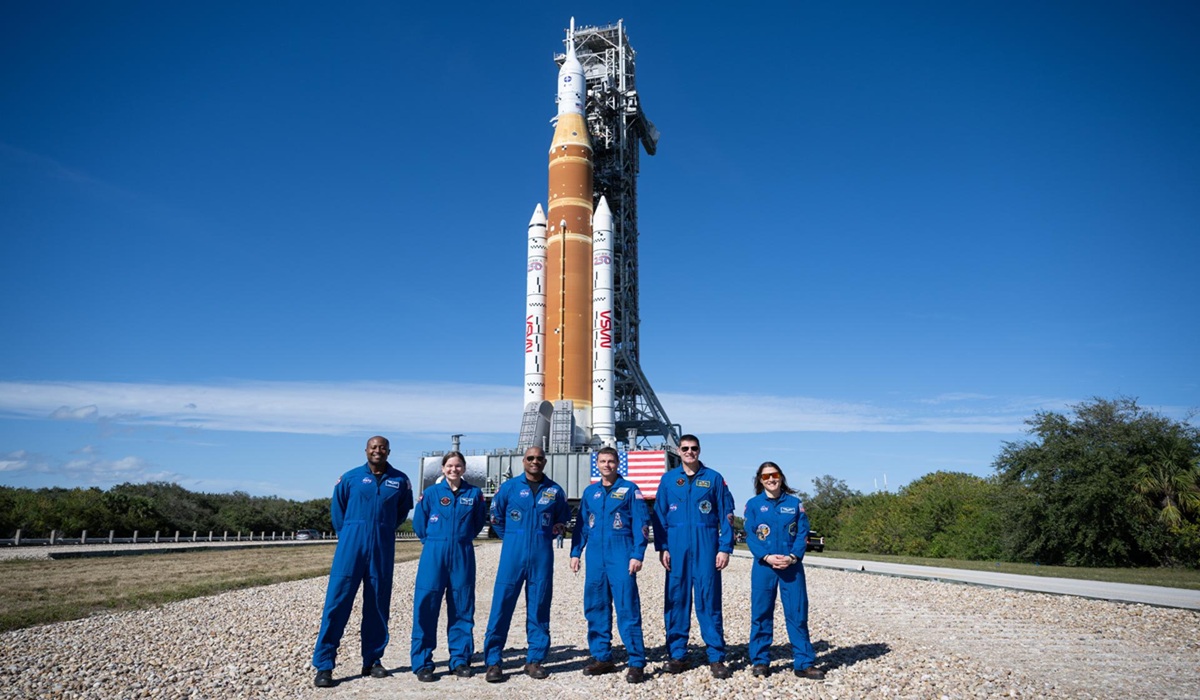
Image Credit: NASA
The countdown toward humanity’s return to deep space is quietly advancing this week as engineers conduct a second fueling test of the Space Launch System rocket that will power the Artemis II mission around the Moon. The exercise, known as a wet dress rehearsal, marks another pivotal moment in preparations for the first crewed lunar flyby mission in more than half a century.
On Friday at 11 a.m. Eastern Time, NASA will hold a live news conference to share the results of the test, which is being carried out at Launch Complex 39B at Kennedy Space Center in Florida. The event will be streamed publicly on NASA’s YouTube channel, offering an inside look at the progress of the most powerful rocket ever built for human spaceflight.
This latest fueling operation represents the second full propellant loading demonstration for the SLS rocket ahead of the upcoming lunar voyage. During a wet dress rehearsal, engineers load the vehicle with super-cold liquid hydrogen and liquid oxygen, the same propellants that will power it at liftoff. The goal is to validate procedures, timing sequences, and system performance under real launch-day conditions without actually igniting the engines.
For NASA, the rehearsal is far more than a technical formality. It provides an opportunity to stress-test ground systems, evaluate cryogenic transfer lines, confirm software coordination, and identify even minor anomalies before astronauts are strapped into the Orion spacecraft. Each simulation reduces risk, sharpens operational readiness, and builds confidence that the rocket can safely perform when launch day arrives.
The mission will carry four astronauts on a journey around the Moon and back, becoming the first crewed lunar expedition since the Apollo era. Unlike its predecessor, which flew without astronauts to test hardware and systems, this flight will demonstrate life-support, navigation, and crew operations in deep space for the first time in a generation. It is designed not only as a mission of exploration but as a proving ground for the technologies and procedures that will shape future expeditions beyond Earth orbit.
For Canada, the stakes are historic. Canadian Space Agency astronaut Jeremy Hansen is set to become the first Canadian to travel around the Moon. His participation underscores Canada’s expanding role in lunar exploration and deep space partnerships. Hansen’s seat aboard Artemis II reflects years of collaboration between the Canadian Space Agency and NASA, particularly Canada’s contribution of advanced robotics technology for the Lunar Gateway program.
The Space Launch System itself stands at the heart of the broader lunar return strategy. Rising nearly 100 metres tall and producing more thrust than the Saturn V rockets of the Apollo era, the SLS is designed to propel Orion beyond low Earth orbit and into lunar space. During the flight, the spacecraft will test life-support systems, communications, navigation capabilities, and high-speed re-entry procedures as it loops around the Moon before returning to Earth.
The wet dress rehearsal lives up to its name. Teams simulate launch day operations down to the minute, including countdown holds and contingency scenarios. Engineers monitor thousands of sensors across the rocket and ground infrastructure, watching for pressure fluctuations, temperature shifts, and timing irregularities. If discrepancies appear, they are logged, analyzed, and corrected long before an actual launch attempt. The upcoming briefing will clarify whether the fueling test met all objectives or whether additional refinements are required before the mission proceeds to its next phase.
Beyond its technical milestones, Artemis II symbolizes a renewed era of international cooperation in space. Canada’s involvement extends well beyond a single astronaut. Through robotics, lunar science contributions, and long-term commitments to the Gateway, the country has secured a sustained presence in humanity’s return to the Moon. This endeavor is therefore not only a NASA operation but a shared step forward for partner nations invested in deep space exploration.
The Moon, once a destination defined by Cold War rivalry, is again becoming a proving ground. This time, however, the architecture emphasizes collaboration, sustainability, and preparation for eventual journeys to Mars.
As engineers complete this second fueling test and await the results to be discussed publicly, attention turns to what it represents. Each successful rehearsal narrows the gap between preparation and liftoff. Each refinement strengthens mission safety. And each milestone brings Canada closer to seeing one of its own orbit the Moon.
The coming news conference will offer a clearer picture of readiness. For now, preparations for Artemis II continue methodically, building toward a mission that promises to redefine Canada’s place in lunar exploration and mark a new chapter in human spaceflight.
About The Author