Another Conservative Defection Pushes Liberals Closer to Majority as Internal Pressure Mounts
- Naomi Dela Cruz
- Canada
- April 8, 2026
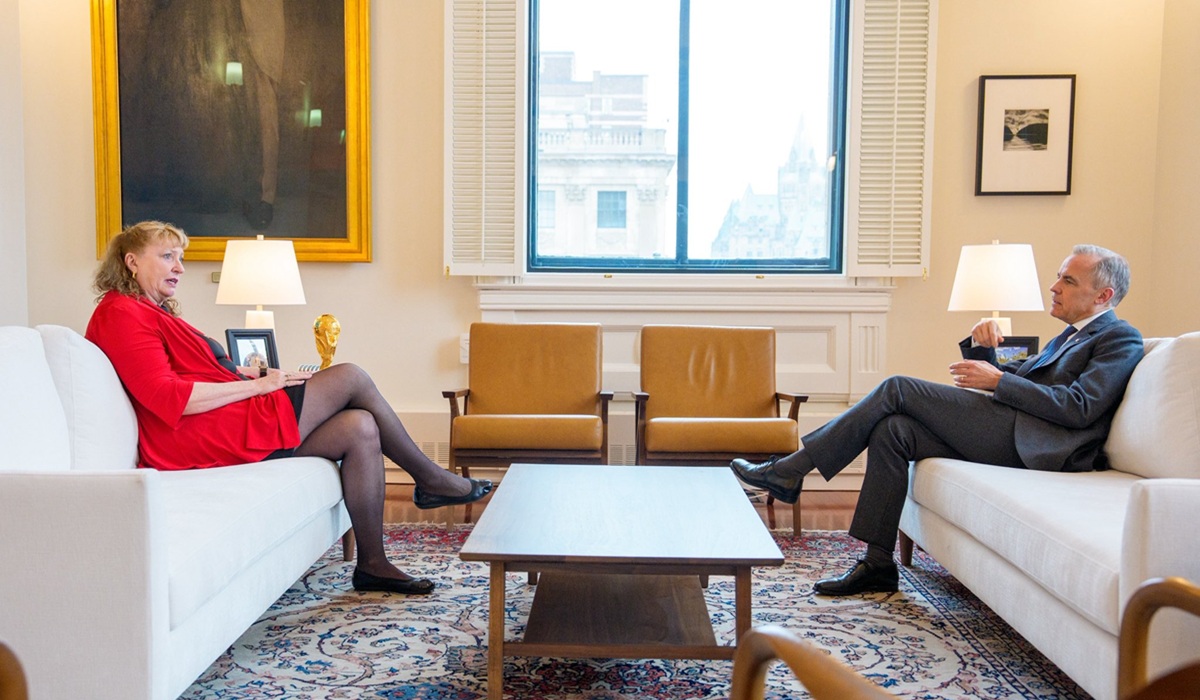
Image credit: Carney Social Media
Canada’s political landscape shifted again on April 8, as Sarnia–Lambton–Bkejwanong MP Marilyn Gladu announced she is leaving the Conservative benches to sit with the governing Liberals. The move marks the fifth floor crossing to the Liberals in recent months, and notably the fourth from the Conservative Party since Mark Carney assumed the prime minister’s office, intensifying questions about stability within the opposition ranks at a critical moment.
Gladu’s decision is not occurring in isolation, nor does it appear to be the end of the movement. Conversations circulating within political circles suggest that a number of MPs are actively weighing similar decisions, with some reports indicating that as many as ten members are either exploring or negotiating a potential shift toward the Liberal caucus. Whether that number ultimately materializes or not, the perception alone is politically significant, reinforcing a narrative that momentum has begun to tilt decisively toward the government.
For the Liberals, the timing could not be more advantageous. With multiple byelections set to take place, the governing party is already positioned competitively in several ridings. Even a modest gain in those contests, combined with recent floor crossings, could bring them within striking distance of securing a majority government. In a Parliament that has been defined by minority dynamics and negotiation, that prospect represents a profound shift in power.
Prime Minister Mark Carney welcomed Gladu publicly, framing her move as part of a broader effort to bring together experienced voices from across the political spectrum. In his statement, he emphasized the importance of unity and practical leadership at a time when global economic uncertainty continues to shape national priorities. He pointed to her background in engineering and international business as evidence of the kind of experience needed to strengthen Canada’s economic position, highlighting her track record of collaboration and her repeated electoral success since 2015.
The messaging from the government is clear. Rather than portraying these defections as opportunistic, the Liberals are presenting them as deliberate steps toward building a coalition of expertise aimed at long-term economic resilience. It is a narrative designed not only to justify the crossings, but to normalize them, suggesting that political alignment is evolving in response to the country’s needs rather than partisan loyalty.
For the Conservatives, however, the situation is becoming increasingly difficult to contain. While party leadership has previously pointed to individual circumstances behind each defection, the cumulative effect is harder to dismiss. When multiple MPs depart within a short period, the issue begins to shift from isolated decisions to a broader reflection on leadership, direction, and internal cohesion.
Pierre Poilievre, who recently retained his leadership after surviving internal challenges, now faces a more complicated reality. While he remains formally in control of the party, the ongoing departures raise questions about whether he truly commands unified support within his caucus. The fact that he endured a no-confidence test but continues to see members leave underscores a deeper tension that has yet to be resolved.
At some point, the political calculus changes. It becomes increasingly difficult to attribute defections solely to the individuals involved, particularly if more MPs follow the same path. The narrative begins to turn inward, focusing on whether the party itself is providing the kind of leadership and vision that members are willing to stand behind. In that context, responsibility inevitably shifts toward the leader.
The optics are equally important. As the Liberals gain ground through both electoral positioning and parliamentary movement, the Conservatives risk appearing fragmented at a time when voters are paying close attention. Political parties often rely on projecting stability and confidence, especially in the lead-up to key electoral moments. A pattern of departures, regardless of the reasons behind them, can erode that perception.
Meanwhile, the broader electorate is watching a transformation unfold in real time. Floor crossings are not new to Canadian politics, but the frequency and concentration seen in recent weeks stand out. They suggest a recalibration of political alliances that may extend beyond immediate tactical considerations, pointing instead to longer-term shifts in how MPs assess their roles and opportunities within Parliament.
As the byelections approach, the stakes will only increase. A strong Liberal performance could accelerate the trend, reinforcing the sense that the governing party is consolidating power. Conversely, any unexpected results could slow the momentum, offering the Conservatives a chance to regroup and stabilize.
For now, however, the trajectory appears clear. With each new defection, the Liberals edge closer to the majority they have been seeking, while the Conservatives face mounting pressure to address the underlying causes of their internal divisions. The question is no longer whether individual MPs are choosing to cross the floor, but what those choices collectively reveal about the direction of Canada’s political future.
About The Author