By: Donovan Martin Sr, Editor in Chief
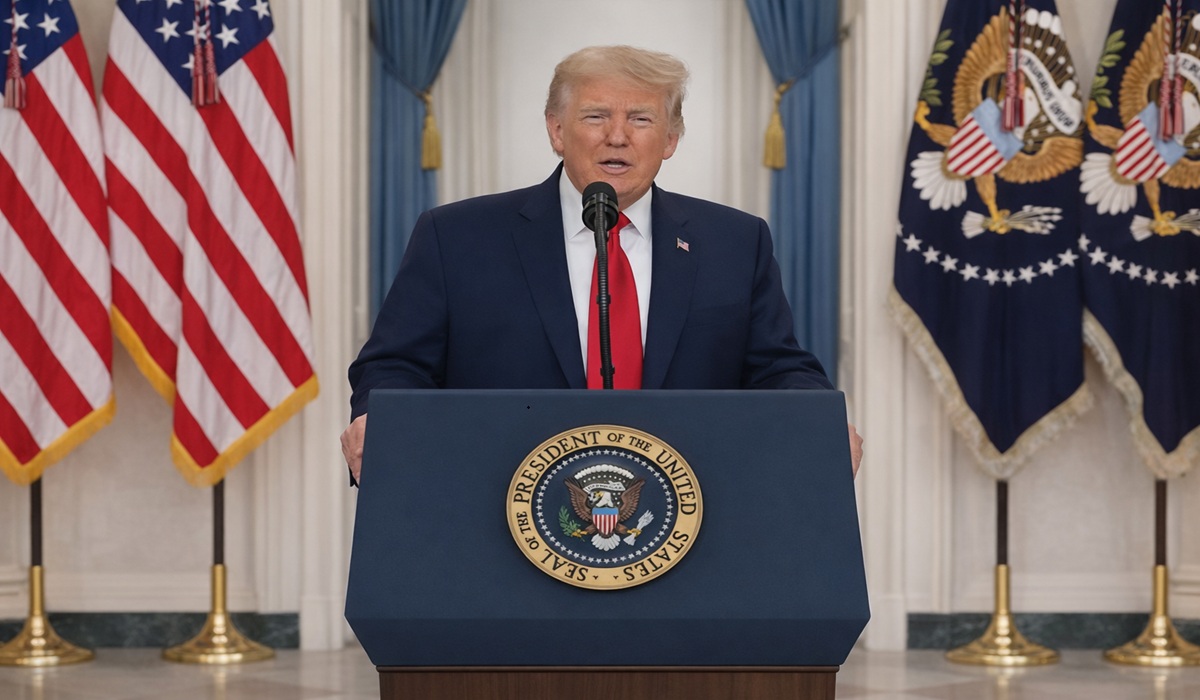
Donald Trump’s televised address on April 1, 2026 was supposed to steady a rattled public, calm markets, and explain why the United States is now deep in a war with Iran that much of the country never wanted in the first place. Instead, it did the opposite. What Americans got was not a coherent strategy so much as a performance built on swagger, threats, and contradiction. Trump declared that U.S. objectives were nearly complete, yet in the same breath warned that the country would continue striking Iran “extremely hard” for another “two to three weeks.” He spoke as if victory were within reach, but everything in his tone suggested a conflict still expanding, still uncertain, and still without a clearly defined end.
The most memorable line in the speech was also the most telling. Trump said the United States would “bring them back to the Stone Ages,” a phrase that landed less like strategy and more like raw intimidation. It was not the language of careful leadership in a volatile region. It was the language of escalation without explanation. He attempted to project control, but the contradictions were impossible to ignore. He insisted the mission was succeeding while simultaneously preparing Americans for continued bombardment. He framed the operation as measured, yet described actions that sounded anything but restrained.
That disconnect is what made the address feel so unstable. Trump tried to sound like a president closing out a campaign, but what people heard instead was a leader still searching for a path forward. Even on the critical issue of the Strait of Hormuz, one of the most important chokepoints in the global energy system, he offered no firm plan. Instead, he suggested that other countries reliant on oil shipments should take on the responsibility of keeping it open. For a nation that has long positioned itself as the guarantor of global shipping lanes, it was a striking shift in tone, and not one that inspired confidence.
The political backdrop made the speech even more fragile. Public sentiment has been moving steadily against the war, with a growing majority of Americans questioning both its purpose and its cost. Trump, who once built his political identity on opposing foreign entanglements, now finds himself defending one of the most consequential military engagements in recent memory. Rising fuel prices, economic strain, and uncertainty about how far this conflict could spread have only deepened that skepticism. The speech did not reverse that momentum. If anything, it hardened it.
Compounding the damage was the way the address handled facts. Several of Trump’s claims about the economy, past dealings with Iran, and the current state of the conflict were quickly challenged. In a moment when clarity matters most, exaggeration and misstatements undermine credibility. A wartime address demands precision, not improvisation. When the details begin to blur, so does public trust.
Then came the contrast that made the speech feel even more off-balance. Around the same time, Iranian President Masoud Pezeshkian issued a letter directed at the American people. In it, he emphasized that Iran’s conflict was not with ordinary citizens, but with those responsible for the war itself. He wrote in a tone that sought to separate the American public from its leadership, making a clear distinction between people and policymakers. Whether one views that message as genuine or strategic, it carried a level of focus that Trump’s speech lacked.
That contrast is where the moment becomes politically and psychologically significant. Trump spoke to Americans as a commander asking for patience in a war he has yet to fully justify. Pezeshkian spoke to Americans as civilians, drawing a line between them and the decisions being made in Washington. One message leaned heavily on force and dominance. The other leaned on division, attempting to isolate leadership from the public it represents. In doing so, it quietly challenged the narrative that this war has unified support at home.
Trump’s speech also struggled because it tried to do too many things at once. It aimed to reassure, threaten, celebrate, and warn all within the same address. He claimed Iran’s capabilities had been significantly weakened, yet acknowledged that the country still possesses the ability to strike back. He suggested regime change was not the objective, even as he spoke about the removal of Iran’s leadership in ways that implied a broader goal. The result was a message that lacked a single, clear thread.
That is what made it feel, to many, like a speech that missed its moment. In times of conflict, the public looks for direction, for a sense that there is a plan guiding the chaos. Instead, they were given a mixture of confidence and uncertainty, strength and hesitation. The tone shifted from sentence to sentence, leaving the impression of a strategy still being shaped in real time.
The international response has only amplified that perception. Allies have signaled discomfort with the idea of prolonged escalation, emphasizing diplomacy over continued strikes. The gap between Washington’s rhetoric and the broader global appetite for de-escalation is becoming harder to ignore. When a country leads a coalition but begins to sound increasingly alone, it raises deeper questions about where the conflict is heading.
What defines a losing war is not always visible in maps or casualty figures. It often reveals itself in language, in the way leaders talk about progress, in the way goals begin to shift or blur. Trump’s address carried many of those signals. It was filled with declarations of success, yet thin on measurable outcomes. It promised strength, yet hinted at limits. It projected certainty, yet revealed doubt.
In the end, the juxtaposition between Trump’s speech and Pezeshkian’s letter tells its own story. Trump leaned into power, framing the conflict as something that could be forced into submission. Pezeshkian leaned into perception, framing the conflict as something imposed by leadership rather than shared by people. One approach attempts to dominate the battlefield. The other attempts to reshape the narrative.
For Americans watching, the result is a growing sense that this war is not unfolding the way it was sold. The speech that was meant to bring clarity instead exposed the fractures. It did not close the gap between promise and reality. It widened it.
About The Author