America Signals Retreat from Hormuz as Policy Contradictions Collide with Escalation
- Ingrid Jones
- Breaking News
- March 31, 2026
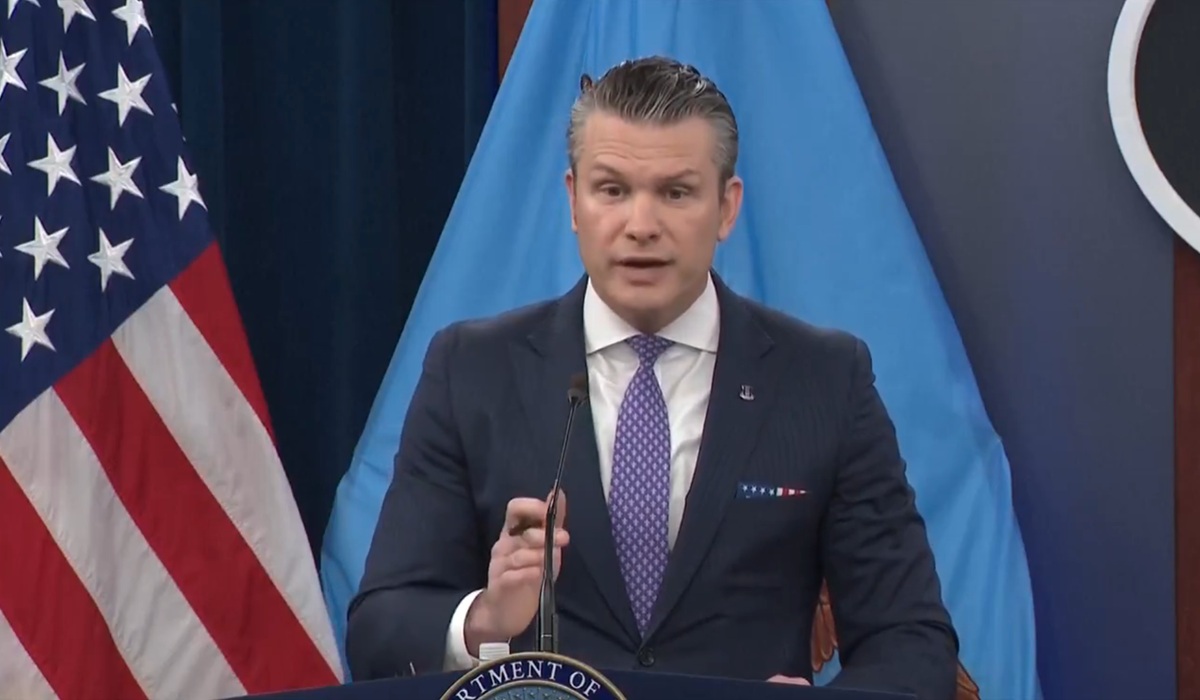
In today’s press conference, War Department Secretary Pete Hegseth delivered a statement that has immediately raised questions about consistency in U.S. policy and military objectives. He stated that the Strait of Hormuz is no longer solely an American priority and that other nations must now take responsibility for keeping it open.
The statement stands in direct contrast to ongoing military positioning. At the same time this message is being delivered publicly, the United States is actively deploying tens of thousands of Marines and naval forces into the region with the stated objective of securing maritime routes and reopening access through the strait. The contradiction is not subtle. On one hand, responsibility is being shifted outward. On the other, American forces are being mobilized in large numbers for precisely that mission.
The situation on the water has already changed in measurable ways. The strait, which had previously operated as an open and unrestricted passage, is no longer functioning under those conditions. It has been reopened selectively to certain countries, and vessels transiting through are now required to meet new terms imposed by Iran. Those terms include payments reaching up to $2 million per passage or alternative arrangements conducted in Chinese yuan. This is not a projection or a scenario under discussion; it is the current operating reality shaping global shipping through one of the most critical energy corridors in the world.
The strategic implications of this shift are immediate. Control of passage through Hormuz has effectively transitioned from a neutral international waterway to a managed route with conditions dictated by a single regional power. That transformation occurred after the escalation of hostilities, not before. Prior to the conflict initiated by Israeli strikes and subsequently joined by the United States, the strait remained open without tolls or imposed fees.
Military considerations surrounding the region further complicate the stated objectives. Any attempt to forcibly secure or reopen the strait requires operating in close proximity to Iranian territory, including key infrastructure such as Kharg Island, which plays a central role in Iran’s energy exports. Operations in this environment carry significant risk due to geography, defensive positioning, and the density of strategic assets within a confined maritime corridor.
At the same time, there is a growing imbalance in direct military participation. While the United States is preparing for and committing ground forces, Israel has indicated it will not deploy troops for a ground campaign against Iran. This places the burden of any sustained ground engagement squarely on American forces, even as the broader conflict originated from Israeli military action.
The framing of the conflict itself continues to diverge from its scale. Rather than being formally described as a war, officials have referred to it as a limited or specialized operation. However, the scope of deployments, the scale of engagement across the region, and the tightening control over casualty information point to a far more extensive military reality. Casualty figures have not been transparently disclosed, and the absence of detailed reporting has contributed to growing uncertainty about the true human cost.
Leadership dynamics within the War Department also remain under scrutiny. Following the removal of senior Pentagon officials by President Donald Trump, the current command structure has shifted significantly. The impact of those changes is now intersecting directly with real-time military decision-making in one of the most complex operational environments in the world.
What remains is a situation defined by conflicting signals. The United States is publicly stepping back from sole responsibility for the Strait of Hormuz while simultaneously deploying forces to influence its status. The strait itself has transitioned from open access to controlled passage with financial conditions imposed. And the burden of ground engagement is consolidating around American troops despite the multinational origins of the conflict.
These are not interpretations or projections. They are the conditions now shaping the reality on the ground and at sea.
About The Author