In a Sea of AI-Slop, Authenticity is the Currency That’ll Get You Hired
- Nick Kossovan
- Employment
- Tiger's Eye Advisory Group - Trending News
- March 29, 2026
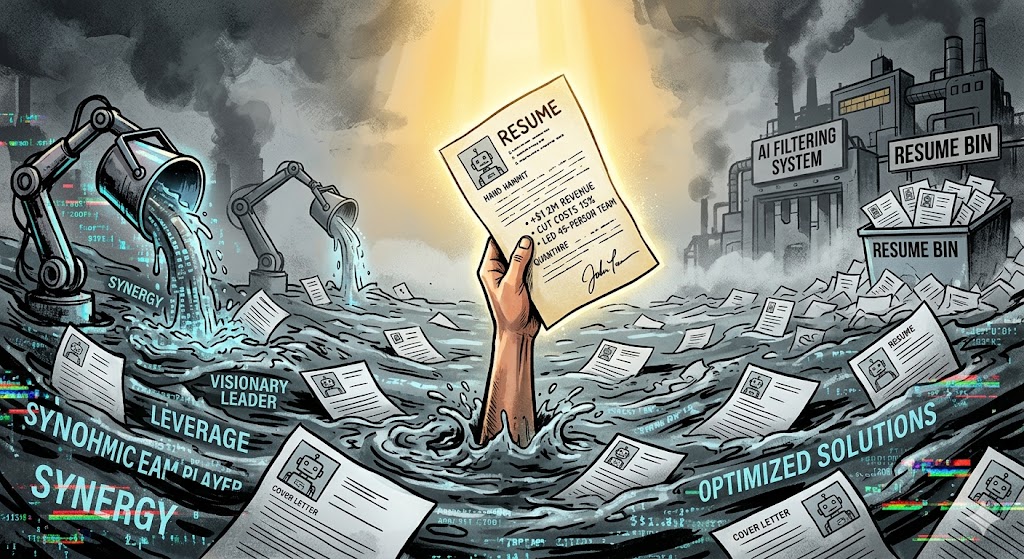
I’ve said it before, and I’ll say it again: job seekers are often their own worst enemies; an obvious example is how they utilize AI lazily. By mass-applying and copying-pasting AI output to their prompts without editing, job seekers hoping for shortcuts and to lessen their job search efforts are flooding employers with what amounts to 100% Grade A AI-slop, creating an irony similar to drowning in a flood caused by leaving the taps running to see if the drains work.
Job seekers flood employers with resumes and cover letters they didn’t even write for jobs they aren’t qualified for, adding to the deluge of applications and forcing employers to increasingly aggressively use ATS software to filter them, which job seekers complain about.
Do job seekers not think that their misuse of AI wouldn’t have consequences?
When job postings receive 1,200 applications within six hours—95% of which are clearly AI-generated—recruiters and hiring managers don’t look harder; instead, they rely more on the very technology job seekers are trying to outsmart because job seekers have made it nearly impossible to find a genuine person in the digital flood they’re causing.
What does “AI-slop” look like? It’s word salad that tries to say everything and yet says nothing. I see it every day, resumes claiming the job seeker’s a “visionary leader leveraging synergistic solutions,” yet failing to list a single actual result you’ve delivered. Cover letters that recycle the company’s ‘About Us’ page like reconstituted paper pulp.
In an article titled How AI Slop Took Over Hiring and How to Sound Human Again, published by Artisan Talent, Katrina Kibben, CEO of Three Ears Media, states bluntly: “Faster doesn’t mean better; it means faster. AI is replicating trends and problems into these new resumes because their training data is a sample of old information that wasn’t good to begin with.“ Simply put, when you lazily use AI to “help“ you with your job search, you become just like all the other job seekers who also lazily use AI.
Two types of AI misuse are job search killers:
- Mass Applying. Increasingly, job seekers are using AI tools to auto-tailor their resume and apply 24/7 to job postings the AI finds on job boards and company websites. While their resume(s) incorporate keywords effectively, they lack a clear career trajectory, relevance, and, most importantly, proof that they’ve positively impacted their previous employer’s profitability. It’s unlikely that a resume like this would pass an employer’s ATS; however, if a human were to lay eyes on it, the lack of “value-add“ would be glaring.
- Ghostwriter. AI tools are widely used by job seekers to write what they think is the perfect cover letter and to answer screening and knock-out questions. As well, job seekers are employing ‘whispering bots’ during video interviews. Perhaps one day AI will be able to mimic your personality, problem-solving, and strategic thinking; however, as of right now, it can’t. Mike Wolford, author of THE AI RECRUITER: Revolutionizing Hiring with Advanced GPT-Powered Prompts, noted: “We’ve gained infinite words but lost specificity—and that’s why everything, from resumes to job posts, sounds the same.”
Employers hire candidates they believe will serve their self-interests; therefore, not using AI lazily and showing employers evidence of your value to your previous employers is the best job search strategy a job seeker can adopt.
Here are three examples of comparing “AI-slop“ against high-impact, human-written value:
- AI-Slop: Managed a customer service team and ensured high levels of customer satisfaction through effective leadership.
- Human Value-Add: Managed a 45-agent inbound call centre operation averaging over 50,000 calls per month. In my first 6 months, I reduced average handle time by 12% and increased first-call resolution from 78% to 89%.
- AI-Slop: Improved internal workflow and organizational efficiency by collaborating with cross-functional departments.
- Human Value-Add: Eliminated redundancies in procurement workflows to save $240,000 annually and accelerated by 15% project turnaround.
- AI-Slop: Experienced in growing sales and market share through strategic outreach and maintaining strong relationships with stakeholders.
- Human Value-Add: Generated $1.2M in new recurring revenue through targeted B2B acquisition, which expanded regional market share by 8% in 2025.
In a job market flooded with AI-slop, a well-written, results-oriented resume is a revolutionary act. Refusing to use AI lazily gives you a competitive advantage. While the job seekers you’re competing against are prompting AI tools such as ChatGPT, Claude, Gemini, or Teal, trying to sound ‘professional,‘ your job search strategy should be identifying an employer’s specific pain points and proving, quantitatively based on past performance, how you have the skills and experience to address them.
Next time you’re angry at the job market, ask yourself how much AI-slop you’re contributing to employers’ inboxes.
Recruiters and hiring managers aren’t searching for someone who can “beat the machine.” They’re looking for the person who’d be a value-add to their profitability, who’s serious about their career and is willing to put in the effort that a machine can’t replicate. Every time you copy-paste an AI-generated response, you’re basically saying, “I don’t care enough about this role to write three original sentences.“ If you don’t care, then don’t expect employers to care about hiring you.
About The Author