Trump’s South Pars Statement Raises Questions About U.S. Role in Escalating Gulf Crisis
- Ingrid Jones
- Tiger's Eye Advisory Group - Trending News
- March 19, 2026
A statement issued by U.S. President Donald Trump following Israel’s strike on Iran’s South Pars gas field has triggered a growing credibility debate, as conflicting accounts emerge about what Washington knew before the attack. The controversy is unfolding at a moment when tensions across the Gulf have already escalated into a dangerous cycle of strikes, retaliation, and economic shock.
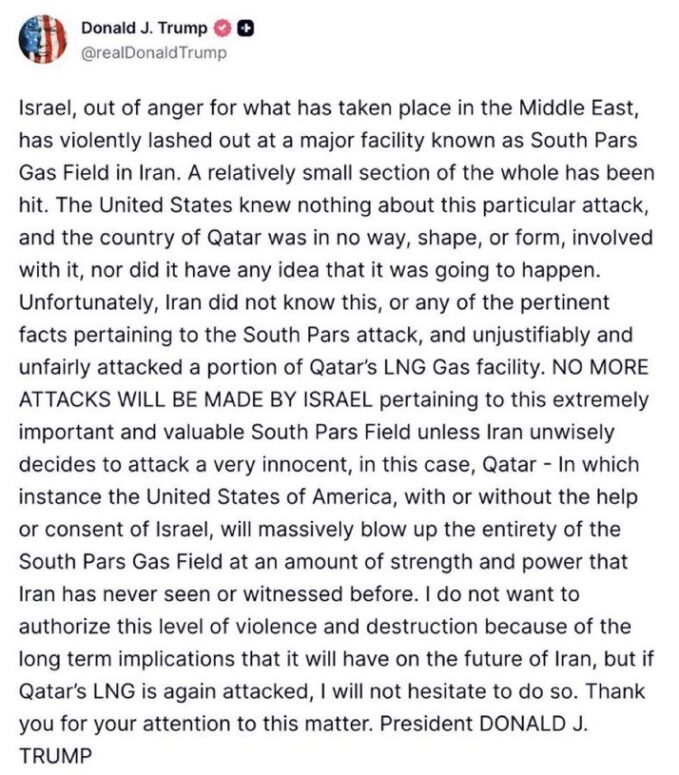
In his public message, Trump stated that the United States had no prior knowledge of Israel’s strike and emphasized that Qatar had no involvement. He framed the attack as an independent Israeli action, describing it as a reaction to broader developments in the region. At the same time, he criticized Iran’s response, calling its retaliation against Qatari energy infrastructure unjustified, and issued a warning that any further attacks on Qatar could trigger a severe American response, including the potential destruction of the entire South Pars field.
The significance of that statement lies in what followed. Reports citing senior U.S. and Israeli officials suggested that the strike may have been coordinated at high levels and that Washington was not entirely in the dark. While those accounts have not been formally confirmed by the White House, they stand in direct contrast to the President’s public claim. That contradiction has become the central issue, raising questions not only about the operation itself, but about how the administration is communicating its role in a rapidly evolving conflict.
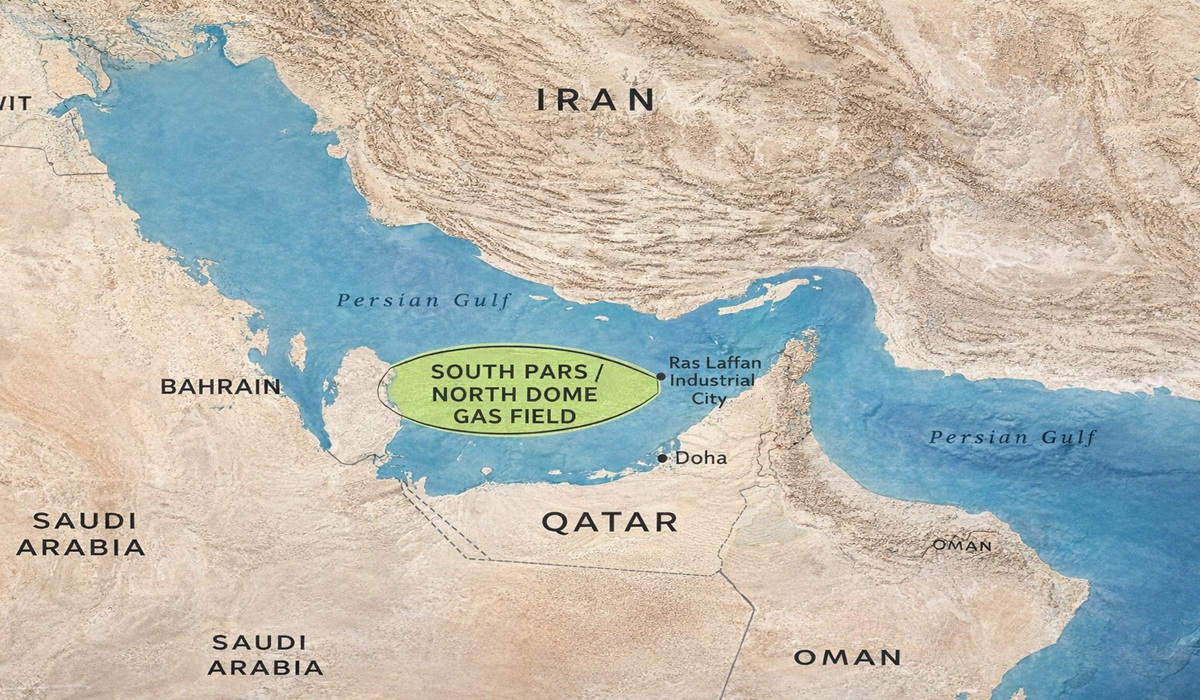
South Pars is not an ordinary target. It is the largest natural gas field in the world, shared between Iran and Qatar, and it underpins a major portion of global liquefied natural gas supply. Any disruption to its operations carries consequences far beyond the region, affecting energy markets, national economies, and geopolitical stability. By striking a site of that magnitude, Israel effectively introduced a new level of risk into an already volatile situation.
The regional fallout was immediate. Iran responded with missile strikes targeting Gulf energy infrastructure, including facilities in Qatar. Damage reported at Ras Laffan Industrial City, one of the most critical LNG hubs in the world, signaled that the conflict had moved beyond symbolic retaliation and into the realm of economic warfare. Other Gulf states reacted quickly, with heightened security measures, temporary shutdowns of key facilities, and evacuation warnings tied to fears of further escalation.
Within this context, Trump’s warning about potentially destroying the entire South Pars field if Qatar is attacked again has drawn particular scrutiny. Because the field is jointly shared, any such action would not only impact Iran but would also devastate Qatar’s energy sector, which is central to its national economy. This introduces a complex strategic contradiction, as Qatar is both a key U.S. ally and host to one of America’s largest military bases in the region.
Diplomatically, the situation places Qatar in a precarious position. The country must balance its partnership with the United States while managing the risks of being directly targeted in a conflict it did not initiate. Trump’s statement, intended to deter further attacks, may instead have added another layer of uncertainty, particularly given the ambiguity surrounding what the United States knew before the initial strike.
The broader issue now extends beyond military strategy. It centers on credibility and trust. In high-stakes geopolitical crises, public statements from national leaders are closely scrutinized by allies and adversaries alike. When those statements appear to conflict with accounts from officials or partners, it can erode confidence and complicate diplomatic efforts. In this case, the gap between Trump’s assertion of no prior knowledge and reports suggesting coordination has become a focal point of concern.
There is also a possible strategic explanation for the discrepancy. It is not uncommon for governments to attempt to create distance from sensitive operations in order to manage political fallout or reduce immediate escalation. However, when such efforts are exposed or contradicted, they can have the opposite effect, intensifying scrutiny and raising questions about transparency.
As the situation continues to unfold, the stakes remain high. Energy markets have already reacted sharply, with price volatility reflecting fears of supply disruption. Regional governments are on alert, and the risk of further escalation remains real. In that environment, clarity from Washington will be critical.
At this stage, the facts available present a clear tension. The President publicly stated that the United States had no knowledge of the strike. Subsequent reporting suggests otherwise. Until that gap is addressed directly, the issue will continue to resonate, not only as a political controversy but as a factor shaping how the United States is perceived in one of the most sensitive geopolitical crises in recent years.
About The Author