In The Month of Ramadan, We Honor Ismail al-Jazari:
- TDS News
- Ramadan
- Tiger's Eye Advisory Group - Trending News
- February 26, 2026
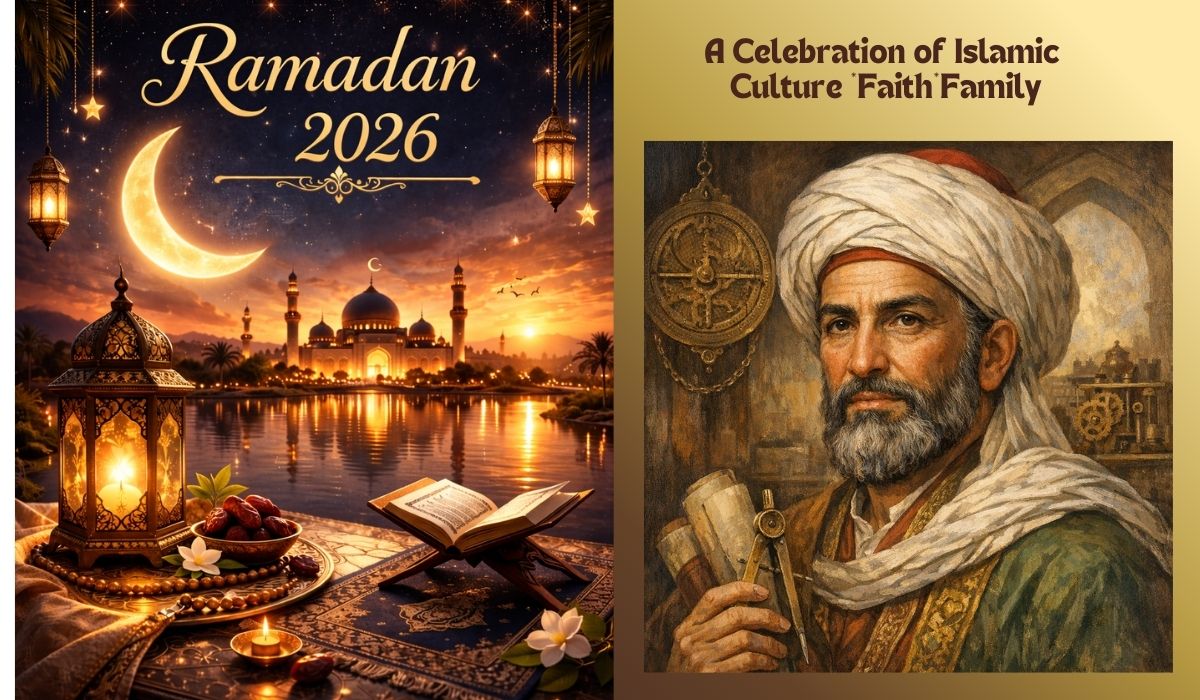
The Engineer Who Made Time Flow
By: Donovan Martin Sr, Editor in Chief
As the crescent moon marks the beginning of Ramadan, attention turns inward. It is a month of restraint, of reflection, of quiet discipline that shapes the soul as much as the body. Yet Ramadan is also a time to remember those who shaped the world beyond the mosque walls, whose faith did not retreat from science or invention but fueled it. Among those figures stands Ismail al-Jazari, a man whose genius flowed as steadily as the water that powered his machines.
Born in the twelfth century in what is now southeastern Türkiye, al-Jazari served the Artuqid dynasty as a chief engineer. His full name was Badiʿ al-Zaman Abu al-ʿIzz ibn Ismail ibn al-Razzaz al-Jazari, but history remembers him simply as al-Jazari. He did not work in isolation or abstraction. He designed devices that solved real problems, measured time, lifted water, and entertained royal courts. His inventions were not merely decorative curiosities. They were mechanical breakthroughs that laid the foundation for modern engineering.
During Ramadan, time feels different. Days stretch long in fasting, and nights shorten in prayer. The measurement of time becomes deeply personal. It is fitting, then, that al-Jazari’s most celebrated creations were clocks. Not simple instruments with ticking hands, but elaborate, water-powered marvels that combined artistry, mathematics, and precision engineering. His famous Elephant Clock was not only a timekeeping device but a symbol of cultural harmony. It incorporated elements representing Africa, India, China, Egypt, and the Islamic world, reflecting a civilization that absorbed knowledge from many lands and refined it into something new.
What made al-Jazari remarkable was not only that he built machines, but that he documented them with clarity. Around 1206, he completed a book often translated as “The Book of Knowledge of Ingenious Mechanical Devices.” In it, he described fifty machines in meticulous detail, complete with illustrations and step-by-step construction methods. At a time when many craftsmen guarded their techniques as secrets, al-Jazari chose transparency. Knowledge, to him, was something to be preserved and shared.
His contributions extended far beyond clocks. He developed sophisticated water-raising machines using crankshafts and connecting rods, mechanisms that would later become fundamental components in engines centuries afterward. Some historians credit him with early versions of programmable automata, mechanical figures that moved in pre-set patterns powered by water flow. These were not toys. They were the ancestors of robotics. In Ramadan, when reflection encourages humility, it is humbling to consider that eight hundred years ago, a Muslim engineer was quietly building concepts that would shape the industrial age.
Faith and intellect were not opposing forces in al-Jazari’s life. In the classical Islamic world, scientific exploration was often viewed as a form of devotion. Understanding the mechanics of creation was a way to appreciate the Creator. The discipline required to design complex hydraulic systems mirrored the discipline required in spiritual practice. Patience, calculation, and precision were virtues in both domains.
There is something poetic about water powering his inventions. Water sustains life, cleanses, and symbolizes renewal. During Ramadan, the first sip of water at sunset carries immense relief and gratitude. Al-Jazari harnessed that same element to drive gears, lift buckets, and mark the passing hours. His machines remind us that even the simplest resources, when guided by knowledge and intention, can generate extraordinary results.
His legacy traveled far beyond his homeland. European engineers centuries later would rediscover similar mechanisms, sometimes unaware that earlier models had existed in the Muslim world. Today, historians of technology increasingly acknowledge his pioneering role in mechanical engineering. Universities study his crankshaft design as a milestone in the evolution of machinery. Museums display replicas of his clocks as tributes to a brilliant mind that bridged art and science.
Ramadan invites believers to consider how they use their time. Al-Jazari literally engineered time into motion. He transformed flowing water into measured intervals, into organized rhythm. In a spiritual sense, he reminds us that faith is not passive. It moves, builds, innovates, and leaves behind something tangible.
As communities gather for evening prayers and families break their fast together, remembering figures like al-Jazari broadens the meaning of the month. Ramadan is not only about restraint from food and drink. It is about harnessing potential. It is about directing energy toward purpose. It is about creating, whether that creation is a kinder heart, a stronger community, or, as in al-Jazari’s case, machines that push humanity forward.
His story stands as a quiet correction to the notion that scientific progress belongs to any one civilization or era. Centuries before the industrial revolution, before steam engines and assembly lines, a Muslim engineer in a medieval court was sketching gears and pulleys that would echo through history. He fasted, he prayed, and he engineered.
In the stillness of Ramadan nights, when the world feels slower and more contemplative, it is worth remembering that devotion and invention can flow together. Al-Jazari proved that faith does not limit the mind. It can inspire it to build wonders that endure long after the water has stopped flowing.
About The Author