Can China replace US in Europe?
- Naveed Aman Khan
- Europe
- Tiger's Eye Advisory Group - Trending News
- February 7, 2026
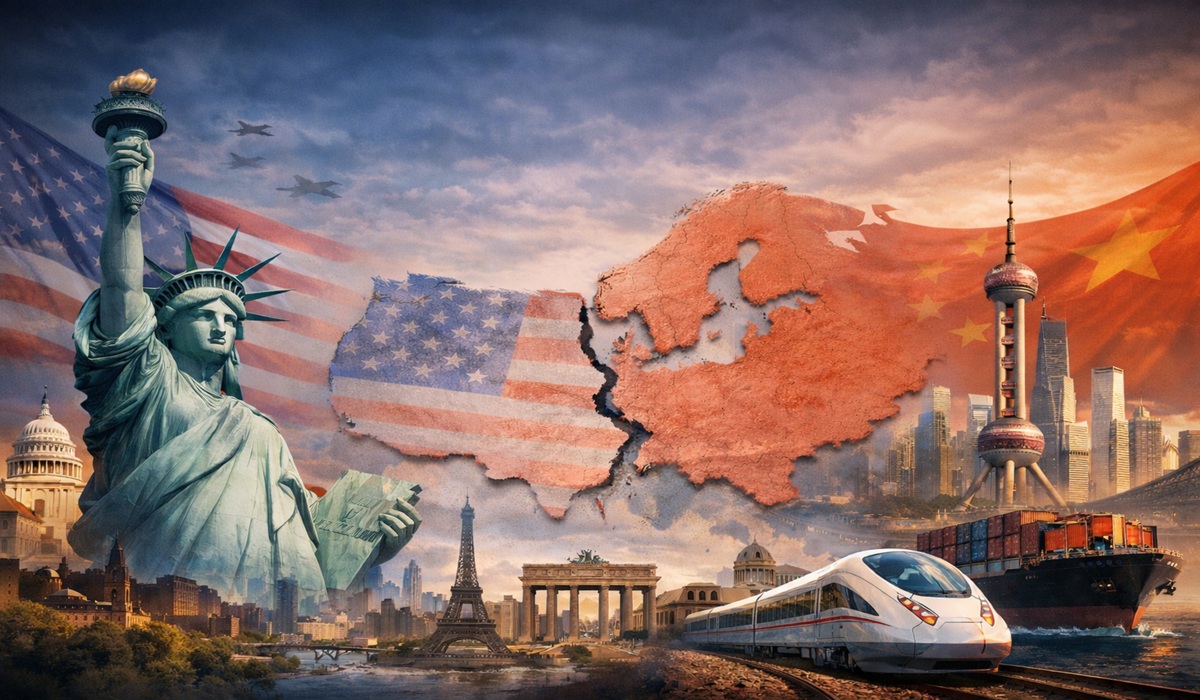
For more than seven decades, the US has been the central external power shaping Europe’s political, security, and economic architecture. From the Marshall Plan that rebuilt war-ravaged economies to the creation of NATO as the cornerstone of collective defense, Washington embedded itself deeply into Europe’s institutional DNA. American leadership did not merely protect Europe; it defined how the continent thought about security, alliances, and global order.
Europe’s growing engagement with China is pragmatic rather than ideological. Unlike the Cold War era, Europe today faces a convergence of crises, including sluggish economic growth, deindustrialization fears, demographic decline, energy insecurity after the Ukraine war, and rising defense costs. Compounding these pressures is uncertainty over America’s long-term commitment to the region, especially during periods of more transactional leadership. In this environment, China, with its vast market, industrial capacity, financial strength, and long-term investment strategies, appears to many European states as an essential economic partner, even if not a full strategic substitute for the US.
European countries are indeed moving closer to China, but cautiously. Germany, France, Italy, Spain, and several Central and Eastern European states have expanded trade, investment, and industrial cooperation with Beijing. China is among the European Union’s largest trading partners in goods, while European corporations, from automotive giants to pharmaceutical firms and renewable energy companies, remain embedded in Chinese supply chains. This economic interdependence has not evolved into political or strategic alignment. The EU defines China as an “economic partner, a competitor, and a systemic rival,” reflecting both opportunity and mistrust.
A key reason China is perceived differently from America lies in its global posture. Unlike Washington, Beijing does not pursue an openly interventionist foreign policy. China maintains only a limited overseas military presence and avoids regime-change operations or large-scale interventions. Its influence is projected primarily through economic instruments such as trade agreements, infrastructure financing, technology cooperation, and development projects, most prominently under BRI. For European states fatigued by geopolitical entanglements, this economic-first approach holds considerable appeal.
By contrast, leadership from the US has rested on military power, security alliances, and ideological alignment. Its influence in Europe is anchored in NATO, nuclear deterrence, intelligence-sharing networks, and shared democratic values. Yet this model has increasingly generated friction. The wars in Iraq and Afghanistan, unilateral sanctions, trade disputes, and pressure on European strategic autonomy have raised doubts about predictability. Episodes of nationalist rhetoric and burden-sharing disputes have shaken confidence in Washington’s reliability.
China’s approach, by comparison, is transactional, patient, and incremental. Beijing emphasizes sovereignty, non-interference, and mutual economic benefit. It does not publicly lecture European states on governance, human rights, or domestic reforms. Whether this restraint reflects principle or strategy, it has enabled China to expand its economic footprint across Europe with limited resistance, particularly in Southern and Eastern regions where infrastructure needs remain significant.
Despite these gains, China’s limitations in Europe are decisive. Unlike the US, China does not provide a security umbrella to the continent. Its global design is economy-based. Europe remains overwhelmingly dependent on NATO and American military power for deterrence, particularly against Russia. The war in Ukraine has reinforced this reality. It was the US that coordinated military aid, intelligence sharing, logistics, and alliance cohesion. China, maintaining strategic ambiguity and avoiding direct confrontation, neither possesses the capability nor the political will to replace Washington as Europe’s primary security guarantor.
The difference between American and Chinese global strategies can be summarized as power projection versus power penetration. The US projects influence through military force, alliances, and institutional dominance. China penetrates systems through trade, finance, infrastructure, and technology. The US often leads with ideology, while China leads with interests and incentives. One model frequently demands alignment; the other offers alternatives. Each carries distinct advantages, vulnerabilities, and long-term consequences.
So who is getting stronger in Europe, the US or China? The answer depends on the domain. Militarily and institutionally, the US remains unrivaled. NATO’s structure, defense interoperability, and intelligence networks ensure continued centrality. Economically and technologically, China is rapidly narrowing the gap. In manufacturing, electric vehicles, renewable energy, critical minerals, and infrastructure investment, Beijing increasingly shapes Europe’s economic calculations.
The deeper transformation is not merely material but psychological. Europe no longer wishes to depend exclusively on the US, yet it is not prepared to align fully with China for its future defense and economic needs. Instead, it pursues strategic diversification, seeking leverage by balancing relations with multiple powers. This reflects a shift toward a multipolar mindset rather than a binary, Cold War-style choice. China’s rise is not about substitution but recalibration.
Beijing is eroding Washington’s monopoly over influence, reshaping Europe’s economic priorities, and redefining power through connectivity rather than coercion. The US remains Europe’s security backbone, but China is steadily becoming its economic counterweight. The real change is not replacement but rebalancing. Europe is no longer choosing sides; it is choosing leverage. In an evolving global order, influence belongs not only to the strongest power, but to the most adaptable one.
About The Author