Starmer in Beijing: UK Looks for Stability, Growth, and a More Predictable Relationship With China
- Naomi Dela Cruz
- Europe
- Breaking News
- January 28, 2026
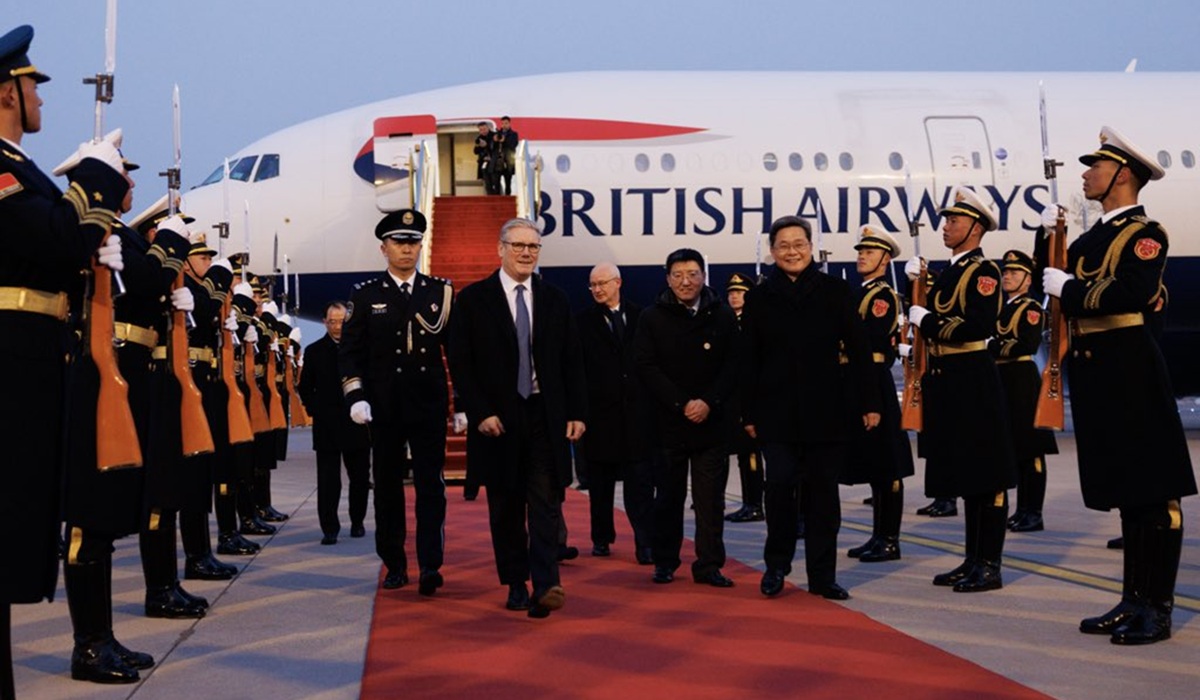
Prime Minister Keir Starmer arrived in Beijing today with a clear message: the UK wants a consistent, pragmatic partnership with China that helps British workers and businesses, while staying firm on national security.
He is travelling to Beijing and Shanghai alongside nearly 60 representatives from British business, sport, and cultural organisations, in what Downing Street is framing as a reset. The government says the goal is stability and clarity after years of mixed signals and mood swings that left companies unsure where Britain stood.
It is also a quiet acknowledgement of something many governments are now realizing in real time. The global environment has shifted, and relying too heavily on any one partner has become risky. The Trump administration’s return to unpredictable economic pressure, shifting alliances, and hard-edged trade tactics has forced allies to rethink what “reliable” really means. For the UK, that has made diversification less of a theory and more of a necessity.
In that context, Starmer is making the case that China is not a relationship the UK can afford to treat as optional. China remains the world’s second-largest economy and the UK’s third-largest trading partner. The government says the relationship supports about 370,000 British jobs, and that China’s role in supply chains and global demand means decisions made there can have very real consequences back home.
Starmer is expected to argue that Britain needs to deal with China steadily, not emotionally. For years, UK policy has swung between extremes, from warm talk of a “Golden Age” to colder periods marked by suspicion and distance. Starmer says that kind of inconsistency is not strategy, it is just noise, and it does not help the public or the economy.
His pitch is not about blind trust. It is about practical engagement and mature diplomacy. The government says it will pursue cooperation where it delivers growth and prosperity, while maintaining guardrails on national security. That means working with China in areas that benefit both sides, and confronting disagreements openly rather than pretending they don’t exist.
Ahead of the visit, Starmer said the UK can be “clear-eyed and realistic” about both opportunity and challenge. The tone is deliberate. It signals that Britain wants to stop treating every interaction as either a celebration or a crisis. Instead, the government is selling a more adult approach: talk when you disagree, cooperate where it makes sense, and protect national interests without turning the relationship into a permanent standoff.
The delegation travelling with Starmer includes well-known names such as HSBC, GSK, Jaguar Land Rover, and the National Theatre. Downing Street says the Prime Minister will push for better access and stronger cooperation in sectors where the UK has global strengths, including financial services, life sciences, and creative industries.
Those industries matter because they translate into real jobs and investment. They also represent the parts of the UK economy where Britain can actually compete at the highest level, even in a difficult global market. The government wants that advantage to convert into growth, and it sees engagement with China as one of the paths to do it.
At the same time, Starmer is expected to make it clear that the UK will not trade security for economic opportunity. The government says he will raise areas of disagreement directly, and that frank dialogue is necessary when viewpoints differ. This is the line the Prime Minister is trying to walk: building prosperity without looking naïve, and building security without sounding permanently hostile.
Starmer will meet President Xi Jinping and Premier Li Qiang in Beijing on Thursday. Talks are expected to cover trade, investment, and national security. He will then travel to Shanghai for additional engagements with British and Chinese businesses.
Business and Trade Secretary Peter Kyle and Economic Secretary to the Treasury Lucy Rigby will join him on the trip, reinforcing that this is not being treated as a symbolic visit. It is being framed as a working mission focused on economic outcomes and long-term positioning.
The government also pointed to earlier progress as evidence that dialogue can produce concrete results. It says the 2025 Economic and Financial Dialogue secured £600 million in immediate benefits, and that formal economic talks resumed with the first UK–China Joint Economic and Trade Commission meeting since 2018.
The bigger story here is that Britain appears to be settling into a new reality. The world is more unstable, alliances are more complicated, and the UK needs relationships that are strategic, consistent, and built for the long term. Starmer’s approach suggests that the government wants to stop treating China primarily as a threat and start treating it as what it is: a global power that the UK must deal with seriously, carefully, and with a focus on results.
This trip is not about pretending everything is fine. It is about the UK finally choosing a steadier lane, one that prioritizes growth and stability at home, and pragmatic cooperation abroad, even when the politics are messy.
About The Author