A Reset in Relations: Canada’s Prime Minister Mark Carney Welcomed in Beijing
- Xuemei Pal
- Canada
- January 15, 2026
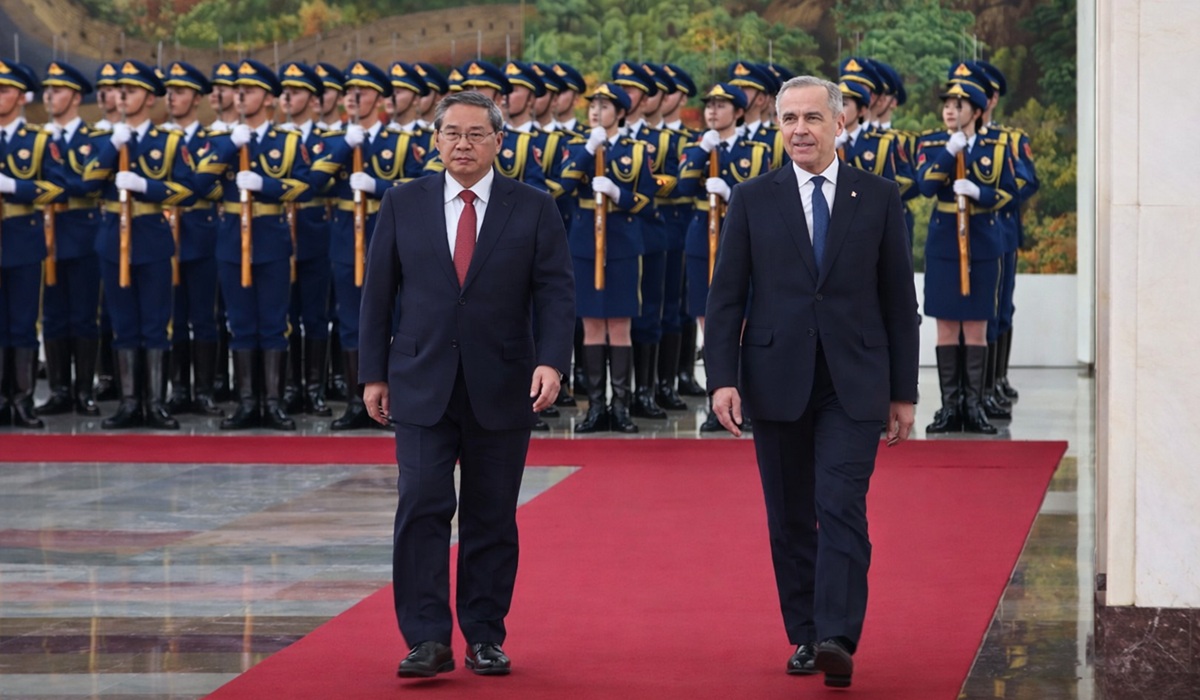
Chinese Premier Li Qiang formally welcomed Canadian Prime Minister Mark Carney to Beijing with a state ceremony at the Great Hall of the People, marking the opening of Carney’s first official visit to China and the most significant bilateral engagement between the two countries in nearly a decade. Military bands performed the national anthems of Canada and China as the two leaders reviewed the honour guard, a visual signal that both governments are intent on resetting and stabilising a relationship that has endured years of strain.
The ceremony set the tone for the first day of high-level talks, during which Prime Minister Carney and Premier Li acknowledged what they described as tangible progress in revitalising Canada–China relations. That progress has been built through a series of ministerial exchanges and leader-level meetings over recent months, culminating in this visit—the first official bilateral trip to China by a Canadian prime minister since 2017. Both leaders framed the moment as an opportunity to move beyond diplomatic stagnation and toward pragmatic cooperation in a rapidly changing global environment.
Discussions focused heavily on the shifting global economy, with particular attention to pressures on international trade and increasingly fragile global supply chains. Against that backdrop, the two sides identified areas where cooperation could deliver mutual benefit. A series of memorandums of understanding were welcomed as concrete steps toward a renewed strategic partnership, covering energy cooperation, efforts to combat cross-border crime, modern wood construction, cultural exchange, and food safety alongside plant and animal health standards. Together, these agreements are intended to provide structure and predictability for future engagement.
Prime Minister Carney emphasised the potential for expanded trade and investment, highlighting energy and agriculture as sectors where Canadian expertise and capacity align closely with Chinese demand. Both leaders expressed support for restoring regular bilateral engagement across a wide range of areas, including economic and financial dialogue, energy policy, security discussions, cultural cooperation, and people-to-people exchanges. The tone of the talks suggested a shared recognition that sustained communication is essential, even where differences remain.
Canada’s relationship with China is deep-rooted, extending well before the formal establishment of diplomatic relations in 1970. Today, Canada maintains an embassy in Beijing alongside consulates general in Chongqing, Guangzhou, Hong Kong, and Shanghai, reflecting the breadth of the relationship. Engagement occurs across all levels of government, from federal to municipal, and spans trade and investment, environmental cooperation, education, cultural exchange, and consular affairs.
Beyond diplomacy and commerce, cooperation between the two countries has also taken social and developmental forms. Canada supports initiatives in China related to women and children, pluralism, respect for diversity, climate change mitigation, biodiversity protection, and global health. Through the Canada Fund for Local Initiatives, small-scale projects across China have addressed environmental sustainability, governance, civil society development, and the protection of disadvantaged groups. Academic ties remain a cornerstone of bilateral relations, anchored by the Canada–China Scholars’ Exchange Program, established in 1973. Over more than five decades, the program has supported over 1,400 scholars, fostering long-term academic collaboration and mutual understanding.
People-to-people ties remain one of the strongest pillars of the relationship. More than 1.8 million Canadian residents are of Chinese origin, and as of the end of 2024, approximately 100,000 Chinese citizens held valid Canadian study permits for programs lasting six months or longer. Mandarin is now Canada’s fourth most spoken language after English and French, and immigrants born in China, including those from Hong Kong, form one of the country’s largest immigrant groups. Tourism, education, and cultural exchange continue to reinforce these connections.
Economically, China remains a major commercial market for Canadian businesses. In 2024, bilateral merchandise trade reached $118.7 billion, slightly lower than the previous year, while Canadian exports to China totaled $29.9 billion, accounting for nearly four percent of Canada’s total merchandise exports. Services trade has shown notable growth, reaching $12.0 billion in 2024, an increase of more than eleven percent year over year. Opportunities remain strongest in agriculture and agri-food, consumer products, natural resources and energy, and environmental technologies.
At the same time, Canadian officials continue to acknowledge risks associated with operating in the Chinese market, including market access barriers, regulatory opacity, intellectual property concerns, and the potential diversion of sensitive technologies. Managing these risks is a central element of Canada’s approach, supported by in-country expertise from multiple federal departments and agencies working together on economic policy, trade, and market access.
These issues are also addressed through the Joint Economic and Trade Commission, an annual bilateral mechanism designed to promote trade and investment. By focusing on trade policy and priority sectors, the commission allows senior officials to assess challenges and identify opportunities to advance two-way commerce. The most recent session, hosted in Ottawa in August 2025, underscored the importance both sides place on maintaining structured economic dialogue.
As Prime Minister Carney’s visit continues, the welcome ceremony and initial talks signal a cautious but deliberate effort by both governments to re-anchor Canada–China relations in dialogue, cooperation, and managed competition. While differences remain, the renewed engagement reflects a shared understanding that constructive ties are increasingly important in an uncertain global landscape.
About The Author