Can Washington Really Rule Venezuela?
- Naveed Aman Khan
- Tiger's Eye Advisory Group - Trending News
- Latin
- January 9, 2026
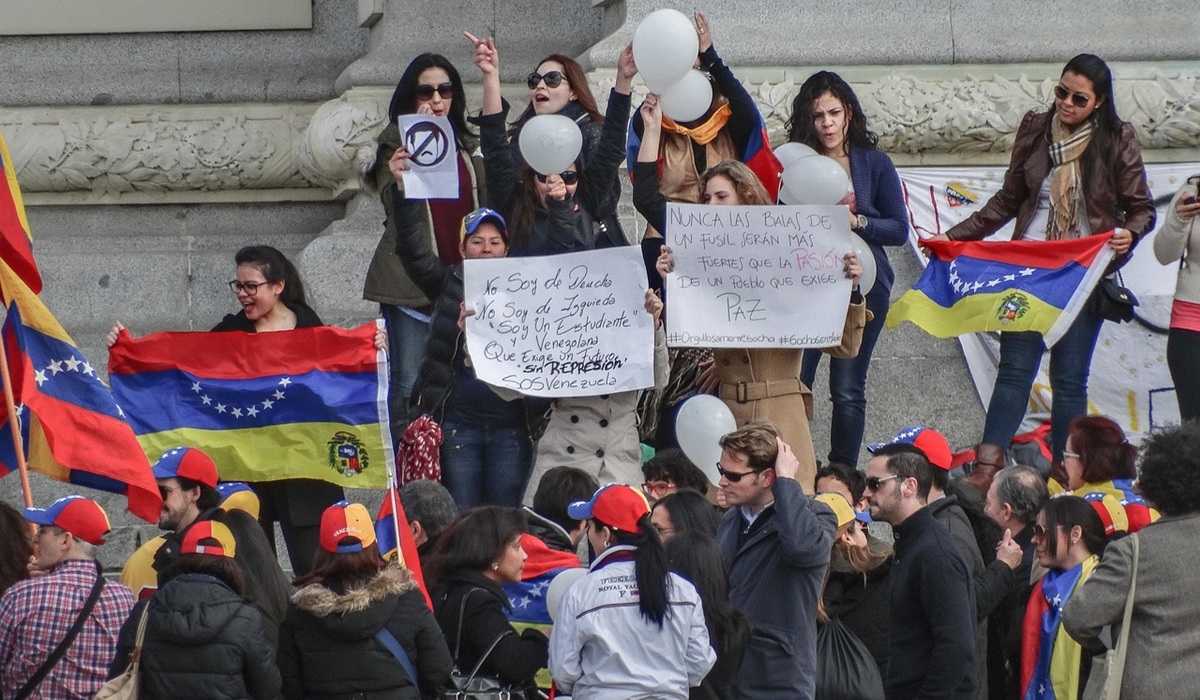
Image Credit: Carlos_Ramón_Bonilla
The dramatic arrest of Venezuelan President Nicolas Maduro by U.S. Delta Force Operatives from the heart of Caracas has been projected by Washington as a spectacular military success. President Donald Trump described it as a “brilliant operation,” but beneath the triumphalist rhetoric lies a disturbing question: was this truly a daring unilateral military raid, or a carefully choreographed political drama executed with silent internal consent?
To understand the improbability of this operation as a purely external military action, one must first examine Venezuela’s security architecture. For years, the Venezuelan state had claimed that its defense system was designed not only to counter internal dissent but also to repel any foreign intervention. The Bolivarian National Armed Forces were ideologically molded under Chavismo, ensuring unwavering loyalty to the president and the state.
Venezuela’s active military strength is around 200,000 personnel, supported by a similar number of paramilitary forces. These are divided among the Army, Navy, Air Force, National Guard, and, most importantly, the Bolivarian Militia. The militia alone numbered over 4.5 million members, prepared to wage guerrilla warfare in the event of a foreign invasion.
The Venezuelan Army fields approximately 63,000 regular troops equipped with modern hardware, including Russian-made T-72B1V tanks and BMP-3 infantry fighting vehicles. The National Guard, with about 23,000 personnel, handles internal security and repression. The Navy and Marine Corps, roughly 15,000 strong, are tasked with coastal defense, while the Air Force, with nearly 10,000 personnel, operates advanced Su-30MK2 fighter jets alongside F-16 aircraft. Above all stands the Presidential Honor Guard, a 2,000-strong elite brigade responsible for the president’s personal protection.
The first and most critical layer of President Maduro’s security was this Presidential Honor Guard. Comprising handpicked personnel from all branches of the military and intelligence services, and supplemented by Cuban security advisers, its sole mission was to guarantee the physical safety of the president and his family. In the months preceding the operation, these guards underwent specialized training to counter “non-conventional enemies.” Yet, on the night of January 3, this elite force failed to offer even symbolic resistance.
Maduro was arrested at Fort Tiuna, Venezuela’s largest and most sensitive military complex. Far more than a barracks, Fort Tiuna functions as a fortified city, housing the Ministry of Defense, the military’s general command, and the presidential residence, La Vineta. Nestled against mountainous terrain and reinforced with bunkers and tunnels, it was considered virtually impregnable. Maduro’s residence itself was a five-story underground bunker, forty meters deep, equipped to sustain 150 people for months, complete with independent oxygen systems and direct access to a presidential hangar.
Despite these formidable defenses, U.S. Delta Force operators reached the president’s bedroom and detained him without resistance, flying him out of the country. Washington labeled the mission—dubbed “Operation Southern Spear”—a military miracle.
The operational details raise more doubts than admiration. The raid involved helicopters from the U.S. Army’s 160th Special Operations Aviation Regiment, including MH-47G Chinooks and MH-60 Black Hawks, operating from the USS Iwo Jima positioned roughly 200 kilometers off Venezuela’s coast. The Chinook, a large and relatively slow helicopter, would have required prolonged flight time over Venezuelan airspace, including hovering over a densely populated capital. That such aircraft could operate unchallenged, without interception by fighter jets or surface-to-air missiles, defies military logic.
Venezuela possesses one of Latin America’s most advanced air defense networks, featuring Russian S-300VM and Buk-M2 systems capable of engaging targets up to 200 kms away. Russian technicians had serviced these systems only months earlier. For the U.S. operation to succeed, these defenses would have had to be deliberately disabled. While limited airstrikes were elsewhere in Caracas, the absence of any response around Fort Tiuna strongly suggests internal collusion—a fixed match rather than a battlefield triumph.
This episode inevitably recalls the 2011 Abbottabad operation in Pakistan, when U.S. Navy SEALs killed Osama bin Laden deep inside Pakistani territory. In both cases, American forces penetrated heavily guarded airspace, conducted precision raids, and exited with minimal resistance. Subsequent revelations about Abbottabad indicated radar “blindness,” ignored alerts, and logistical facilitation—all pointing toward tacit consent or at least willful negligence by elements within the host state.
In Venezuela, senior military figures appear to have reached an understanding with Washington. Despite public condemnations labeling the arrest an “unacceptable provocation,” no credible explanation has emerged as to where Venezuela’s armed forces were when their president was taken from a fortified military complex.
Political signals preceding the operation further strengthen the case for a negotiated outcome. Reports of December 2025 talks suggested Maduro was considering stepping aside in exchange for guarantees of personal safety. A Chinese delegation met Maduro hours before his arrest, implying last-minute assurances. Trump’s unusually conciliatory tone days earlier—urging Maduro to make a “wise decision”—now appears less rhetorical and more transactional. Most tellingly, Washington announced immediate “temporary” oversight of Venezuela’s affairs and signaled deep involvement in its oil sector.
The moral and political implications are profound. This operation was not merely about removing an authoritarian leader or combating narcotics trafficking. Venezuela holds the world’s largest proven oil reserves, and control over these resources lies at the heart of global power politics. The arrest of Maduro demonstrates that in contemporary geopolitics, sovereignty is fragile when internal loyalty collapses. Steel bunkers, missile shields, and elite guards are meaningless if those entrusted with defense no longer believe in the cause they serve.
Venezuela now enters a new era—one where its claims of independence ring hollow and its strategic future appears shaped not in Caracas, but in Washington. States fall not only when attacked from outside, but when their institutions rot from within.
So, can America rule Venezuela? The answer is no. It will try with occupation, similar to Iraq, Libya, Syria and Afghanistan, which have all failed. However, Trump’s hubris may lead him to think that because the US has air supremacy, it can take on over 4 million militia fighters to take the country. As a sobering reminder, he just needs to learn the lessons of Vietnam.
About The Author